
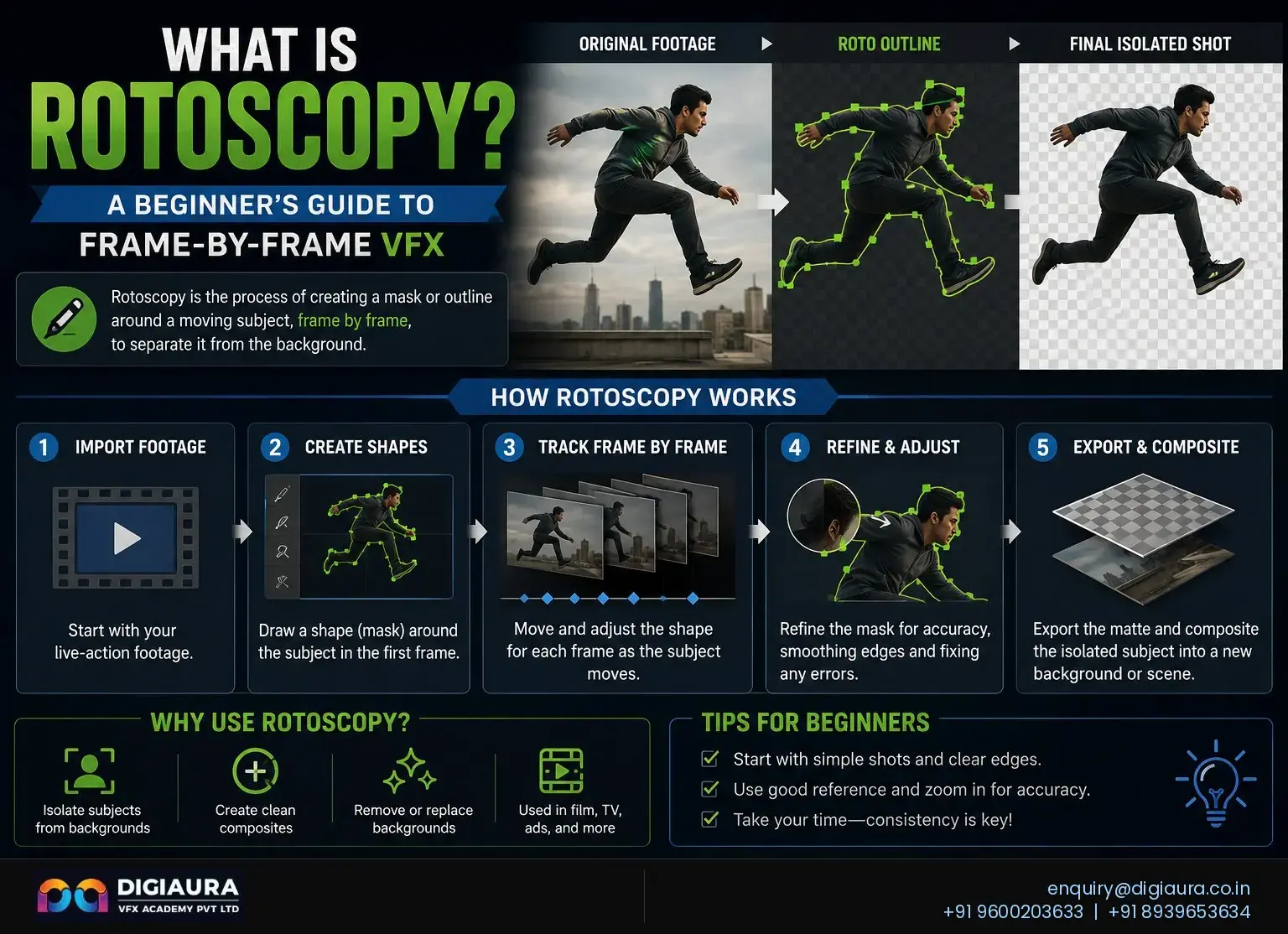
Rotoscopy is the technique of tracing over live-action footage, frame by frame, to create a precise matte — a silhouette — that separates a subject from its background. In modern VFX pipelines, that matte becomes the foundation for compositing: placing actors into digital environments, removing wires and rigs, adding visual effects elements, or integrating CG characters into real-world footage. If you have ever wondered how films make a lightsaber glow convincingly behind an actor's hand, or how a car commercial seamlessly replaces a real sky with a dramatic cloudscape — rotoscopy is almost always part of the answer. Explore DigiAura's Rotoscopy Course →
Key Takeaways
- Rotoscopy is the frame-by-frame process of tracing subjects in video footage to create accurate mattes used in VFX compositing.
- Invented by Max Fleischer in 1915, rotoscopy has evolved from hand-drawn acetate tracing to AI-assisted digital workflows — but skilled human artists remain essential.
- Modern rotoscopy uses Silhouette FX (industry standard), Foundry Nuke, Adobe After Effects with Mocha Pro, and emerging AI-assisted tools.
- Rotoscopy is distinct from rotomation: roto creates mattes; rotomation creates animated skeleton data for digital doubles.
- Entry-level rotoscopy artists in India earn ₹2–3.5 LPA, with experienced artists reaching ₹6–10 LPA at major studios.
What Is Rotoscopy? The Clear Definition
Rotoscopy (also spelled rotoscoping) is a visual effects technique in which an artist draws or traces a precise outline — called a matte or roto shape — around a specific subject in each frame of a video clip. That matte is then used in compositing to isolate the subject from its original background, enabling the compositor to manipulate the two elements independently.
In practice, this means an artist might spend hours carefully tracing an actor's silhouette across 500 frames of footage — adjusting for every subtle movement of an arm, a strand of hair moving in the wind, or a foot touching the ground. The resulting matte is a grayscale sequence (or alpha channel) where the subject is white, the background is black, and semi-transparent edges handle the transition between them.
The term itself comes from the Rotoscope — a device patented by animator Max Fleischer in 1917 — which projected filmed footage onto a glass panel so animators could trace each frame to create fluid, realistic character movement. The technique was born in traditional animation but is now central to virtually every professional VFX pipeline in the world.
Citation Capsule: Rotoscopy is the frame-by-frame process of tracing live-action footage to create mattes used in VFX compositing. Originally invented by Max Fleischer (patent filed 1915, granted 1917), it is now a core discipline in every professional visual effects pipeline, enabling background replacement, wire removal, and seamless digital element integration.
How Does Rotoscopy Work? A Step-by-Step Breakdown
Understanding the rotoscopy workflow helps beginners set realistic expectations for the skill and precision the discipline demands. Here is how a typical rotoscopy task unfolds in a professional pipeline:
- Receive the Shot Brief: The roto artist receives a sequence of frames (usually exported from Nuke or delivered as an EXR or TIFF sequence) along with a brief specifying which elements need to be isolated — typically a person, a prop, a vehicle, or a specific body part such as a hand or foot.
- Analyse the Footage: Before drawing a single shape, an experienced roto artist watches the entire clip to understand the motion. They note where subjects move fastest, where edges become ambiguous (hair, fabric, blur), and which frames are the most challenging keyframes.
- Set Keyframes: Using software like Silhouette FX or Nuke's Roto node, the artist draws Bezier or B-spline shapes on the key moments of the motion — typically the first frame, last frame, and any frames where the motion changes direction significantly.
- Animate Between Keyframes: The software interpolates the shape between keyframes. The artist then plays through the sequence and corrects any frames where the interpolated shape deviates from the actual subject edge.
- Refine Edges: Edge quality is critical. Roto artists use feathering, motion blur matching, and sometimes per-pixel adjustments to ensure the matte edges match the way the camera captured the subject — including lens blur, in-camera motion blur, and depth of field.
- Quality Check: The matte is composited over a contrasting background (usually bright red or a checkerboard) so the artist can inspect every frame for leaks, hard edges, or shape inaccuracies. Corrections are made until the matte is clean.
- Deliver: The finished matte is exported as an alpha channel embedded in an EXR sequence and handed to the compositing team. From there, it feeds directly into the compositing pipeline.
Professional roto work is measured in frames-per-day output. A junior roto artist might complete 50–80 frames of clean matte per day for simple shots. Complex shots involving hair, translucent fabric, or fast motion may require an experienced artist an entire day to complete a single 20-frame sequence to production standard.
The History of Rotoscopy — From Fleischer Studios to Marvel VFX
Rotoscopy has a longer history than most people in VFX realise. Max Fleischer, the animator behind Betty Boop and Koko the Clown, filed the original Rotoscope patent in 1915. The device projected filmed footage of a live actor (usually Fleischer's brother Dave) onto a glass panel mounted on an animation stand. Animators then traced each frame onto paper, giving their characters a naturalistic fluidity that was impossible to achieve purely by hand.
Disney adopted and expanded the technique extensively in the 1930s and 1940s. Snow White and the Seven Dwarfs (1937) used rotoscoped human figures as the basis for Snow White's movement. Cinderella (1950) and Sleeping Beauty (1959) continued the practice, with rotoscoped live-action reference informing the motion of human and semi-realistic animal characters.
The shift from analogue to digital rotoscopy happened through the 1990s. Software replaced acetate and paint, Bezier curves replaced hand-drawn outlines, and the workflow moved from animation desks to computer workstations. The development of compositing software — particularly Foundry Nuke (released commercially in 2007) and Silhouette FX — transformed roto from an animation technique into a core VFX discipline.
Today, AI-assisted rotoscopy tools are accelerating parts of the process. Adobe After Effects' Rotobrush 2.0 and tools built on machine learning can track human subjects with reasonable accuracy in clean, controlled footage. However, production-quality rotoscopy for feature films and high-end OTT content still requires skilled human artists to handle complex edges, motion blur, translucent elements, and quality control — a reality that ensures the discipline remains a valued career path.
What Is Rotoscopy Used For in Modern VFX?
Rotoscopy is not a single-purpose tool. It solves a wide range of compositing problems that occur in virtually every live-action production with VFX elements. Here are the primary use cases:
Background Replacement and Compositing
The most common use of rotoscopy is isolating actors or subjects so they can be placed against a different background. Unlike green screen (chroma key), which requires a controlled shooting environment, rotoscopy works on any footage — including material shot on location without a clean background. This is essential for correcting locations in post-production, extending sets digitally, or replacing a real-world environment with a CG creation.
Visual Effects Integration
When digital VFX elements interact with live-action subjects, rotoscopy creates the depth relationship between them. A lightsaber passing behind an actor's hand requires a roto of that hand. A CG creature walking in front of an actor requires a roto of the actor. Sparks, fire, magical effects, and energy blasts that need to pass around or behind real-world subjects all depend on roto mattes to look convincing.
Wire and Rig Removal
Stunt performances involving wires, safety cables, or mechanical rigs require those support elements to be removed in post-production. Roto mattes of the wires — or of the subjects in front of them — allow the compositing team to paint out the physical apparatus cleanly. This is one of the most technically demanding forms of roto because wires are thin, move quickly, and often pass through complex areas like hair or fabric.
Colour Grading and Selective Adjustments
Colourists and compositors use roto mattes to apply colour corrections or exposure adjustments to specific parts of a frame — for example, brightening only an actor's face, desaturating a background area, or adding shadow to a specific region. This selective colour work would be impossible without precise per-frame mattes.
Citation Capsule: Rotoscopy is used in modern VFX for background replacement, visual effects integration (where CG elements interact with live subjects), wire and rig removal, and selective colour grading. Every major live-action film and OTT production with VFX elements relies on rotoscopy as a foundation of its compositing pipeline.
Rotoscopy vs. Rotomation — What Is the Difference?
Rotoscopy and rotomation are closely related but serve fundamentally different purposes. Beginners often confuse the two terms. Here is the distinction:
| Aspect | Rotoscopy | Rotomation |
|---|---|---|
| Output | Matte (alpha channel / shape) | Skeleton animation data |
| Purpose | Isolate subjects for compositing | Drive digital double or CG character motion |
| Primary Use | Background replacement, wire removal, VFX integration | Crowd simulations, digital doubles, stunt replacements |
| Tools | Silhouette FX, Nuke Roto node, After Effects, Mocha | Maya, 3ds Max, combined with roto references |
| Skill Requirement | Shape animation, edge quality, precision | Roto + 3D character rigging + animation principles |
In production, rotomation artists are typically more senior than roto artists and earn correspondingly higher salaries, since the discipline requires both precise roto skills and 3D animation knowledge. DigiAura VFX Academy trains students in both rotoscopy and rotomation as distinct, sequential disciplines. Learn about the Rotomation course at DigiAura →
What Software Do Rotoscopy Artists Use?
The choice of software depends on the production environment, but a handful of tools dominate professional rotoscopy workflows worldwide:
Silhouette FX (Boris FX)
Silhouette FX is the industry-standard dedicated rotoscopy application. Used by studios including ILM, DNEG, Framestore, and MPC, it offers a node-based compositing environment built specifically for roto, paint, and plate work. Its B-spline shapes, per-point feathering controls, and stereo roto capabilities make it the preferred tool for high-volume, high-quality roto work. DigiAura trains its rotoscopy students on Silhouette FX as the primary production tool.
Foundry Nuke
Nuke's built-in Roto node and RotoPaint node are used widely in compositing pipelines where the roto work is done alongside compositing rather than in a dedicated application. For integrated pipelines — where a compositor handles their own roto — Nuke is often the preferred environment. Node-based workflows allow roto shapes to feed directly into the compositing tree with no round-trip export required.
Adobe After Effects with Mocha Pro
After Effects is commonly used in smaller productions, post houses, and advertising pipelines. Its native Rotobrush 2.0 tool uses AI-based edge detection and can work well for clean, controlled footage. For more complex work, Mocha Pro (a planar tracking and roto tool from Boris FX) integrates with After Effects to provide production-grade rotoscopy capabilities at a lower price point than a full Silhouette licence.
AI-Assisted Rotoscopy Tools
Machine learning tools are beginning to automate parts of the rotoscopy process for controlled footage. Adobe Firefly, Runway ML, and Meta's Segment Anything Model (SAM) can generate initial mattes that a human artist then refines. As of 2026, AI roto tools are most useful for clean footage with limited motion. Hair, fabric, translucent elements, fast motion, and complex multi-character scenes still require skilled human roto artists to achieve feature-film quality standards.
How Accurate Does Rotoscopy Need to Be?
Production standards for rotoscopy quality are exacting. Feature film and high-end OTT content is delivered at 2K or 4K resolution and reviewed on large screens by experienced VFX supervisors. Even a single-pixel error along an edge can be visible when composited over a contrasting background.
In studio pipelines, completed roto work goes through at least one dedicated quality control (QC) review before it reaches the compositing team. QC involves stepping through every frame of the matte at full resolution and checking edge quality, motion consistency, and the handling of semi-transparent elements like hair and fabric. Work that does not meet the QC standard is returned for revision — which is why speed and accuracy together are the key production metrics for a roto artist, not just one or the other.
Professional rotoscopy studios measure output in frames per day. The industry benchmark for clean, medium-complexity roto is approximately 100–150 frames per day for an experienced artist. Complex shots — heavy hair, multi-layer occlusion, fast motion — may require an entire day for 30–50 frames. Training to work at this speed without sacrificing accuracy is one of the core goals of a structured rotoscopy programme.
Is Rotoscopy a Good Career in India in 2026?
Rotoscopy is one of the most accessible entry points into professional VFX work in India, and demand for trained roto artists has grown consistently alongside India's expanding VFX industry.
What Salary Can a Rotoscopy Artist Earn in India?
Entry-level roto artists joining their first studio role typically earn between ₹2 LPA and ₹3.5 LPA, depending on the studio, city, and the quality of their training and showreel. Artists who have completed a structured programme with real production shots in their portfolio tend to enter at the higher end of that range.
Mid-level roto artists with 2–3 years of studio experience commonly earn ₹4–7 LPA. Roto leads and supervisors — who manage teams, set quality standards, and liaise with VFX supervisors — can earn ₹8–14 LPA at established studios. Artists who expand their skills into compositing or rotomation typically see faster salary progression.
Where Are the Rotoscopy Jobs in India?
The major hiring centres for roto work in India are Mumbai, Hyderabad, and Chennai, with Bengaluru growing rapidly as studios expand capacity for global outsourcing work. Chennai in particular benefits from a strong Kollywood pipeline — Tamil-language film productions require consistent roto, paint, and compositing work throughout the year. According to FICCI-EY Media & Entertainment Report 2025, India's VFX industry is growing at 15–18% CAGR and is projected to cross $3 billion in 2026, creating thousands of new studio jobs annually.
Global outsourcing is an equally significant driver. Hollywood and European productions — feature films, streaming series, commercials — send significant volumes of roto and paint work to India because costs are competitive and the available talent pool is deep. Studios in India that handle international pipelines include DNEG India, Technicolor India, Prime Focus, and numerous mid-size facilities with specialised roto teams.
Citation Capsule: India's VFX industry is growing at 15–18% CAGR and is projected to reach $3 billion in 2026 (FICCI-EY Media & Entertainment Report, 2025). Rotoscopy artists are among the most consistently hired VFX professionals in India, with entry-level roles at ₹2–3.5 LPA and mid-level roles reaching ₹7 LPA at established studios.
How DigiAura VFX Academy Trains Rotoscopy Artists
DigiAura VFX Academy (Chennai) offers a dedicated Rotoscopy course that trains students on Silhouette FX — the same software used by ILM, DNEG, and Framestore. The curriculum is built from the production requirements of Spellbound VFX, an active production studio that founded DigiAura. This means students work on real production footage from the first month of their course, not on tutorial exercises or synthetic test material.
The rotoscopy programme is available at three levels:
- Basic (3 months): Covers Silhouette FX fundamentals, B-spline and Bezier shape tools, keyframing principles, edge quality, feathering, and an introduction to the roto pipeline. Students complete their first production-quality roto shot within the first six weeks.
- Intermediate (6 months with paid internship): Adds complex shape animation (hair, fabric, fast motion), multi-pass roto, Nuke pipeline integration, quality control processes, and a structured paid internship at Spellbound VFX or a partner studio — so students earn income before completing the programme.
- Advanced / Diploma (1 year): Full pipeline training including roto, paint and prep, compositing fundamentals, and an introduction to match move. Graduates receive 100% placement assurance through DigiAura's active studio network.
DigiAura's rotoscopy programme is structured across three levels — Basic (3 months), Intermediate (6 months with paid internship), and Advanced / Diploma (1 year with placement assurance). View the full course curriculum and intake schedule at DigiAura →
The key differentiator is the source of the training footage. DigiAura does not use pre-packaged tutorial footage or stock video. Students receive actual frames from Spellbound VFX's production pipeline — the same material their professional roto team works on. By the time DigiAura students graduate, their showreel contains shots that were produced to the standards a studio QC team would accept.
Frequently Asked Questions About Rotoscopy
What is rotoscopy in simple terms?
Rotoscopy is the process of tracing the outline of a person or object in a video, frame by frame, to create a silhouette called a matte. That matte lets VFX artists separate the subject from the background so they can add effects, replace the background, or integrate digital elements realistically.
How long does it take to learn rotoscopy?
A beginner with no prior VFX experience can learn the fundamentals of rotoscopy in a structured 3-month course. Reaching professional production speed — typically 100–150 clean frames per day on medium-complexity shots — takes approximately 6–12 months of consistent practice with real production footage. Programmes that use actual studio material, like DigiAura's rotoscopy course, accelerate this timeline significantly versus self-study.
Is rotoscopy done by hand or by machines in 2026?
Both. AI-assisted tools can generate initial roto mattes for controlled footage, but human artists are still required to refine the output, handle complex edges (hair, translucent fabric), and meet the quality standards expected for feature-film and premium OTT delivery. In 2026, professional rotoscopy is a human-led workflow increasingly assisted by AI pre-passes — not a fully automated process.
What is the difference between rotoscopy and rotomation?
Rotoscopy creates a matte — a flat silhouette image used in compositing to isolate a subject. Rotomation takes roto data further and uses it to create animated 3D skeleton data, driving a digital double or CG character to match the motion of a real actor in the footage. Rotomation requires both precise rotoscopy skills and 3D animation knowledge.
Which software is best for learning rotoscopy?
Silhouette FX (now part of Boris FX) is the industry-standard rotoscopy application used by major VFX studios worldwide. For beginners, Adobe After Effects with Mocha Pro provides a more accessible entry point. Foundry Nuke's built-in Roto node is standard in compositing-focused pipelines. Professional training programmes teach Silhouette FX as the primary tool because it is what production studios use at scale.
Can I learn rotoscopy after 12th standard?
Yes. Rotoscopy courses are open to students from any 12th-standard stream — Arts, Science, or Commerce. There are no mathematics or science prerequisites. The discipline requires patience, attention to detail, and a steady hand — qualities that are not stream-specific. DigiAura VFX Academy accepts students directly after 12th and offers both short-term certificate courses and full diploma programmes in rotoscopy.
Rotoscopy is one of the most foundational skills in professional visual effects. It has been part of the film industry for over a century, and it remains irreplaceable in every modern VFX pipeline. Whether you are curious about how your favourite film achieves its effects, or you are considering rotoscopy as a career entry point into the VFX industry, the discipline rewards proper training — with real production footage, professional tools, and mentors who work at the same standards studios demand. Talk to DigiAura's team about starting your rotoscopy training →