
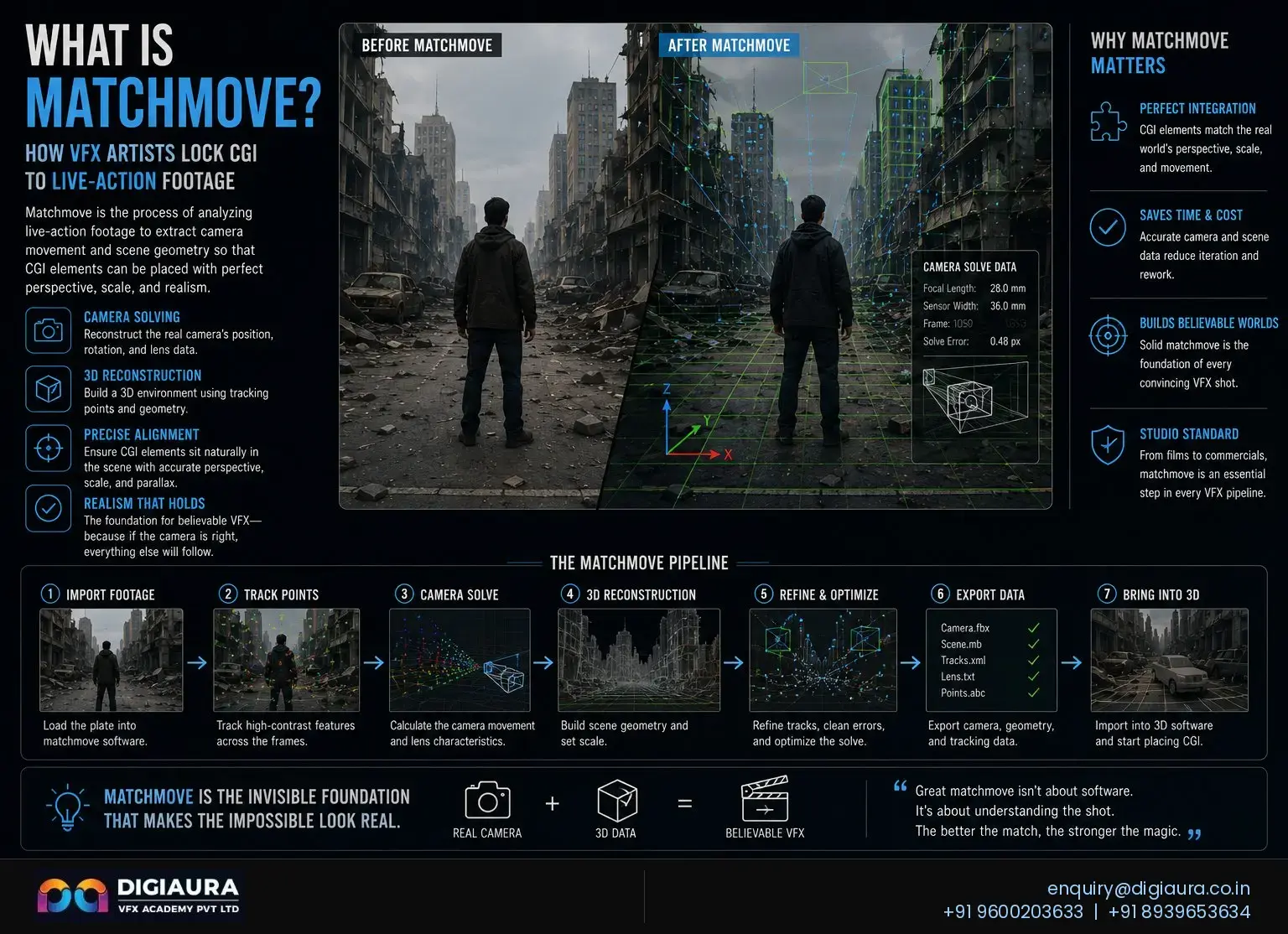
Every time a CGI spaceship lands on a real tarmac, a digital creature walks through a practical corridor, or a visual effects explosion erupts from a filmed location, one discipline is responsible for making that fusion look physically believable: matchmoving. It is the VFX technique that solves the three-dimensional path of a live-action camera so that digital elements can be placed into footage with perfect positional accuracy, frame by frame. It is one of the most foundational skills in any production VFX pipeline, one of the first disciplines hired during post-production, and one of the most consistently in-demand roles in India's rapidly expanding visual effects industry. Explore VFX courses at DigiAura Academy
Key Takeaways
- Matchmoving (also called camera tracking or match moving) is the VFX process of reconstructing the 3D position, rotation, focal length, and lens distortion of a real camera from 2D live-action footage so that CGI elements integrate seamlessly into the shot.
- The process works by placing 2D tracking points on stable features in the footage, solving the spatial relationship between those points across frames, and generating a 3D camera path that mirrors the original lens movement exactly.
- The three leading matchmove applications used in professional production are 3DEqualizer (industry standard for film), SynthEyes (mid-range and indie), and PFTrack (pipeline-integrated enterprise). Blender offers a free entry-level option.
- Matchmoving sits at the beginning of the VFX post-production pipeline. Every downstream department, including CGI, animation, lighting, and compositing, depends on the accuracy of the matchmove solve to do their work correctly.
- Matchmove artist median salary in the United States is USD 70,000 per year (VFX Engine, 2025), with a range from USD 48,000 at entry level to USD 108,000 for senior roles. In India, trained matchmove artists earn between 3 and 8 LPA depending on experience and studio.
- AI-assisted matchmoving tools are now being used at major studios to automate feature selection and initial camera solves, but human artist review and correction remain essential for production-quality deliverables in 2026.
What Is Matchmoving in VFX?
Matchmoving is the VFX process of analysing 2D live-action footage and reconstructing the 3D path of the camera that filmed it. The output is a digital camera inside a 3D application, such as Autodesk Maya or SideFX Houdini, that moves exactly as the real camera did during filming. Once that camera solve is complete, 3D artists can place CGI objects, creatures, vehicles, or environments into the scene and they will appear as if the original camera physically filmed them from that position, at that angle, with that lens.
The technique gets its name from the core challenge it solves: the CGI elements must match the movement of the original footage. If the camera panned left by 3.7 degrees on frame 42, the CGI camera must pan left by exactly 3.7 degrees on frame 42. If the lens had a 5% barrel distortion, the 3D render must account for that same distortion. Any mismatch, even a fraction of a pixel, causes the CGI to visibly slip against the background and breaks the illusion immediately.
Citation Capsule: Matchmoving is the computational technique of recovering camera motion parameters from image sequences so that computer-generated imagery can be composited into live-action footage in a geometrically consistent manner. It is also referred to as camera tracking or match moving, and its output is a 3D camera solve that represents the reconstructed position, orientation, focal length, and lens distortion of the original physical camera for every frame of the shot.
The VFX global market is projected to grow by USD 15.24 billion between 2025 and 2029, at a CAGR of 17.2% (Technavio, 2024). That growth is driven by rising demand from streaming platforms, theatrical blockbusters, and virtual production, all of which depend heavily on accurate matchmoving as the first step in their CGI integration pipelines.
How Does Matchmoving Work? The Step-by-Step Process
Matchmoving is a structured, multi-stage workflow. Each step builds on the previous one, and an error at any stage will propagate downstream into every department that uses the solve. Here is the professional production process from shot receipt to delivery:
- Step 1: Shot Assessment and Footage Ingest. The matchmove artist receives the locked-off or moving camera footage, along with a shot brief describing what CGI needs to be placed and where. The artist assesses the quality of tracking reference available in the frame, reviews any on-set data such as focal length logs, lens charts, or survey geometry, and imports the footage into the matchmove software at the correct frame rate and resolution.
- Step 2: Feature Selection and 2D Tracking. The artist identifies stable, high-contrast features in the frame, such as wall corners, paint marks, floor textures, or physical tracking markers placed on set by the VFX supervisor. These features are tracked across every frame, producing a set of 2D tracks that record how each point moves through the image over time. Good tracking requires points that are spread across the frame in depth as well as in screen space, since parallax between near and far features is what allows the 3D solve to work.
- Step 3: The Camera Solve. The matchmove software analyses the 2D tracking data and attempts to reconstruct a 3D scene. This is a photogrammetry-based computation: if you know how a set of points moves in 2D across frames, and you know the approximate focal length of the lens, you can compute the 3D position of those points and the camera path that would produce exactly those 2D projections. The result is a sparse 3D point cloud representing the tracked features, with a 3D camera moving through that cloud.
- Step 4: Solve Validation and Cleanup. The artist checks the solve quality by overlaying the reconstructed camera on the footage and comparing the 3D point cloud positions against the real features. Poorly tracked points, which appear to drift or jitter relative to the image, are removed or re-tracked. Lens distortion is calibrated against a checkerboard chart provided by the DIT or VFX supervisor on set, or estimated from the footage directly if no chart was captured.
- Step 5: Scene Geometry Reconstruction. A minimal 3D geometry of the physical environment is built or imported, typically floors, walls, and any surfaces that CGI needs to interact with. This geometry is aligned with the solved point cloud so that CGI placed later will land on the correct physical surfaces. For complex productions, survey data, LIDAR scans, or photogrammetry meshes may be provided by the art department.
- Step 6: Export and Handoff. The solved camera, point cloud, and scene geometry are exported in the format required by the downstream department. Maya .ma, FBX, and Alembic are the most common export formats. The matchmove artist documents the solve quality, any limitations, and any shots with difficult tracking conditions so that the receiving artists know what to expect.
Matchmove vs Camera Tracking: Is There a Difference?
The short answer is no. Matchmoving and camera tracking describe the same core process from two different industry perspectives. The term "matchmove" originates from the film VFX industry and emphasises the artistic goal: making CGI match the movement of the filmed footage. The term "camera tracking" or "3D camera tracking" originates from the software development and technical side of the industry and emphasises the computational method: tracking the camera's 3D path from 2D imagery.
In professional production, both terms are used interchangeably. A matchmove department at a feature film studio is the same as a camera tracking department. 3DEqualizer, the dominant matchmove software in the film industry, refers to its process as camera solving. PFTrack uses the term tracking. The job title is most commonly "Matchmove Artist" or "Camera Tracking Artist" depending on the studio.
Where the distinction does matter is between matchmoving and motion tracking in 2D compositing software. In After Effects or Nuke, "tracking" often refers to a 2D process where you track a point or a plane in screen space to apply a 2D transformation. That is fundamentally different from matchmoving, which reconstructs a full 3D camera solve. A 2D track gives you screen-space motion. A matchmove gives you 3D world-space camera position and orientation.
Types of Tracking in Professional VFX
The broader category of tracking in visual effects encompasses several distinct disciplines. Understanding the differences between them helps VFX students choose the right specialisation and helps production coordinators assign work correctly.
| Tracking Type | What It Solves | Output Delivered | Primary Software | Who Receives the Data |
|---|---|---|---|---|
| Camera Tracking (Matchmove) | 3D camera position, rotation, FOV, lens distortion | 3D camera solve + point cloud | 3DEqualizer, PFTrack, SynthEyes | CG, Lighting, FX, Compositing |
| Object Tracking | 3D position and rotation of a specific object in the shot | 3D object transform data | PFTrack, 3DEqualizer, SynthEyes | CG replacement, CGI vehicle/prop overlay |
| Body Tracking (Rotomation) | 3D skeleton and joint positions of a human or creature | 3D skeleton animation data | Maya, PFTrack, 3DEqualizer | CG, Animation, Creature FX |
| 2D Planar Tracking | 2D surface motion in screen space | 2D corner pin or transform data | Mocha Pro, After Effects, Nuke | Compositing (screen replacements, VFX paint) |
Camera tracking and object tracking are frequently performed by the same matchmove artist. Rotomation is a closely related but distinct discipline requiring deeper knowledge of human anatomy and 3D rigging. At many mid-size Indian VFX studios, matchmove artists are trained in both camera tracking and basic object tracking, with rotomation handled by a dedicated team.
Where Matchmoving Fits in the VFX Pipeline
Matchmoving is typically the first VFX task performed on any live-action shot. Its position at the start of the pipeline means that every downstream department depends on the quality and accuracy of the matchmove solve. An incorrect camera solve does not only affect one department: it causes propagating errors through CGI, lighting, and compositing that require expensive rework at every stage.
Here is how matchmoving fits within the broader VFX production pipeline:
- Pre-Production: The VFX supervisor and matchmove lead plan on-set tracking marker placement, survey requirements, lens kit specifications, and any pre-vis geometry that will be needed for the solve. This planning directly affects how easy or difficult the matchmove will be in post-production.
- On-Set VFX Supervision: Physical tracking markers (typically fluorescent dots, paint crosses, or tennis ball references) are placed on set walls, floors, and props. The VFX supervisor or data wrangler captures lens charts, distortion grids, and set survey data that the matchmove artist will use during the solve.
- Matchmove (Post-Production, Week 1): The matchmove team receives locked footage and begins solving camera paths shot by shot. The solve is reviewed by the VFX supervisor before the data is passed downstream.
- CG Layout and Blocking: Artists use the solved camera and scene geometry to position CGI characters, vehicles, and environments correctly in the 3D scene. Without a clean matchmove, this stage cannot begin.
- Animation, FX, Lighting: All CG work proceeds relative to the solved camera and point cloud established in the matchmove stage. The lighting team uses the solved camera to match the real-world illumination captured on set.
- Compositing: The compositing artist integrates the rendered CGI with the original footage. Any imperfections in the matchmove solve become visible at this stage as CGI elements slipping or drifting against the background.
The Best Matchmove Software in 2025 (Compared)
The matchmove software landscape has remained relatively stable at the professional level, with 3DEqualizer dominating theatrical feature film production and SynthEyes holding strong in television, commercials, and independent production. Here is a practical comparison of the tools currently used in professional matchmove pipelines:
| Software | Pricing (2025) | Difficulty Level | AI Features | Best For |
|---|---|---|---|---|
| 3DEqualizer | EUR 129/month (rental) | Advanced | Limited; manual precision focus | Feature films, VFX-heavy productions |
| SynthEyes | USD 325/year | Intermediate | Automated tracking assist | TV, commercials, independent VFX |
| PFTrack | Enterprise pricing (contact) | Advanced | Deep learning tracking in 2025 release | Large studios with pipeline integration needs |
| Mocha Pro | USD 325/year | Beginner to Intermediate | PowerMesh, AI roto assist | Planar tracking, compositing workflows |
| Blender (Camera Tracker) | Free (open source) | Beginner | Basic automated tracking | Students, freelancers, low-budget production |
3DEqualizer (3DE) has been the dominant tool in film VFX for over two decades and received a Scientific and Technical Academy Award in 2002 for its contribution to the industry. Its precision in handling complex lens distortion, nodal pan shots, and survey-constrained solves makes it the preferred choice for feature-level VFX work. Most senior matchmove positions at studios such as Double Negative, MPC, Industrial Light and Magic, and Prime Focus specify 3DE proficiency as a requirement.
SynthEyes is the most cost-accessible professional option and is widely used at mid-size studios for episodic television, OTT content, and commercials. Its streamlined interface and strong automated tracking assist make it a productive tool for artists handling high shot counts under tight deadlines.
PFTrack 2025 introduced a significant deep learning-based tracking system that allows the software to automatically identify and track features that traditional gradient-based tracking approaches miss, particularly in low-contrast or defocused regions. This positions PFTrack as the most AI-forward option in the professional tier as of 2026.
What Does a Matchmove Artist Do Every Day?
A matchmove artist at a professional VFX studio works within a structured production schedule, typically receiving shot assignments through a shot tracking system such as ftrack, Shotgun (ShotGrid), or Flow Production Tracking. A typical production day includes the following tasks:
- Shot Review and Briefing: Review the shot brief, reference plates, any on-set data, and the VFX supervisor's notes before opening the footage. Understanding what CGI will be added and where it needs to interact with the environment informs every tracking and geometry decision.
- Footage Assessment: Identify strong tracking features in the frame, note any challenging sections (motion blur, lens flare, crowds, fast camera moves), and plan the tracking strategy for the shot.
- Track and Solve Work: Perform the actual 2D tracking and 3D camera solve in 3DEqualizer, SynthEyes, or PFTrack. Validate the solve quality using residual error metrics and visual overlay inspection. Correct problem tracks, re-solve as needed.
- Geometry Modelling: Build or receive set geometry, align it to the solved scene, and verify that CGI interaction surfaces are positioned and scaled correctly relative to the solved camera and point cloud.
- Lens Distortion Calibration: If distortion charts were captured on set, calibrate the lens model in the matchmove software and apply the correct undistortion to the export. If no charts exist, estimate distortion from image straight-line analysis.
- Export and Documentation: Export the camera solve in the required format, write delivery notes, and submit the shot for VFX supervisor review. Respond to any revision notes and re-deliver as required.
- Dailies Review: Attend or review dailies to see how downstream departments are using the matchmove data, and flag any shots where the solve may be insufficient for the composite that is being built.
How Do Matchmove Artists Collaborate with Other VFX Departments?
Matchmove artists work most closely with the VFX supervisor, the CG layout team, and the compositing department. The VFX supervisor reviews solves for accuracy and flags technical issues. The CG layout team receives the solved camera and point cloud as the starting geometry for placing CG assets. Compositors are the downstream artists most directly affected by matchmove quality since they are the ones attempting to blend rendered CGI with the live plate.
In productions that involve virtual production or LED volume stages, matchmove artists work closely with the real-time tracking team to reconcile in-camera VFX data with the traditional post-production solve workflow. The virtual production market is projected to reach USD 8.76 billion by 2030 at a CAGR of 33.1% (GlobeNewswire, December 2025), creating significant new demand for matchmove artists who can operate in hybrid physical-digital production environments.
Matchmove Artist Career Path and Salary
Matchmoving is one of the cleanest entry points into the professional VFX industry. It is a technically specialised skill that can be learned and demonstrated through a showreel, it requires no prior work history in film to break into at junior level, and studios in India, the UK, Canada, and the US hire matchmove artists at scale for every major production. Here is the career structure and verified salary data:
| Career Level | Experience | Salary (USA) | Salary (India) | Salary (UK) |
|---|---|---|---|---|
| Junior Matchmove Artist | 0 to 2 years | USD 48,000 to 58,000/yr | INR 3 to 5 LPA | GBP 22,000 to 28,000/yr |
| Mid-Level Matchmove Artist | 2 to 5 years | USD 65,000 to 85,000/yr | INR 5 to 8 LPA | GBP 30,000 to 38,000/yr |
| Senior / Lead Matchmove | 5 to 10+ years | USD 90,000 to 108,000/yr | INR 10 to 18 LPA | GBP 40,000 to 52,000/yr |
Salary data sourced from VFX Engine (10,740+ data points across 4 countries, using government SOC codes, H-1B disclosures, and union rate cards, 2024 to 2025). The overall matchmove artist median salary in the United States is USD 70,000 per year. California (Los Angeles and San Francisco) commands the highest premiums, with mid-level artists in California earning a median of USD 80,000 per year.
How to Build a Matchmove Showreel That Gets You Hired
The matchmove showreel is the primary hiring tool at every career level. Unlike creative departments where aesthetics play a large role, matchmove showreels are evaluated almost entirely on technical accuracy. Here is what VFX supervisors and matchmove leads look for:
- A minimum of three to five complete shots, each with at least one CGI element integrated into live-action footage using your matchmove solve.
- A split-screen or overlay comparison showing the raw footage alongside the solved camera and point cloud.
- At least one shot involving a moving camera with significant parallax, not a locked-off shot or a simple pan.
- A shot that demonstrates lens distortion calibration, with the undistorted plate visible alongside the CGI integration.
- At least one scene with a practical CGI interaction, such as a CGI object resting on a real floor or touching a real wall.
- Clear labelling of which shots you solved independently versus shots completed as part of a team exercise at a training institution.
AI and the Future of Matchmoving
Artificial intelligence is beginning to change how matchmoving work is performed at the production level, though the transformation is still in early stages as of 2026. The most significant developments are in automated feature detection and initial solve generation, where deep learning models are now capable of identifying trackable features in footage conditions that would confuse traditional gradient-based trackers, including highly textured or repetitive surfaces, specular highlights, and defocused backgrounds.
PFTrack 2025 introduced a deep learning tracking module that uses neural networks trained on large production footage datasets to select and track features with greater robustness than classical optical flow methods. The system can generate an initial camera solve that a human matchmove artist then reviews, validates, and corrects rather than building the solve from scratch. This changes the work from solve creation to solve supervision, and meaningfully increases the number of shots a single artist can handle per day.
However, fully automated matchmoving that delivers production-ready solves without human oversight does not yet exist as a reliable commercial product. The edge cases that require human judgment, such as shots with near-zero parallax, scenes where all tracked features are moving (crowds, vegetation, water), and productions using non-standard lenses, continue to require experienced human artists who understand the spatial geometry underlying the computation.
For matchmove artists currently in training or early in their careers, AI tools are best understood as productivity multipliers that increase the value of skilled artists, not as replacements for them. The ability to review, correct, and optimise AI-generated solves is itself a high-value skill that requires the same fundamental understanding of camera geometry, lens physics, and spatial reasoning that traditional matchmoving demands.
Frequently Asked Questions About Matchmoving
What is the difference between matchmove and rotoscoping?
Matchmoving solves the 3D position and path of the camera, producing data that allows CGI to be inserted into a shot in three-dimensional space. Rotoscoping traces the 2D silhouette outline of subjects in the footage, producing alpha mattes used in compositing to separate foreground elements from backgrounds. They are separate disciplines performed by different departments and using different software, though both analyse the same live-action footage.
What is a camera solve in VFX?
A camera solve is the result of the matchmoving process: a digital camera inside a 3D application that has been mathematically reconstructed to replicate the real camera's position, rotation, focal length, and lens distortion for every frame of the shot. Once a camera is solved, CGI artists can use it as the virtual viewpoint through which all digital elements are rendered, ensuring they align correctly with the photographed background plate.
Can I learn matchmoving without a film school degree?
Yes. Matchmoving is a technically learned skill that is assessed entirely on showreel quality at the hiring stage. Many working matchmove artists trained at specialised VFX institutes rather than film schools. Studios evaluate proficiency through a technical test during the hiring process, not through academic credentials. A strong showreel demonstrating accurate camera solves in 3DEqualizer or SynthEyes is more effective than a degree from a non-specialist institution.
How long does it take to become a matchmove artist?
A focused training programme covering 3DEqualizer or SynthEyes, camera geometry fundamentals, lens calibration, and scene geometry typically runs between 3 and 6 months at a professional VFX training institute. After completing structured training with real production footage, most students are able to build a hire-ready showreel within 6 to 9 months of beginning their studies.
Is matchmoving a good career in India in 2026?
Yes. India's VFX industry is expanding rapidly, driven by the growth of domestic film production (particularly in Tamil, Telugu, and Hindi cinema), by Indian studios servicing international Hollywood and OTT productions, and by the government's AVGC promotion initiative. India faces a documented talent gap of 2.3 million VFX professionals (FX and Beyond Report, 2024). Trained matchmove artists with professional software proficiency are among the most consistently hired VFX specialists at studios in Chennai, Mumbai, Hyderabad, and Bengaluru.
What is a point cloud in matchmoving?
A point cloud in matchmoving is the 3D scatter plot of tracked feature positions that is reconstructed during the camera solve process. Each tracked 2D point in the footage corresponds to a real physical point in the 3D world, and the camera solve algorithm determines where in three-dimensional space each of those points must be located to be consistent with the observed 2D motion. The resulting cloud of 3D points gives the matchmove artist a spatial map of the filmed environment and is used as a reference for aligning proxy geometry and confirming the accuracy of the camera path.
Matchmoving is the invisible foundation of every visual effects sequence where CGI and live-action coexist. From the opening frames of a blockbuster feature to the creature interaction in an OTT streaming series, the quality of the matchmove solve determines whether the audience believes what they are seeing. If you are considering a career in visual effects, matchmoving is one of the most technically direct, consistently employed, and clearly evaluable skills you can build. Talk to DigiAura's team about VFX training in Chennai