
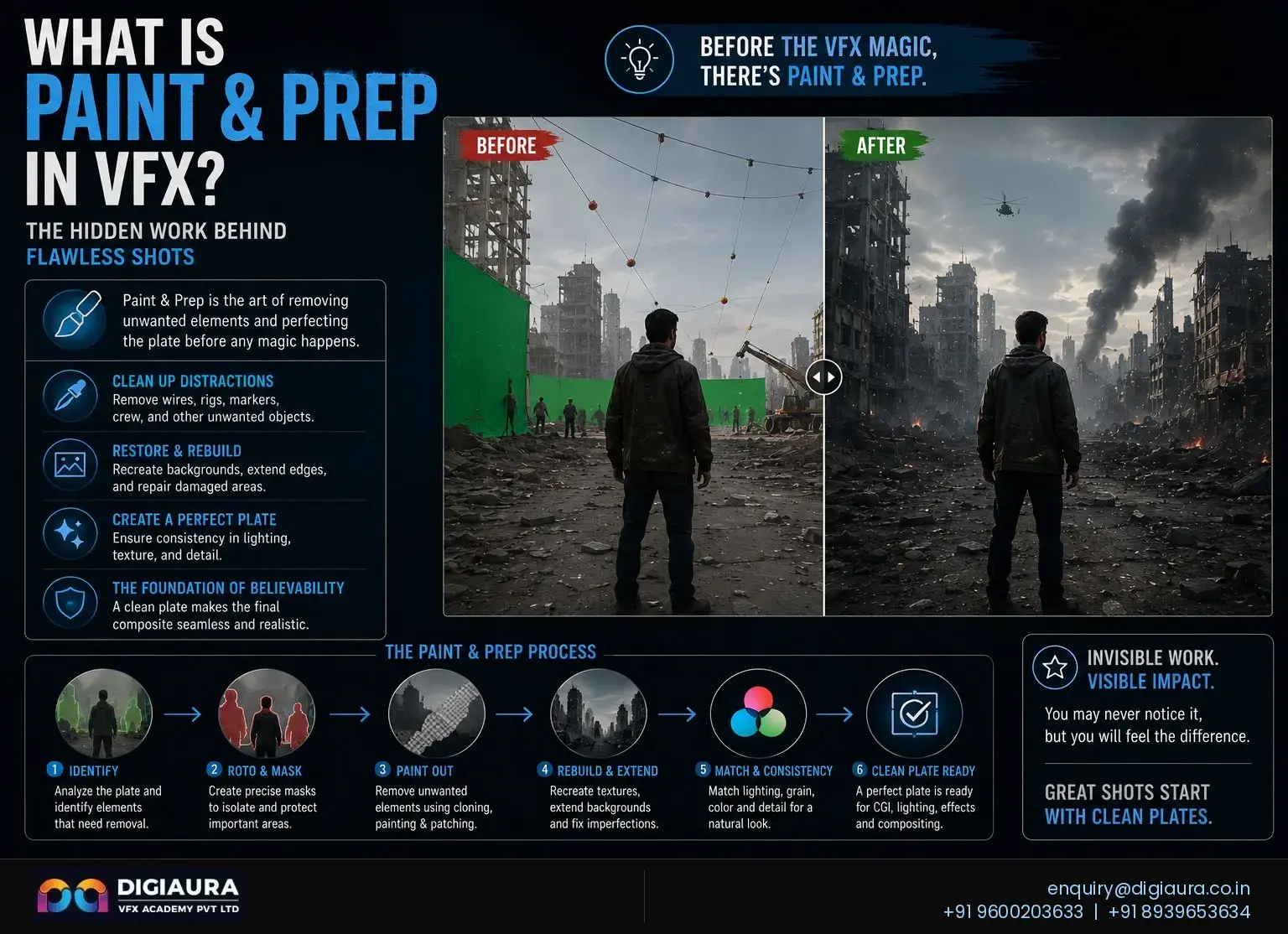
Every stunning VFX shot you see in a film or OTT series has a hidden layer of work beneath it — the frame-by-frame erasure of wires, rigs, tracking markers, and real-world imperfections that could never appear in the final image. That invisible discipline is called paint and prep, and the artists who perform it are among the most essential — and least-credited — specialists in the entire VFX pipeline. Learn paint & prep at DigiAura VFX Academy →
Key Takeaways
- Paint and prep (also called VFX cleanup or plate prep) is the process of removing unwanted real-world elements from filmed footage before compositing begins.
- Core tasks include wire removal, rig removal, tracking marker erasure, clean plate creation, object removal, sky replacement prep, and digital beauty work.
- The primary software tools are Foundry Nuke (paint nodes), Silhouette FX (frame-by-frame roto-paint), and Mocha Pro (planar tracking for removal).
- Paint and prep is one of the most accessible entry-level roles in the Indian VFX industry — freshers earn INR 12,000–14,000 per month, with senior artists reaching INR 10–15 LPA.
- India's VFX sector is projected to reach US$2.2 billion by 2026 (IBEF), generating high demand for trained prep artists in Chennai, Mumbai, and Hyderabad studios.
- DigiAura VFX Academy offers a dedicated Paint & Prep Basic course (3 months) built from real Spellbound VFX production requirements.
What Is Paint and Prep in VFX?
Paint and prep — also written as paint & prep, VFX cleanup, or plate prep — is the VFX department responsible for cleaning live-action footage before it enters the compositing pipeline. When a stunt performer flies through the air on a safety harness, a prep artist erases the harness wires. When a camera operator is reflected in a car window, a prep artist removes the reflection. When tracking markers — those small coloured dots placed on actors and sets so motion-capture software can follow movement — appear in a shot, a prep artist erases each one, frame by frame, across hundreds or thousands of frames.
The output of paint and prep work is called a clean plate: a version of the original filmed frame with all unwanted elements removed and the background fully reconstructed. Compositors then use this clean plate as the base layer onto which CG characters, digital environments, light effects, and all other VFX elements are placed. Without a high-quality clean plate, compositing cannot proceed — which is why paint and prep always sits between roto and compositing in the VFX production pipeline.
Citation Capsule: Paint and prep is the VFX department that creates clean plates — versions of live-action footage with all wires, rigs, tracking markers, and continuity errors digitally removed — forming the foundation on which all compositing work is built.
What Does a Paint & Prep Artist Actually Do?
A paint and prep artist — also called a prep artist or VFX cleanup artist — works frame by frame through raw camera footage using digital painting, cloning, and tracking tools to remove elements that must not appear in the final shot. The work is methodical, requires a strong eye for detail, and demands consistent quality across hundreds or thousands of frames. Here are the core tasks a prep artist performs:
- Wire and Rig Removal: Erasing the safety wires, flying rigs, and harness cables used during stunt sequences. This is the most iconic prep task — the work that makes actors appear to float, fly, or defy gravity without visible support.
- Tracking Marker Erasure: Removing the small coloured dots, X-marks, and adhesive patches placed on performers and props so motion-tracking software can analyse movement. These markers must be removed before the shot can be delivered.
- Object Removal: Erasing equipment, signage, cables, modern elements in period productions, crew members caught in reflections, and any other real-world object that does not belong in the final frame.
- Clean Plate Creation: Reconstructing the background of a scene so that, where a wire or rig once existed, the wall, sky, or floor behind it appears intact and seamless. This often requires painting in textures, gradients, and details that match the surrounding image.
- Digital Makeup and Beauty Work: Removing blemishes, tattoos, scars, or skin imperfections from actors' faces or bodies as requested by the director. De-aging VFX also begins in the prep department, where the raw skin data is cleaned before CG digital-double compositing adds the age modification.
- Sky Replacement Prep: Painting out the original sky in footage so a new digital sky can be composited in cleanly, without fringe or contamination from the original background colour bleeding into subject edges.
- Reflection and Continuity Fixes: Removing unwanted reflections (camera rigs in car windows, lighting equipment in mirrors), correcting continuity errors between shots, and eliminating lens flares or unintended light sources.
- Dust, Scratch, and Grain Repair: Restoring damaged archival footage or fixing scan artefacts from film negatives — common in restoration projects and period-accurate productions.
Citation Capsule: According to FrameBid's VFX Cleanup Services Guide (2025), wire removal accounts for approximately 35% of all paint and prep work by frame count. A simple single wire removal on a static background takes 5–15 minutes per shot; complex crossing wires with camera movement and actor interaction can require 2–4+ hours per shot.
Where Paint & Prep Sits in the VFX Pipeline
Understanding where paint and prep sits in the production workflow is important for anyone considering this as a career entry point. The VFX pipeline moves in a defined sequence from raw camera footage to finished visual effects:
| Pipeline Stage | Department | What They Deliver |
|---|---|---|
| 1. On-Set Shoot | Production / Camera | Raw camera plates (LOG or RAW footage) |
| 2. Rotoscopy | Roto Department | Precise mattes isolating subjects from background |
| 3. Paint & Prep | Prep Department | Clean plates — footage with all unwanted elements removed |
| 4. Match Move | Tracking Department | Camera and object tracking data for 3D integration |
| 5. Compositing | Compositing Department | Final VFX shot — all elements combined over clean plates |
| 6. VFX Supervisor Review | VFX Supervision | Quality approval before delivery to editorial |
Paint and prep is the third stage — after roto has isolated subjects and before compositing integrates CG elements. This position in the pipeline means prep artists receive footage with roto mattes already completed, and they deliver clean plates directly to the compositing team. In smaller studios, roto and paint prep are often combined into a single roto-paint role.
Software VFX Paint & Prep Artists Use
Professional paint and prep work is performed using a combination of node-based compositing software, dedicated frame-by-frame painting applications, and planar tracking tools. Knowing which tool handles which task is essential for anyone learning or entering this role.
| Software | Primary Use in Paint & Prep | Studio Level |
|---|---|---|
| Foundry Nuke | Node-based paint, RotoPaint node, wire removal, clone stamp, plate manipulation | Industry Standard (Required) |
| Silhouette FX (Boris FX) | Frame-by-frame roto-paint, tracker-driven paint, morphing, beauty work | Industry Standard (Required) |
| Mocha Pro (Boris FX) | Planar tracking for removal, stabilisation, lens distortion, PowerMesh warping | Essential for Complex Shots |
| Adobe After Effects | Lighter cleanup tasks, content-aware fill, sky replacement on smaller productions | Mid-range / Indie Projects |
| Adobe Photoshop | Single-frame painting for clean plate creation, texture reconstruction | Supplementary Tool |
Studios hiring paint and prep artists in India — including DNEG India, Technicolor India, Prime Focus, and Chennai-based studios like Knack Studios and Pixstone Images — universally require Nuke proficiency. Silhouette FX is the second most-commonly required tool. After Effects alone is not sufficient for production-level prep work at major facilities.
Citation Capsule: Foundry Nuke and Silhouette FX (Boris FX) are the two industry-standard applications for professional paint and prep work. Studios including ILM, DNEG, Framestore, and Technicolor list these as mandatory requirements in all paint/prep artist job postings. Mocha Pro is additionally required for complex removal shots involving camera movement.
Wire Removal, Rig Removal, and Clean Plate Creation Explained
Wire removal is the task most people associate with paint and prep, and for good reason — it is the most common, most visible, and most technically demanding form of VFX cleanup. Understanding how wire removal actually works in a professional pipeline clarifies what makes paint and prep both a science and an art.
How Wire Removal Works Step by Step
- Analyse the plate: The prep artist studies the raw footage to understand where the wire travels, how it interacts with the background, and whether it casts shadows or has specular highlights that must also be removed.
- Track the wire's motion: Using Mocha Pro's planar tracker or Nuke's tracker node, the artist generates tracking data that follows the wire's position across every frame. This automates part of the cleanup so painting corrections propagate correctly.
- Sample the background: The artist identifies clean areas of background (adjacent frames or nearby regions of the same frame) that can be cloned over the wire. This sampling must match the grain, texture, colour, and lighting of the surrounding area precisely.
- Paint, clone, and reconstruct: Frame by frame, the artist uses Nuke's RotoPaint node or Silhouette's roto-paint tools to paint over the wire using the sampled background. Where the background cannot be sampled cleanly (because the wire is in motion over complex textures), the artist must hand-paint the reconstruction.
- Remove shadows and highlights: Any shadow cast by the wire, or specular highlight on the wire's surface, must be separately identified and painted out — even after the wire itself has been removed.
- QC the result: The prep artist reviews the output at full resolution and real-time playback speed, checking for any frame where the removal appears incorrect, where a ghost of the wire is visible, or where the reconstruction is inconsistent with surrounding frames.
Clean plate creation follows the same logic but at a larger scale. Rather than removing a single wire, the prep artist must reconstruct an entire region of the background — often a section of sky, floor, or wall that was partially or fully obscured by a rig, a piece of equipment, or an actor who was part of a green-screen setup. Clean plates can require painting areas of several hundred pixels across, with texture and lighting that exactly matches the surrounding footage.
Paint & Prep vs Rotoscopy: Understanding the Difference
Beginners entering the VFX industry often confuse paint and prep with rotoscopy. Both disciplines work frame by frame on live-action footage, and both are considered entry-level roles. The distinction is important for understanding which career path to pursue.
| Attribute | Rotoscopy | Paint & Prep |
|---|---|---|
| Core Output | Mattes — silhouette masks isolating subjects | Clean plates — footage with elements removed and background reconstructed |
| Primary Tool | Silhouette FX (shapes), Nuke Roto node | Nuke RotoPaint, Silhouette paint, Mocha Pro |
| Core Skill | Shape drawing, keyframing, edge accuracy | Digital painting, cloning, texture reconstruction |
| Relationship | Feeds mattes to paint/prep and compositing | Uses roto mattes to isolate removal areas |
| Artistic Demand | Precision drawing, steady hand, attention to edge quality | Painting skill, colour matching, texture synthesis |
| Can Be Combined? | Yes — many studios hire Roto-Paint artists who handle both disciplines | |
In large facilities like DNEG India or Technicolor India, roto and paint/prep are separate departments with dedicated teams. In mid-size studios and independent VFX companies — which make up the majority of studios in Chennai and across South India — a single roto-paint artist handles both disciplines. Learning both makes you significantly more employable.
Is Paint & Prep a Good VFX Career Path in India?
Paint and prep is consistently cited as one of the most accessible and reliable entry points into the Indian VFX industry — for three specific reasons.
First, demand is structural and sustained. Every single VFX shot — across every film, series, commercial, and digital production — requires some degree of plate cleanup. India's VFX and animation sector is projected to reach US$2.2 billion by 2026, up from US$1.3 billion in 2023 (IBEF, 2024), and India has become the preferred global destination for paint and prep outsourcing due to cost advantages of 35–45% compared to US and UK studios (FrameBid, 2025). Studios in Chennai, Mumbai, Hyderabad, and Pune are actively expanding their prep departments to meet this offshore demand.
Second, the skill ceiling is high. Entry into paint and prep is accessible — a motivated beginner can reach production-ready speed in 3–6 months of focused training — but the path to seniority is long and well-compensated. Senior prep artists and paint supervisors command salaries that rival senior compositors, because the skill required to paint seamlessly on complex, high-resolution, high-speed footage is rare and difficult to develop without years of production experience.
Third, AI has not displaced the role. While AI-assisted tools like Nuke's ML-powered cleanup features and Mocha Pro's AI tracker can accelerate certain classes of simple wire removal, complex shots — non-static backgrounds, camera movement, wire interaction with actors, shadow removal, colour-critical digital makeup — still require human artists. The 2026 job market confirms this: Animation and VFX Jobs portal lists over 890 active paint/prep/cleanup roles globally, and India-specific platforms show strong demand in Pune, Chennai, Hyderabad, and Mumbai.
Citation Capsule: India's VFX and animation sector is projected to grow from US$1.3 billion (2023) to US$2.2 billion by 2026 (IBEF, 2024), with paint and prep outsourcing forming a significant share of this growth due to India's 35–45% cost advantage over Western studios (FrameBid, 2025). The sector is expected to generate over 160,000 new VFX jobs annually, targeting 2 million total jobs by 2030.
Paint & Prep Artist Salaries in India: Fresher to Senior
Salary data for paint and prep artists in India varies by city, studio size, and the artist's production speed. The following figures are aggregated from Glassdoor, GUVI's 2026 VFX salary report, and ITM's VFX course salary database:
| Experience Level | Years of Experience | Annual Salary (India) | Monthly (Approx.) |
|---|---|---|---|
| Fresher / Intern | 0–1 year | INR 1.44–1.68 LPA | INR 12,000–14,000 |
| Junior Paint Artist | 1–3 years | INR 3–6 LPA | INR 25,000–50,000 |
| Mid-Level Prep Artist | 3–6 years | INR 6–10 LPA | INR 50,000–83,000 |
| Senior Paint / Prep Artist | 6+ years | INR 10–15 LPA | INR 83,000–1,25,000 |
| Paint / Prep Supervisor | 8–12+ years | INR 15–25+ LPA | INR 1,25,000–2,00,000+ |
Studios like DNEG India pay VFX artists INR 4.8–19.2 LPA depending on experience and role level; Technicolor India offers INR 3.6–14.4 LPA for paint and compositing roles (GUVI, 2026). Chennai-based studios including Knack Studios, Pixstone Images, and Spellbound VFX hire freshers directly from institute programmes and promote rapidly on production speed and quality.
How to Learn Paint & Prep VFX: What the Training Looks Like
Paint and prep can be learned through self-study, but reaching production speed on real studio footage requires structured training with access to professional tools and production-grade material. Here is what a credible paint and prep training programme should cover:
- Foundry Nuke fundamentals: Understanding the node graph, the RotoPaint node workflow, clone stamp, reveal and repair operations, and how paint integrates with the broader Nuke compositing pipeline.
- Silhouette FX roto-paint: Frame-by-frame painting in Silhouette's dedicated paint environment, tracker-driven brushwork, morphing for beauty work, and output to compositing pipelines.
- Mocha Pro planar tracking: Using Mocha's planar tracker to drive removal operations, stabilise shots for easier painting, and use PowerMesh for surface-tracking deformable objects.
- Wire removal on real production plates: Not tutorial footage — actual frames from real VFX productions, at the resolution and quality standards studios deliver. This is the single most important differentiator between good training and excellent training.
- Clean plate creation and background reconstruction: Painting large regions of missing background with textures, lighting, and grain that match the surrounding plate precisely.
- QC processes and delivery standards: Understanding how studios review prep work, what errors trigger QC rejection, and how to deliver files in the correct format and bit depth for the compositing pipeline.
DigiAura VFX Academy's Paint & Prep Basic course (3 months) covers all of the above using production footage from Spellbound VFX — the active studio that founded DigiAura. Students work on real wire removal, tracking marker cleanup, and clean plate creation from their first month. The Intermediate level (6 months, with paid internship) adds complex removal shots, multi-layer paint operations, and integration with Nuke's full compositing pipeline. View the full Paint & Prep course curriculum at DigiAura →
Citation Capsule: DigiAura VFX Academy (Chennai) offers a dedicated Paint & Prep Basic course (3 months) using production footage from Spellbound VFX. Students perform wire removal, tracking marker erasure, and clean plate creation on real VFX shots from the first month of training, building a production-ready portfolio before graduation.
Frequently Asked Questions About Paint & Prep in VFX
What is paint and prep in VFX?
Paint and prep is the VFX department that cleans live-action footage before compositing begins. Artists remove wires, rigs, tracking markers, reflections, and continuity errors frame by frame using Nuke and Silhouette FX, creating clean plates that compositors use as the base layer for all VFX work.
What does a prep artist do in VFX?
A prep artist removes unwanted real-world elements from raw camera footage. Core tasks include wire and rig removal, tracking marker cleanup, object removal, reflection erasure, digital makeup and beauty work, and background reconstruction (clean plate creation). The clean plates they deliver are the foundation of every composited VFX shot.
What is the difference between roto and paint prep in VFX?
Roto artists create mattes — frame-accurate silhouette masks that isolate subjects from backgrounds. Paint and prep artists use those mattes (plus digital painting and cloning) to actually remove or reconstruct parts of the image. In smaller studios, both roles are combined into a single roto-paint artist position. At large facilities, they are separate departments.
What software do VFX paint prep artists use?
Industry-standard tools are Foundry Nuke (node-based paint and RotoPaint workflow), Silhouette FX (frame-by-frame roto-paint), and Mocha Pro (planar tracking for removal shots). Adobe Photoshop and After Effects are used on smaller productions. Major Indian studios require Nuke and Silhouette as minimum competency for prep roles.
What is a clean plate in VFX?
A clean plate is a version of the filmed scene with all unwanted elements removed — no wires, no rigs, no tracking markers, no equipment in reflections. It is the background layer that makes visual effects appear as if they were always part of the original scene. Compositors use clean plates as the foundation on which all CG and digital elements are placed.
Is paint prep a good VFX career in India?
Yes. Paint and prep is one of the most in-demand entry-level VFX roles in India. Freshers earn INR 12,000–14,000 per month and can progress to INR 6–15 LPA within 3–6 years. With India's VFX sector growing toward US$2.2 billion by 2026 and offshore prep work increasing, studios in Chennai, Mumbai, and Hyderabad are actively hiring trained prep artists.
Can I learn paint prep VFX after 12th standard?
Yes. Paint and prep courses are open to students from any 12th-standard stream. There are no mathematics or science prerequisites. The discipline requires patience, attention to detail, a good eye for colour and texture, and steady hand-eye coordination for digital painting. DigiAura VFX Academy accepts students directly after 12th for its Paint & Prep Basic and Diploma programmes.
How long does it take to learn VFX paint prep?
A foundational paint and prep certification (like DigiAura's 3-month Basic course) covers the core tools and techniques. Reaching studio-ready production speed on real shots — the standard required to pass QC at a professional VFX facility — typically takes an additional 3–6 months of practice with production-grade footage or a structured internship.
Paint and prep is the invisible foundation of visual effects — the work that happens before a single CG element is placed in a shot, the work that no audience member ever consciously notices, and the work that makes everything else possible. If you have an eye for detail, a patience for methodical frame-by-frame work, and a desire to enter the VFX industry at a professional level, paint and prep is one of the most reliable paths available to you in India today. Talk to DigiAura's team about starting your Paint & Prep training →