Create fire, smoke, destruction, and fluid simulations using Maya dynamics and Houdini fundamentals.
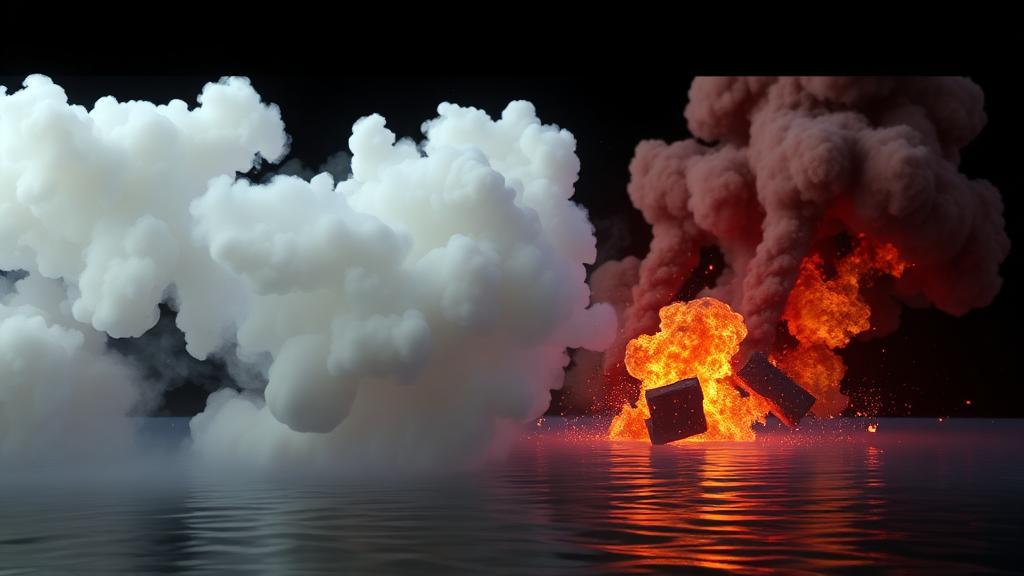
DigiAura's 3D FX course trains you in the dynamic simulation skills that create the spectacular physics-driven effects central to action films, blockbuster VFX sequences, and premium OTT productions. You will learn to simulate fire and combustion with realistic heat distortion in Maya Bifrost, smoke and pyro volumes with natural turbulence and atmospheric quality, particle systems for sparks, debris, and rainfall, rigid body destruction for shattering objects and environments, cloth and soft body simulations, and fluid dynamics for water and liquid interactions. The course also introduces Houdini — the procedural FX platform that dominates feature film simulation work at major studios — giving you a practical foundation in the node-based approach that underpins all high-end FX work. Render workflow covers outputting FX elements via Arnold as sequences ready for Nuke compositing integration.
DigiAura's 3D FX course provides Maya simulation training alongside a genuine Houdini introduction — giving students real exposure to the procedural thinking and node-based workflow that defines industry-leading FX work. This dual-platform perspective prepares graduates for the transition to Houdini-dominated feature film FX pipelines and the growing demand for procedural FX specialists in game development and virtual production.
This module covers the procedural creation and control of thousands of small elements, focusing on stylized and natural effects.
This module introduces the core principles of using physics solvers to simulate destruction and movement.
This module focuses on making your digital effects look professional and compositing-ready.
This program provides the comprehensive foundation necessary to pursue specialized, advanced training in dedicated FX packages like Houdini, or to immediately integrate high-quality dynamic elements into broader 3D and VFX projects.
The 3D FX course specializes in creating dynamic digital simulations — effects that behave according to physics rather than being manually animated. You will learn to simulate fire and combustion with realistic heat distortion, smoke and pyro volumes with natural turbulence, particle systems for sparks, debris, and rainfall, rigid body destruction for shattering objects, cloth and soft body simulations, and fluid dynamics for water and liquid effects.
Both courses focus on simulation and dynamic effects, but may differ in depth, software emphasis, and portfolio outcomes. Contact DigiAura directly to understand the specific curriculum differences and which course best matches your current skill level and career goals. Generally, one provides foundational simulation concepts while the other may emphasize a deeper specialization or different software track.
The 3D FX course uses Maya (Bifrost, nParticles, Maya Fluids) for dynamics and simulation, and provides introductory workflows in Houdini — the industry-leading procedural FX platform used at major feature film studios. You will also learn the render workflow for outputting FX elements as sequences that integrate into the compositing pipeline via Nuke.
Houdini is a 3D software made by SideFX that uses a fully procedural, node-based workflow. It is the dominant FX platform at major VFX studios worldwide — including ILM, DNEG, Framestore, and Weta FX — for fire, smoke, water, destruction, and complex simulations. Houdini's procedural system allows FX artists to create infinitely adjustable simulations and share complex effects setups across a production. Proficiency in Houdini is among the most in-demand skills in high-end VFX.
3D FX artists are among the highest-paid specialists in the VFX industry due to the complexity and technical demand of simulation work. Entry-level positions are available as Junior FX Artist at studios working on action films, disaster sequences, and creature effects. Career progression leads to Senior FX Artist and FX Supervisor — highly specialized, well-compensated leadership roles. FX skills also apply to gaming (real-time particle effects), advertising (product CGI), and virtual production.
