Learn node-based Nuke compositing — colour, keying, CG integration, and VFX pipeline fundamentals.
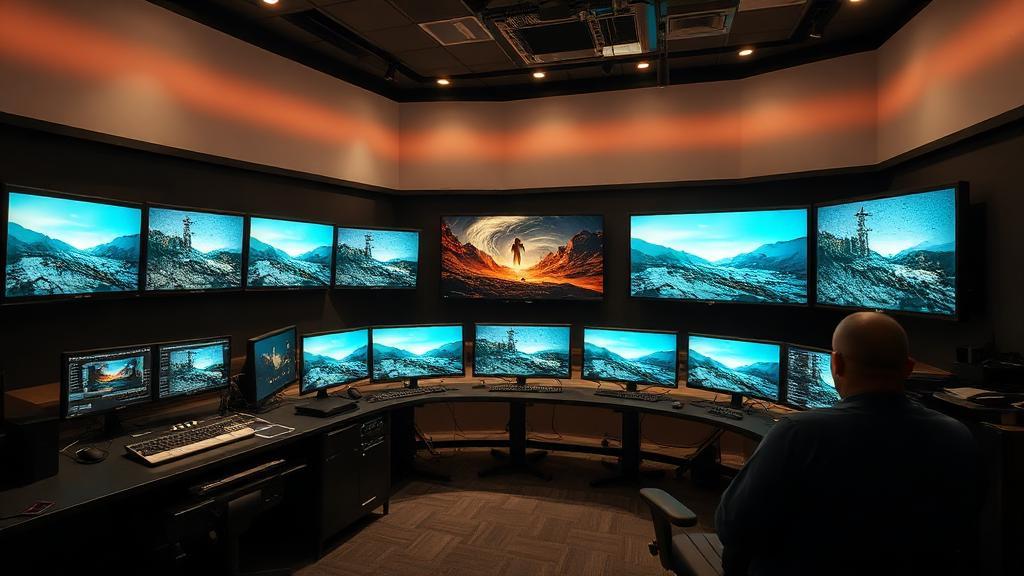
Compositing is the final creative stage of the visual effects pipeline — the art and craft of assembling live-action footage, CGI renders, matte paintings, and particle effects into one seamless, photorealistic final image. A skilled compositor is the visual architect who makes every audience member believe that a digital spaceship, a creature, or an entirely reconstructed environment was physically present when the camera rolled. DigiAura's Compositing course in Chennai teaches you the node-based workflow in Foundry's Nuke — the software used at ILM, DNEG, Framestore, Weta FX, and virtually every major film and streaming VFX studio globally. You will master colour theory and grading, green and blue screen keying and spill suppression, simple CG integration, film grain matching, and professional Nuke script organisation from day one of training.
DigiAura teaches Nuke from the very first session — not After Effects or other tools that require relearning when you enter a professional studio. This means your Nuke proficiency is immediately applicable in a production environment, giving you a significant advantage over graduates from institutes that teach non-industry tools.
Compositing is the definitive final step in the visual effects pipeline—the critical stage where all the disparate pieces of a shot are brought together and unified into a single, seamless, and believable image.
This is where the magic happens. Compositing is the art of assembling all the different visual elements—live-action, CGI, matte paintings, and effects—into one final, seamless shot. This course introduces you to node-based software (like Nuke) and the core principles of color, light, and perspective.
This foundational course will introduce you to the exciting world of node-based compositing, the industry standard for creating photorealistic visual effects. You will learn the technical and artistic skills required to take footage from various sources—including footage you created in Rotoscopy and Paint & Prep—and blend them flawlessly, ensuring the digital elements match the lighting, grain, and atmosphere of the live-action plate. This is the course where you learn to be the final visual architect of a film.
This basic program focuses on establishing a strong understanding of the artistic and technical principles that govern professional compositing:
We focus on the tools that dominate the professional industry, ensuring your skills are immediately relevant:
Mastering foundational Compositing is the most direct path to a high-value VFX career. This course provides the technical and artistic groundwork required to advance to our Intermediate and 100% Placement Assured Advanced Compositing programs.
Compositing is the final assembly stage of the VFX pipeline where all visual elements — live-action footage, CGI renders, matte paintings, particle effects, and clean plates — are blended into one seamless final image. A Compositor is the visual architect who ensures every element matches in color, lighting, grain, and perspective, making the digital additions appear as if they were physically present in the filmed scene.
You will learn the node-based workflow in Foundry's Nuke, the industry standard for high-end compositing. Topics include color theory and color grading, basic green/blue screen keying and spill suppression, simple CG element integration, layer management and professional script organization, film grain matching, and how compositing inputs (roto mattes, CG renders, clean plates) connect into the final pipeline.
Nuke is a node-based compositing application that provides greater flexibility, precision, and scalability for complex VFX shots compared to the layer-based approach of After Effects. Every major feature film VFX studio — including ILM, DNEG, Framestore, and Weta FX — uses Nuke as its primary compositing tool. Learning Nuke directly prepares you for professional film and streaming VFX production roles. DigiAura trains you on Nuke from the very first day.
The Basic Compositing course prepares you to apply for Junior Compositor or Compositing Assistant positions at VFX studios. Compositing is the most direct path to a creative, senior role in VFX, as Compositors are responsible for the final quality of every shot. Building on the basic course with intermediate and advanced training dramatically accelerates your career progression.
Compositing is the stage where every other VFX skill feeds in. Roto mattes from Rotoscopy, clean plates from Paint & Prep, camera solves from Matchmove, and 3D renders from the animation department all arrive at the Compositor. Understanding compositing gives you insight into why accuracy matters in every upstream department and makes you a more effective collaborator regardless of your primary specialization.
