
Key Takeaways
- Maya has the most India VFX job listings — 1,703 on Foundit (Sep 2026). Houdini has 73, but commands a 28% salary premium over the same experience level and ₹22–40+ LPA for senior FX specialists — Arena Animation Pune, Aug 2026.
- Cinema 4D Lite comes free with any Adobe After Effects subscription — lowest barrier to entry of the three tools. Full Cinema 4D Solo licence: USD 839/year.
- Houdini Apprentice is free (non-commercial, watermarked). Houdini Education: USD 95/year. Houdini Indie: USD 299/year. Houdini FX (professional): USD 3,505/year — SideFX pricing, October 2026.
- 70% of Houdini users are professionals; 87% of Cinema 4D users are professionals — vs 50% for Blender — Poliigon State of 3D 2024 (n=6,251 respondents).
- For most Indian VFX students, the recommended sequence is: Maya first (high-volume jobs, film/gaming pipeline), then Houdini (FX specialisation for premium salary), then Cinema 4D only if targeting broadcast or motion graphics.
Houdini, Maya, and Cinema 4D are three of the most important software tools in the VFX industry — but they serve different purposes, attract different studios, and lead to different salary trajectories. Choosing the wrong one as your primary skill wastes training time in a competitive job market. This guide compares all three across verified job data, salary ranges, pricing, and career use cases specific to India's VFX industry in 2026, then gives a concrete recommendation for students deciding where to start. India's VFX market was valued at USD 1.1 billion in 2025, growing to USD 1.8 billion by 2034 (IMARC Group) — the opportunity is there, but only for artists trained in the right tools.
Three Software Tools, Three Career Paths
Before comparing features, understand that these tools are not direct competitors at the studio level — many productions use all three in different departments. What matters for a student choosing a primary skill is: which tool opens the most doors in the direction you want your career to go?
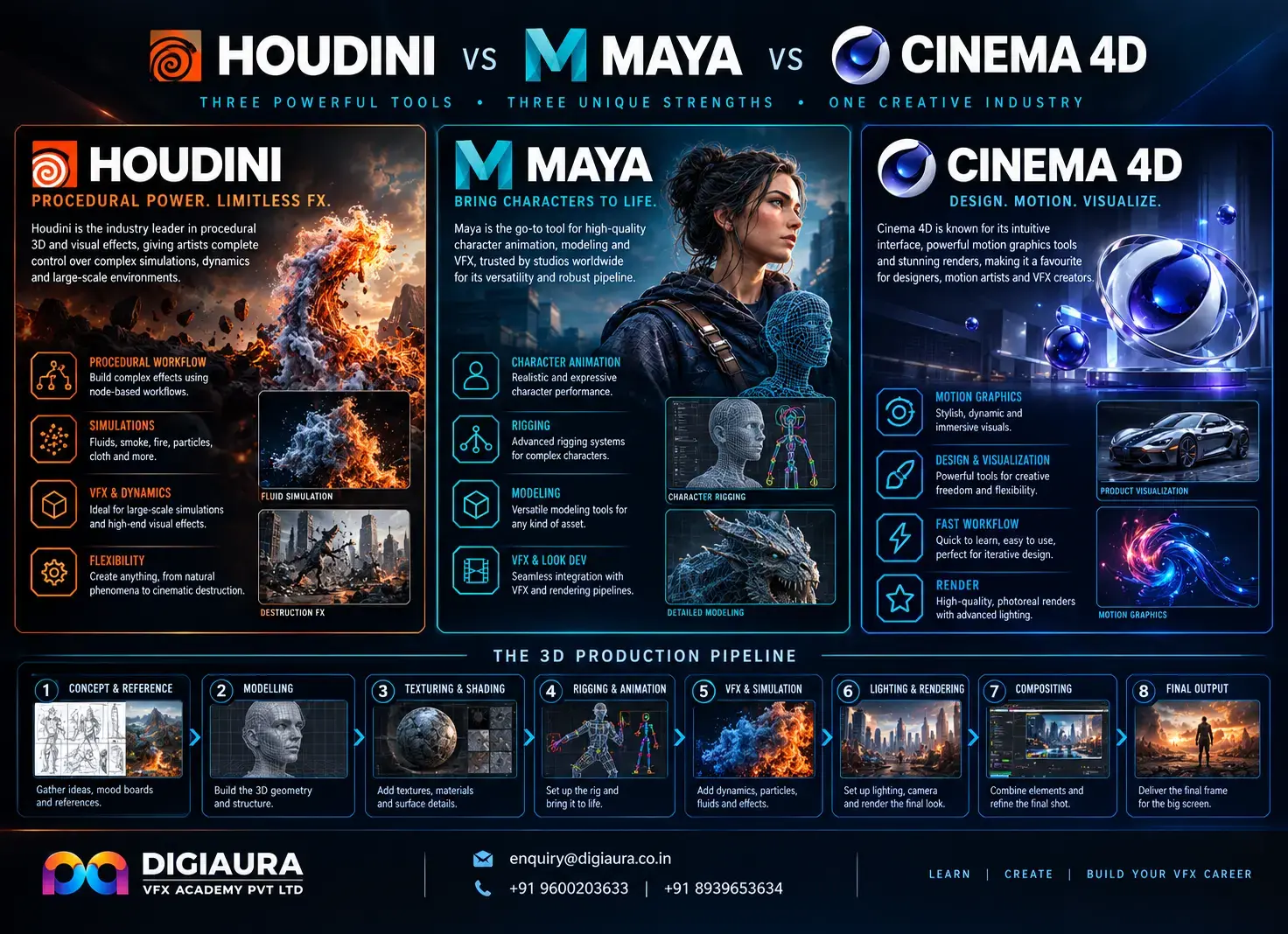
Houdini (SideFX) is the industry standard for FX simulation — fire, smoke, water, destruction, crowds, and procedural effects. It uses a node-based, procedural architecture where nearly everything is generated through networks of interconnected nodes. This makes it extraordinarily powerful and flexible, but steep to learn. Every major VFX studio uses it for FX work: ILM, DNEG, MPC, Weta Digital, Method Studios, PhantomFX. Houdini 22 was released in July 2026 with major new features including 3D Gaussian Splatting, KineFX rig templates, and the Copernicus texture toolset.
Autodesk Maya is the industry standard for character animation, rigging, and 3D modelling. It is the primary tool in film animation studios (Pixar, DreamWorks, Disney) and gaming companies (Electronic Arts, Blizzard, Ubisoft). Most game engines and film pipelines accept Maya's FBX and Alembic file formats natively. Its Arnold renderer is built-in and widely used for offline rendering. Maya is the highest-volume hire tool in India's VFX industry, appearing in 1,703 job listings on Foundit (Sep 2026).
Cinema 4D (Maxon) is the dominant tool for motion graphics and broadcast animation. Its MoGraph procedural toolset makes it uniquely suited for creating complex animated text, logo reveals, data visualisations, and broadcast graphics. It is widely used in advertising agencies, broadcast networks, YouTube motion designers, and commercial production houses. Cinema 4D Lite is bundled free with Adobe After Effects, making it the most accessible of the three tools for beginners already in the Adobe ecosystem.
| Feature | Houdini | Maya | Cinema 4D |
|---|---|---|---|
| Primary strength | FX simulation, procedural VFX | Character animation, rigging, pipeline | Motion graphics, broadcast, MoGraph |
| Learning curve | Steep (node-based procedural) | Moderate | Gentle |
| India job listings | 73 (Foundit, May 2026) | 1,703 (Foundit, Sep 2026) | 198 (Glassdoor, Oct 2026) |
| Entry salary India | ₹5–8 LPA | ₹2.5–4 LPA | ₹4–6 LPA |
| Senior salary India | ₹22–40+ LPA | ₹10–25 LPA | ₹10–18 LPA |
| Student / free option | Apprentice (free, watermarked) | Free (edu, renewable annually) | Lite free with After Effects |
| Indie / annual licence | USD 299/yr (Indie) | USD 330/yr (Indie) | USD 839/yr (Solo) |
| Top industries (India) | Film, OTT, gaming FX | Film, gaming, animation studios | Broadcast, advertising, YouTube |
| Latest version | Houdini 22 (Jul 2026) | Maya 2026 | Cinema 4D 2026 |
India Job Demand: Which Software Gets You Hired?
Job volume and job quality tell different stories for these three tools. Maya dominates raw listing volume. Houdini produces fewer listings but higher-value roles. Cinema 4D sits between the two but skews toward advertising and broadcast rather than film and OTT production.
India VFX job listings by software. Maya dominates volume; Houdini is a specialist premium-pay tool.
The disparity does not mean Houdini is a bad career choice — it means Houdini roles are concentrated, high-value, and competitive. Studios do not post dozens of Houdini FX openings because they cannot fill them with mediocre candidates the way they can fill roto pipelines. When a Houdini FX position opens at PhantomFX, DNEG India, or Makuta VFX, it commands ₹15–25 LPA for pyro and fluid simulation specialists, with senior Houdini artists earning ₹22–40+ LPA. The 73 Foundit listings represent premium positions, not low supply.
Salary Potential in India: What Each Specialisation Pays
Houdini mastery carries a 28% salary premium over the base VFX rate at the same experience level, according to Arena Animation Pune (August 2026), which aggregates AmbitionBox, Glassdoor, and LinkedIn salary data. PayScale India records an average of ₹3,22,774/year for FX Artists with SideFX Houdini skills (n=27, Oct 2024) — a figure pulled down by entry-level profiles; senior Houdini specialists are dramatically higher. The chart below shows the full entry-to-senior salary range for each software path.
India VFX salary range: entry (darker bar) to senior (lighter extension), by software specialisation.
The salary data shows a clear pattern: Houdini takes longer to master but delivers the widest salary ceiling. A senior Houdini pyro and fluid simulation artist working for an international outsourcing studio or on global productions can earn ₹22–40+ LPA — comparable to mid-level software engineers in India. Maya offers a faster entry, moderate ceiling, and the largest number of available roles. Cinema 4D's ceiling is lower in India's production studio context, but motion graphics freelancers billing international clients can substantially exceed the salaried figures above.
Houdini: The FX Simulation Standard
Houdini's procedural, node-based architecture makes it unlike any other 3D software. Every operation is non-destructive and programmable — a fire simulation is a network of connected nodes that can be adjusted, re-run, and saved as a reusable digital asset (HDA). This procedural approach is what makes Houdini indispensable for large-scale simulations that need to be art-directable without starting from scratch.
Use cases in production: Pyro simulation (fire, smoke, explosions), FLIP fluid simulation (water, lava, blood), rigid body destruction (RBD), cloth and hair simulation (Vellum), crowd simulation, procedural environment generation, and real-time VFX via the Houdini Engine plug-in (which integrates directly into Unreal Engine and Unity — making it increasingly valuable in gaming pipelines). Houdini 22 (July 2026) added 3D Gaussian Splatting support, making it the first major DCC to natively handle this emerging capture-to-3D format.
Industry adoption: 65% of large motion design studios (100+ artists) have integrated Houdini into their pipeline; 48% of mid-sized studios; 35% of freelancers — Artivoxa State of Houdini 2025. The Poliigon State of 3D 2024 survey (n=6,251 respondents) found that 70% of Houdini users use it professionally — the highest professional-use ratio among all 3D tools surveyed.
For Indian students: Houdini Apprentice is completely free for learning (non-commercial use, watermarked output, max 1920×1080 render). The Houdini Education licence ($95/year since July 2026) removes the watermark and adds FBX/Alembic export. Houdini Indie ($299/year) covers indie projects with revenue up to $100K/year. These accessible entry points make Houdini learnable without significant upfront cost — the barrier is time and dedication to the steep learning curve, not software access.
Autodesk Maya: The Animation and Pipeline Backbone
Maya is the generalist tool of the film and gaming industries. It handles character modelling, rigging (setting up the skeleton and controls that animators use), character animation (keyframe and motion capture), scene layout, lighting (with the built-in Arnold renderer), and rendering. It is the tool that connects every department — a character is modelled in Maya, rigged in Maya, animated in Maya, lit in Maya, and exported from Maya to the compositor.
Why Maya dominates job volume in India: The 1,703 Foundit job listings for Autodesk Maya (Sep 2026) reflect its use across the broadest range of VFX and animation roles — junior modellers, character animators, riggers, lighters, technical directors, and pipeline TDs all work in Maya. Every major VFX studio in India runs Maya in at least one department. Studios like MPC (Bangalore), DNEG India (Hyderabad), and PhantomFX (Chennai/Mumbai/Hyderabad) all use Maya as a core pipeline tool alongside Houdini for FX and Nuke for compositing.
For Indian students: Maya is free for students through Autodesk's Education programme (one-year renewable licence). Maya Indie ($330/year) is available for independent studios earning under $100,000 annually. For learners, Maya's interface is more conventional than Houdini — menus, viewports, and timeline are familiar to anyone who has used other 3D software. Most quality VFX training programs teach Maya as the foundational 3D tool before introducing Houdini for FX specialisation.
Cinema 4D: Motion Graphics and Broadcast Excellence
Cinema 4D's MoGraph procedural animation toolset is its defining advantage. MoGraph allows artists to create complex, motion-driven animations — hundreds of objects behaving and transforming in coordinated ways — using effectors and fields rather than hand-keyed animation. This makes it uniquely efficient for broadcast graphics, logo animations, title sequences, advertising, and the kind of design-driven motion work common in digital marketing and social media production.
Key facts: 87% of Cinema 4D users use it professionally — higher than any other 3D software including Maya (Poliigon State of 3D 2024, n=6,251). Redshift (bundled with Cinema 4D in the Maxon One subscription) captured 74.2% of all Cinema 4D render farm jobs in 2025, up from 46.4% in 2022 — based on analysis of 200,000+ real render jobs by Drop&Render (March 2026). Cinema 4D is also the software that motion designers most commonly use alongside After Effects for integrated 3D/motion work — and the Lite version bundled with Creative Cloud subscriptions gives any After Effects user immediate access to basic 3D capabilities.
For Indian students: Cinema 4D is the right choice if your target career is motion graphics for broadcast TV, advertising agencies, YouTube content studios, or brand design teams — not film VFX studios. Its entry barrier is low (Lite version is free if you have After Effects), its learning curve is the gentlest of the three tools, and its professional community and tutorial ecosystem are excellent. If you want to work on film or OTT VFX productions, Cinema 4D is a supplementary tool at best; Maya and Houdini are the pipeline standards.
Software Pricing in 2026: What It Costs to Learn Professionally
All three tools offer accessible student and indie entry points, but the professional licence gap is significant. Houdini and Maya are priced similarly at the indie level; Cinema 4D's Solo licence is three times more expensive at the indie tier. At the professional level, Houdini FX ($3,505/year) is the most expensive by a wide margin — studios absorb this cost, not individual students.
| Tier | Houdini | Maya | Cinema 4D |
|---|---|---|---|
| Free / Student | Apprentice — free, non-commercial, watermarked | Free (Autodesk Education, renewable annually) | Lite — free with After Effects CC |
| Education | USD 95/year — removes watermark, adds FBX/Alembic export | Free (edu programme) | USD ~80/year (Maxon One Edu) — includes Redshift |
| Indie | USD 299/year — revenue cap USD 100K | USD 330/year — revenue cap USD 100K | USD 839/year (Solo) |
| Professional | Core: USD 1,475/yr | FX: USD 3,505/yr | USD 2,010/year (no perpetual) | USD 839/yr Solo | USD 1,265/yr Maxon One |
All pricing in USD. Houdini Indie pricing per Shade.inc, October 2026. Maya per Autodesk.com. Cinema 4D per Drop&Render, April 2026.
The Recommended Learning Sequence for Indian VFX Students
Based on the job market data, salary trajectories, and industry adoption patterns above, the recommended sequence for most Indian VFX students targeting film and OTT productions is:
- Start with Maya. Highest job volume in India (1,703 listings), moderate learning curve, free for students, and teaches the 3D fundamentals — modelling, rigging, animation, and lighting — that apply across the entire pipeline. Maya gives you the broadest immediate employability. Most quality VFX programs teach Maya first.
- Add Houdini for FX specialisation. Once you have 6–12 months of Maya production experience, begin self-studying Houdini through the free Apprentice version. Focus on one simulation type initially — pyro (fire/smoke) or FLIP fluids — rather than trying to learn everything. The Houdini Education licence ($95/year) is a low-cost upgrade for serious students. This specialisation is what separates mid-level from senior-level salaries in Indian VFX studios.
- Learn Cinema 4D only if targeting motion graphics. If your career direction is broadcast design, advertising, digital marketing, or YouTube content creation rather than film VFX, Cinema 4D is a strong primary choice. Start with the free Lite version in After Effects and assess before purchasing a Solo licence. For film/OTT VFX students, Cinema 4D is a supplementary skill, not a primary one.
Students targeting the VFX career path over the animation path should prioritise Maya and Houdini. Students targeting the animation path (gaming, advertising, brand content) should prioritise Maya and then Blender or Cinema 4D depending on their sector. For a complete breakdown of VFX vs Animation career differences, salary data, and job market figures, see the VFX vs Animation guide.
Want structured training in Maya and the VFX pipeline?
DigiAura VFX Academy's programmes are built on industry-standard tools — the same ones used in Chennai, Mumbai, and Hyderabad studios. Students work on live production briefs from day one. Browse all DigiAura VFX courses → or talk to an admissions counsellor →