
Key Takeaways
- VFX had 6,478 active job listings on Foundit (July 2026) versus 3,015 for Animation — VFX has roughly 2× more specialist vacancies on India's leading job platform.
- At entry level, VFX leads: median ₹3.1 LPA vs ₹2.1 LPA for 3D Animation. At senior level (10+ yr), Animation overtakes: ₹9.5 LPA vs ₹5.1 LPA — PayScale India (n=65 VFX profiles, Feb 2026; n=97 Animator profiles, Feb 2025).
- India's Animation, VFX, and Post-Production segment generated ₹105 billion in 2025, growing 10% CAGR to ₹138 billion by 2028 — FICCI-EY 2026.
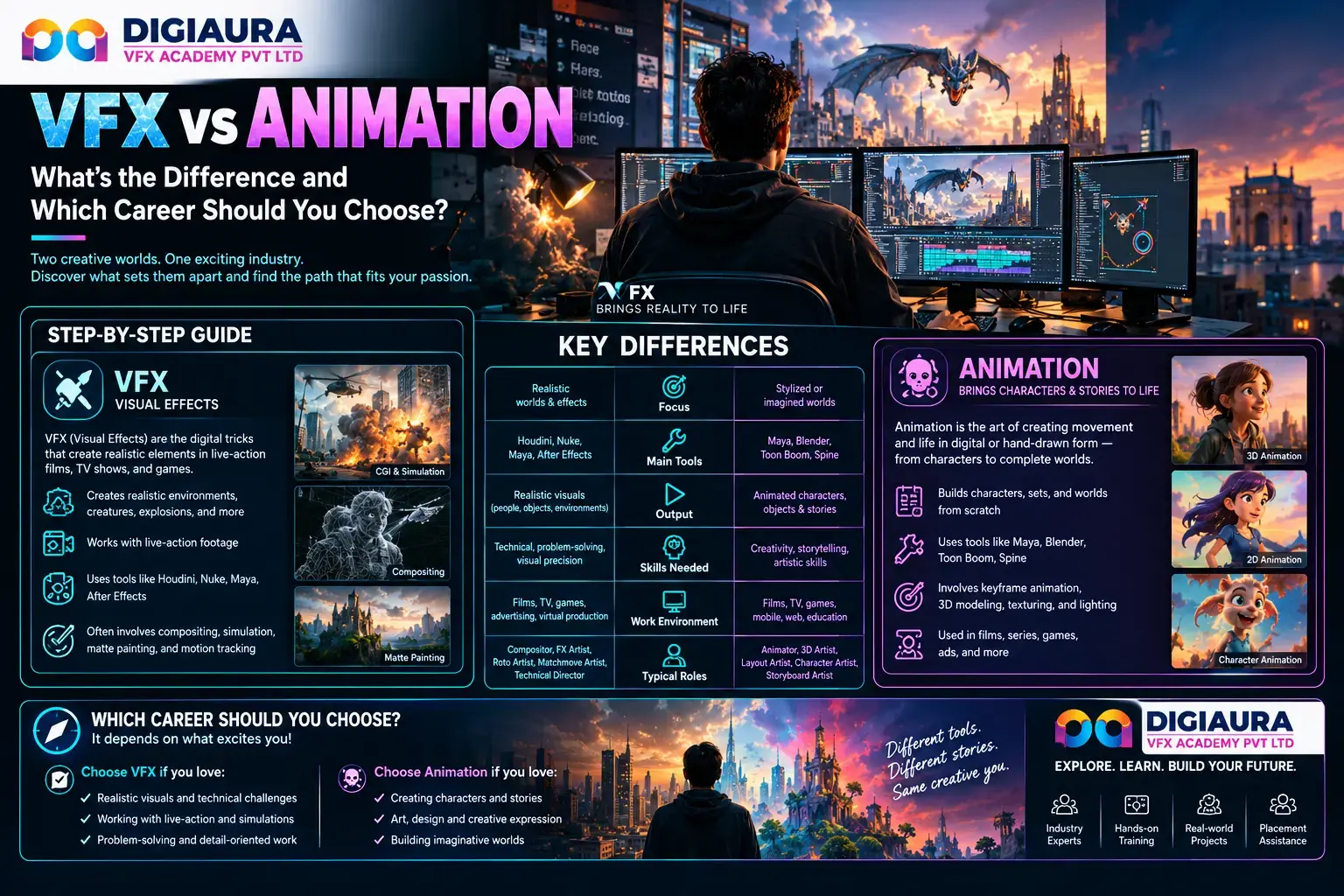
- VFX is more technically intensive (Nuke, Houdini, live-action footage). Animation is more artistically intensive (Maya, Blender, Toon Boom, character principles).
- Both careers are strong. The right choice depends on whether you want to enhance reality (VFX) or create worlds from scratch (Animation).
VFX (Visual Effects) manipulates or creates imagery on top of live-action footage — explosions, CG creatures, sky replacements, wire removal. Animation creates motion entirely from scratch, whether 2D hand-drawn sequences or 3D computer-generated characters. Both sit within India's ₹105 billion Animation, VFX, and Post-Production segment (FICCI-EY 2026), but they differ significantly in technical requirements, tool stacks, salary trajectories, and industry demand. This guide compares both careers across verified salary data, live job market figures, and the decision framework that matters most for Indian students choosing in 2026.
The Core Difference Between VFX and Animation
The simplest way to understand the distinction: VFX artists start with real footage and alter it. Animators start with nothing and build motion. A VFX compositor takes a plate shot of an actor on a green screen stage and adds a digital environment, a CG spaceship, and a particle explosion on top. An animator takes a digital character rig and uses software to make it walk, run, laugh, or fight — entirely within 3D software, with no live-action footage involved.
In practice, the two fields overlap — a VFX shot might include CG characters that were animated, and a game cinematic might require compositing — but the primary skill orientation differs. VFX leans technical: node-based compositing logic, camera solving, physics simulation, colour science. Animation leans artistic: timing, weight, appeal, character performance, and the 12 principles of animation first articulated by Disney animators in the 1930s that still govern the field today.
| Dimension | VFX | Animation |
|---|---|---|
| Core discipline | Compositing & altering live footage | Creating motion from scratch |
| Orientation | Technical-creative | Artistic-creative |
| Primary tools | Nuke, Houdini, Silhouette, AE, DaVinci | Maya, Blender, Toon Boom, TVPaint, C4D |
| Entry salary (India) | ₹3.1 LPA median | ₹2.1 LPA median |
| Senior salary (India) | ₹5.1 LPA median | ₹9.5 LPA median |
| Job vacancies (India) | 6,478 on Foundit (Jul 2026) | 3,015 on Foundit (Jul 2026) |
| Top industries | Film, OTT, broadcast, advertising | Gaming, advertising, ed-tech, YouTube |
| Course duration | 3 months – 2 years | 3 months – 3 years |
Salary data: PayScale India — VFX Artist (n=65, Feb 2026) and 3D Animator (n=97, Feb 2025). Job vacancies: Foundit.in, July 2026.
India Market Reality: Where VFX and Animation Stand in 2026
India's Animation, VFX, and Post-Production segment generated ₹105 billion in 2025 and is projected to grow at 10% CAGR to ₹138 billion by 2028 (FICCI-EY Report 2026). But the two segments within that total tell different stories.
VFX: recovering and growing. India's dedicated VFX segment reached ₹54 billion in 2023 (FICCI-EY 2024), contracted 14% to approximately ₹46 billion in 2024 as global studio budgets tightened, and is recalibrating to ₹48 billion in 2025–26. The recovery is supported by global outsourcing demand from studios like DNEG, Scanline VFX, and MPC, which expanded Indian operations through 2025–26. The standalone India VFX market was valued at USD 1.10 billion in 2025, growing to a projected USD 1.80 billion by 2034 at 5.58% CAGR — IMARC Group.
Animation: contracting from OTT cuts. India's animation segment contracted 6% in 2025 to ₹27 billion (down from ₹29 billion in 2024), following a 19% decline in 2024. The driver: Netflix and Apple TV+ reduced their animation production slates globally, from 15 titles in 2022 to approximately 5 by 2025 (FICCI-EY 2025 via AnimationXpress). This has a direct impact on the studio-based animation job market, though gaming and advertising animation has partially offset the decline. Students evaluating animation should factor this into their decision — demand is more sector-dependent than VFX.
The honest picture: both fields have genuine career potential, but VFX currently has more active job openings and is recovering faster. Animation offers stronger long-term salary upside at senior levels and broader sector diversity (gaming, ed-tech, advertising) that makes it more resilient to any single platform cutting its slate.
Salary Comparison: VFX vs Animation in India
VFX artists earn more at entry and early-career stages. 3D animators overtake significantly at senior levels. This salary crossover is one of the most important and least-discussed facts in VFX vs animation career comparisons for Indian students. PayScale India data (VFX Artist: n=65, Feb 2026; 3D Animator: n=97, Feb 2025) shows the full progression.
VFX Artist vs 3D Animator median annual salary by career stage, India. PayScale India, 2025–2026.
The crossover at mid-career matters: at the 5–9 year mark, a 3D animator (₹6.0 LPA) earns more than a VFX artist (₹5.0 LPA). At senior level (10+ years), the gap widens sharply — ₹9.5 LPA for 3D animators versus ₹5.1 LPA for VFX artists. This likely reflects the higher premium for character animation leads and animation directors in gaming and premium content studios, where senior animators command salaries comparable to senior software engineers. By comparison, senior VFX artist median data is compressed because the wide range of VFX roles (from roto artists to VFX supervisors) averages down; VFX supervisors individually earn ₹9–18 LPA at studios like DNEG (GUVI / AmbitionBox 2026).
Job Market in India: VFX vs Animation Vacancies in 2026
VFX has roughly double the specialist job listings of animation on India's leading job platforms. Foundit (India's largest job aggregator) listed 6,478 VFX vacancies versus 3,015 animation vacancies in July 2026. This reflects VFX's concentration in film and OTT production pipelines, where specific roles — roto artist, compositor, matchmove artist — are posted as distinct job categories with high turnover and volume. Animation roles, while fewer on specialist VFX platforms, appear in higher volume on broader platforms — LinkedIn listed 5,000+ animator roles in India, spanning gaming studios, advertising agencies, ed-tech companies, and social media content studios.
Active job listings: VFX vs Animation, India. Foundit.in, July 2026.
The vacancy gap does not mean animation has poor job prospects — it means VFX roles cluster on specialist platforms while animation roles are distributed across more varied sector-specific boards (gaming: LinkedIn, Naukri Gaming; ed-tech: AngelList, company careers pages; advertising: specialised creative portals). For an Indian student evaluating immediate employability after training, VFX has a clearer and higher-volume entry-level pipeline. For a student thinking about a 10-year career arc across multiple sectors, animation's sector diversity is a meaningful advantage.
Tools and Software: VFX vs Animation
The tool stacks don't overlap much, which is why switching between the two fields mid-career requires retraining.
VFX tool stack: Nuke (node-based compositing — industry standard for film and OTT), Houdini (FX simulation: fire, water, destruction, crowds), Silhouette (rotoscopy and paint), After Effects (motion graphics and broadcast compositing), DaVinci Resolve (colour grading), 3DEqualizer or SynthEyes (matchmove/camera tracking), Mocha (planar tracking). Entry-level positions typically require Silhouette + Nuke basics. Senior VFX roles often require Houdini for FX simulation — the single highest-premium skill in the VFX job market in India.
Animation tool stack: Autodesk Maya (3D character animation — industry standard for film and gaming), Blender (open-source 3D and 2D, increasingly used in gaming and indie production), Toon Boom Harmony (2D animation for TV and feature film), TVPaint (frame-by-frame 2D), Cinema 4D (motion graphics and broadcast animation), Adobe Animate (web and interactive), 3ds Max (architectural and product visualisation). Entry-level 3D animation positions typically require Maya. 2D animation requires Toon Boom Harmony for studio work or Adobe Animate for digital/web.
The key difference: VFX tools are almost entirely proprietary and studio-specific (Nuke costs USD 6,800+ per perpetual licence; Houdini Indie costs USD 269/year). Animation tools include viable free alternatives — Blender is production-capable and free, and is increasingly used by gaming studios and independent animators. This makes animation training more accessible for self-learners, but Nuke and Houdini remain the hiring benchmark for VFX studio positions in India.
Career Paths: Where Each Field Takes You
VFX career progression: Roto Artist → Paint / Cleanup Artist → Matchmove Artist → Junior Compositor → Compositor → Compositing Lead → VFX Supervisor → VFX Producer / VFX Director. The roto-to-compositor path is the most common entry route in India and can progress from entry to lead compositor in 4–6 years with consistent output quality. VFX Supervisors at DNEG India earn ₹4.8–19.2 LPA; Houdini FX specialists earn ₹8–20 LPA at mid-career.
Animation career progression: Junior Animator → Animator → Senior Animator → Animation Lead → Animation Director → Creative Director. In gaming studios, the track often includes Rigger → Technical Animator → Lead Technical Animator as an alternative path for students with more technical aptitude. Senior animators at gaming studios (which are the primary growth segment of India's AVGC sector — growing at 12% CAGR) and at international outsourcing studios command the ₹9–15 LPA senior salaries reflected in PayScale data.
Which Industries Hire VFX Artists vs Animators?
VFX artists are hired by: Feature film studios (Bollywood VFX vendors, Hollywood outsourcing houses), OTT platform content (Netflix India, Amazon Prime Video, Disney+ Hotstar — every original title requires VFX work), broadcast television (news channels, sports production), advertising agencies (product VFX, car commercials, FMCG), and gaming companies (real-time VFX for environments and effects). The film and OTT pipeline is the dominant employer.
Animators are hired by: Gaming studios (the single largest growth segment — character animation, cutscenes, in-game animation), advertising and branded content (explainer videos, motion graphics for digital ads and social media), education and ed-tech (e-learning animation, explainer videos for platforms like BYJU's, Unacademy), YouTube content studios, architectural and product visualisation firms, healthcare (medical animation, patient education), and streaming OTT platforms for original animated content. Gaming is the most resilient sector for animators in 2026 given the OTT animation contraction.
Freelance Potential: VFX vs Animation
Both fields have strong freelance potential in India, but the type of freelance work differs.
VFX freelancers typically work on per-project contracts for film productions, advertising shoots, and regional OTT content. Nuke compositors and Houdini FX specialists are particularly sought after on freelance platforms — international clients pay 3–5× domestic rates for verified Houdini expertise. Senior freelance VFX artists report earning ₹22–40 LPA equivalent when billing international clients directly through platforms like Upwork or Fiverr Pro. The barrier: building a strong enough reel and industry reputation to attract international work takes 3–5 years of studio employment first.
Animation freelancers have a broader and faster-growing market in India's digital content economy. Motion graphics designers, explainer video animators, and social media reels artists can build a client base faster through platforms like Fiverr, Upwork, and direct Instagram/LinkedIn outreach. 2D animation for YouTube channels, brand explainer videos, and educational content are high-demand categories with consistent freelance work. Character animators for gaming are less commonly freelance — gaming studios prefer full-time artists integrated into their pipelines.
How to Decide: A Framework for Indian Students
The right choice depends on four honest self-assessments:
- Technical vs. artistic aptitude. Do you enjoy solving visual problems through logic and software systems (node graphs, physics simulations, colour science)? VFX. Do you prefer performance, observation, and making characters feel alive through timing and weight? Animation.
- Short-term vs. long-term salary optimisation. If you want the highest possible salary in your first 1–3 years of work, VFX has a higher entry floor (₹3.1 LPA median vs ₹2.1 LPA). If you are willing to invest 8–10 years into deep specialisation, senior animators out-earn senior VFX artists at the median level (₹9.5 vs ₹5.1 LPA).
- Sector preference. Want to work on films and OTT productions? VFX is the dominant pipeline. Want to work across gaming, advertising, ed-tech, and brand content? Animation gives you more sector flexibility and resilience to any single industry downturn.
- Speed to first job. The roto artist entry point in VFX (3-month certificate) is the fastest path to employed status in India's creative industries. Entry-level animation roles take longer to fill because studios expect a stronger portfolio of animation principles, which requires more training time. The VFX pipeline has more fresher-volume roles and clearer skill requirements at the entry level.
If you are still undecided, the VFX career after 12th guide covers the specific entry pathways, salary data, and government policy context for VFX in India in more depth. India's AVGC sector currently employs 2.6 lakh people and the government's national AVGC Task Force targets 20 lakh professionals by 2030 (PIB, December 2022 / IBEF, August 2024) — creating significant hiring headroom in both disciplines over the coming decade.
Not sure which path fits your profile?
DigiAura VFX Academy in Chennai offers courses across both VFX and motion graphics — and our admissions team can help you match your aptitude and goals to the right programme. Talk to a DigiAura counsellor → or browse all courses →