
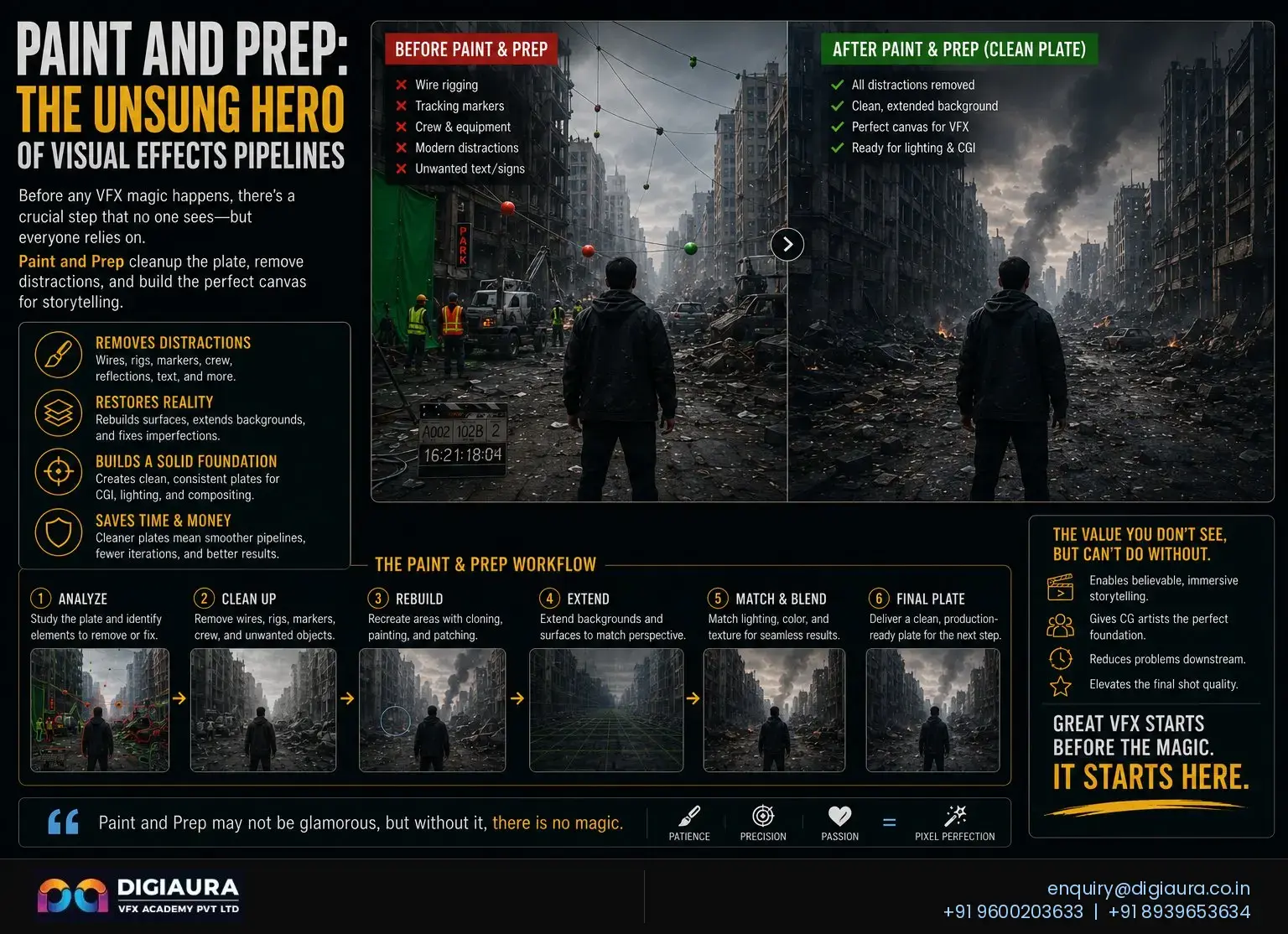
Every film you have ever watched in a cinema contains invisible work that the audience is never meant to notice. Before the compositor adds starfields, explosions, and digital creatures, a separate department must remove every trace of the physical production from the raw camera footage: the safety wires that kept a stunt performer from hitting the floor, the tracking markers taped across a car bonnet, the camera rig that crept into the edge of a frame, the boom microphone shadow that fell across an actor's face, the blemish that makeup could not cover, and the lens dust that appeared between two takes. This invisible labour is called paint and prep, and it is one of the most foundational disciplines in every professional VFX pipeline. Learn paint and prep professionally at DigiAura VFX Academy
Key Takeaways
- Paint and prep is the VFX department that digitally removes wires, rigs, tracking markers, lens dust, skin blemishes, and every other production artefact from live-action footage before compositing begins.
- The discipline covers wire and rig removal, beauty work and de-aging, clean plate creation, tracking marker removal, dust busting, and background object removal.
- Paint and prep is distinct from rotoscoping: roto produces silhouette masks, while paint physically replaces or removes unwanted pixels from the footage itself.
- The two industry-standard tools are Foundry Nuke (RotoPaint node) and Boris FX Silhouette. Mocha Pro handles tracking-assisted removal, and Autodesk Flame is used at high-end finishing facilities.
- AI tools like Adobe Content-Aware Fill for Video and Runway ML are automating simpler removal tasks, but complex shots continue to require trained human artists.
- Junior paint prep artists in India earn Rs 3 to 6 LPA. Senior artists with five or more years of experience earn Rs 10 to 15 LPA. India processes paint prep work for major studios in London, Los Angeles, and Tokyo.
What Is Paint and Prep in VFX?
Paint and prep is the VFX department responsible for digitally cleaning live-action footage before it reaches the compositing stage. Artists in this department identify and remove every artefact that the production introduced into the image: physical safety equipment, set dressing that overflowed into the background, continuity errors between takes, and any optical imperfection introduced by the camera or the environment on set. The result of all this work is footage that looks as though it was captured in a perfectly controlled environment, even when it was not.
The name describes the dual function of the role. "Paint" refers to the act of digitally painting over or cloning out unwanted elements using raster paint tools. "Prep" refers to the preparatory nature of the work: this department processes the footage so that it is clean, stable, and ready for the compositor to use. In many studios, especially across India and the United Kingdom, the department is simply called the prep department, and the people working in it are called prep artists or paint and prep artists.
Paint Prep vs Rotoscoping: Understanding the Difference
Paint and prep is frequently confused with rotoscoping because both disciplines deal with isolating or modifying elements in footage and both use overlapping toolsets. The distinction is fundamental. Rotoscoping produces an alpha matte, a silhouette mask that tells compositing software which pixels belong to the foreground subject. Paint and prep physically replaces, removes, or reconstructs the pixel content of the image itself. A roto artist creates the mask; a paint artist removes what should not be there. For a deeper understanding of rotoscoping, see our guide to how movies remove backgrounds without green screen.
On smaller productions, one artist may perform both tasks on the same shot. In larger studios, the two departments are separate teams that hand deliverables to each other in a defined pipeline sequence: the roto department provides alpha mattes, and the paint department uses those mattes as a guide for its removal and cleanup work. Both departments feed their deliverables to the compositing department downstream.
| Aspect | Paint and Prep | Rotoscoping |
|---|---|---|
| Primary output | Cleaned footage with unwanted pixels replaced | Alpha matte (silhouette mask sequence) |
| Primary tool type | Raster paint, clone, and projection tools | Vector spline shapes animated over time |
| What it removes | Physical artefacts from the image content | Nothing. It creates a selection mask only |
| Pipeline position | After roto, before compositing | After tracking, before paint and compositing |
| Core skill | Colour matching, texture reconstruction, paint blending | Shape accuracy, edge quality, temporal consistency |
Where Paint and Prep Sits in the VFX Pipeline
Understanding where paint and prep sits in the production pipeline clarifies both what the department receives and what it delivers. The typical VFX pipeline runs in this sequence: on-set capture, data management, matchmove and tracking, rotoscoping, paint and prep, compositing, colour grading, and final delivery. Paint and prep sits in the middle of this chain. It receives raw or roto-processed footage and delivers cleaned plates and repaired image sequences to the compositing department.
This position carries a critical implication: every artefact that the paint department fails to remove will be visible in the final composite. Conversely, every successful removal simplifies the compositor's job significantly. Paint and prep functions as the quality gate between on-set reality and the digital environment that compositors construct. A compositor working with clean, prep-approved footage can focus entirely on creative integration. A compositor working with unprepped footage must simultaneously manage production artefacts and compositing problems, which degrades the quality and consistency of the final result.
Wire and Rig Removal: The Most Recognised Paint Task
Wire removal is the paint task most people outside the industry associate with VFX cleanup work. Stunt performers wear harnesses and are suspended from thin wires to perform actions that would otherwise be physically impossible or dangerous: flying scenes, superhero leaps, martial arts fights where the performer is propelled through the air, and any action sequence where the risk to the performer must be managed through physical rigging. After filming, every wire visible in every frame of every shot must be digitally painted out before the scene can be used in the final film.
The challenge of wire removal is not the wire itself but the complexity of what lies behind it. A wire crossing an open blue sky is a relatively straightforward clone operation. The same wire crossing a textured brick wall with depth variation, passing in front of an actor's face, threading through motion blur, or entering and exiting the frame multiple times within a single shot creates a significantly more complex problem. The paint artist must reconstruct the background information the wire is obscuring, frame by frame, ensuring that the reconstruction blends seamlessly with the surrounding pixels in colour, texture, film grain, and apparent motion.
Citation Capsule: Wire removal is one of the oldest and most labour-intensive paint tasks in visual effects. In one second of footage at 24 frames per second, a wire removal artist must inspect and address every wire occurrence in 24 individual frames. For a five-second stunt sequence with multiple wires, that can represent several hundred individual paint operations before the shot is considered clean. Source: BeverlyBoy.com, What Is Wire Removal in VFX?
The Wire Removal Process Step by Step
- Shot assessment. The paint artist reviews the entire shot before beginning work, identifying how many wires are present, where they enter and exit the frame, which frames present the most challenging background interaction, and whether any wires cross over skin, hair, or other surfaces requiring careful texture reconstruction.
- Motion tracking. Many studios use Mocha Pro or the Nuke tracker to track the 2D position of the wire across the shot. This data automates the gross movement of the replacement patch so the artist refines rather than repaints every frame from scratch.
- Background reference identification. The artist identifies frames or areas of the shot where the background behind the wire is visible and undistorted. This reference material is the source for reconstructing what the wire is covering in occluded frames.
- Paint the removal. Using clone tools, projection techniques, or retimed clean frames as a source, the artist paints out the wire across the shot. The grain structure and colour response of the reconstructed area must match the surrounding image so the repair is invisible at full resolution on a calibrated monitor.
- Quality control review. The completed sequence is rendered and reviewed at full resolution, looped at normal playback speed, and inspected for flickering, inconsistent texture, or any frame where the wire remains partially visible through the repair.
- Delivery to compositing. The cleaned image sequence, typically as 16-bit or 32-bit EXR files, is passed to the compositing department with any notes about challenging areas that may benefit from additional attention in the composite.
Famous Wire Removal Examples in Film
The Matrix (1999) required the removal of hundreds of wires used to achieve the bullet-dodge sequences and fight choreography that defined the film's visual language. Every wire was painted out frame by frame without the AI tools available today. The Spider-Man films used extensive wire removal for web-swinging sequences filmed on practical New York locations. Marvel Cinematic Universe productions regularly employ dedicated wire removal teams for action sequences filmed on both controlled stages and practical locations. In Indian cinema, recent large-scale productions including Kalki 2898-AD and RRR required substantial wire removal work for their action sequences, processed in part by Indian VFX facilities.
Beauty Work and Digital Cosmetics
Beauty work, also called digital cosmetics in some facilities, is the use of VFX paint techniques to refine or alter an actor's on-screen appearance. The concept covers a broad spectrum of tasks: at its simplest it means removing a temporary blemish or glare from a forehead on a close-up. At its most complex it encompasses full de-aging, where an actor's facial skin texture is replaced across thousands of frames to make them appear decades younger than they currently are.
Beauty work is particularly demanding because the standard required is extremely high. The audience must have no awareness that any correction was made. A wire removal that is 95% successful is still detectable. A skin retouching job that gives even a slight impression of digital smoothing will be noticed immediately by audiences sensitive to manipulation. Paint artists who specialise in beauty work develop a nuanced understanding of how skin texture behaves under different lighting conditions, how to preserve natural pores and micro-movements that give performance its emotional depth, and how to ensure corrections are consistent across multiple camera angles and takes of the same scene.
Skin Retouching and Continuity Repairs
Skin retouching at the feature film level is fundamentally different from retouching in still photography. A photograph is a single frame. A 90-second close-up scene runs at 24 frames per second, producing 2,160 individual frames. Every frame must be corrected consistently, with the correction tracking the natural movement of the actor's skin, shifts in lighting as the actor moves, and the grain structure of the camera sensor. A correction that looks natural on frame one must look equally natural on frame 2,160.
Continuity errors are another major source of beauty work requests. If an actor's hairstyle differs slightly between two takes that will be cut together, the paint department may be asked to normalise the digital hair to match. If a costume accessory present in one take is missing in the reverse angle, paint artists reconstruct it. If an actor's face is more flushed from exertion in the closer shot than in the wider establishing shot, the paint department normalises the skin tone across all related cuts to make the edit invisible.
De-aging: The Most Complex Beauty Task
De-aging takes beauty work to its most technically demanding extreme. When a film requires an actor to appear 20 or 30 years younger than their current age, the paint and compositing departments collaborate to replace the actor's facial skin texture with a younger version, either filmed specifically for the purpose or constructed from historical reference material. The de-aging process requires precise face tracking across every frame, high-quality replacement texture that responds correctly to the lighting on set, and careful blending at the hairline, jaw, and neck boundaries where the replacement meets the original footage.
De-aging was used to striking effect in The Irishman (2019), where Robert De Niro, Al Pacino, and Joe Pesci were aged down across hundreds of scenes. Captain Marvel (2019) de-aged Samuel L. Jackson throughout the entire film. Ant-Man (2015) opened with a de-aged Michael Douglas in a pivotal scene. Each of these productions required months of dedicated paint and compositing work to achieve results that hold up at theatrical resolution and under repeated home viewing.
Citation Capsule: Digital de-aging in films like The Irishman involved frame-by-frame skin texture replacement across long, dialogue-heavy scenes. The defining challenge of de-aging is not removing wrinkles but preserving the actor's natural performance and the micro-expressions that give their face emotional depth, frame by frame, without any visible correction at theatrical resolution. Source: Outpost VFX, De-ageing in Film (2024).
Clean Plates: The Compositor's Foundation
A clean plate is one of the most important deliverables the paint and prep department produces. It is a version of a shot from which all foreground subjects and production artefacts have been removed, leaving only the background exactly as it appeared on set. The compositor uses a clean plate as a pixel-accurate reference to fill in background information behind moving subjects, remove wire rigs, replace skies, and integrate CG environments and characters into the scene.
Why Clean Plates Are Essential
Without an accurate clean plate, the compositor has nothing accurate to sample when reconstructing background areas occluded by subjects or production elements. The compositor must estimate what the background looks like in those areas, which produces inaccuracies at full resolution or during motion. With a clean plate, the compositor has a per-pixel reference for every part of the background, enabling seamless integration that holds up under close inspection and repeated viewing.
Clean plates are created in three ways. The ideal method is for the production to shoot a dedicated clean plate pass on set: the camera holds its position after the main take and records the background with no performers or props in frame. When no clean plate pass was shot, the paint artist constructs one by painting out all subjects across multiple frames and patching background areas from different moments when those areas are momentarily visible. The third method uses 3D projection techniques to reconstruct the background geometry and re-render a synthetic clean plate that matches the camera perspective.
How to Create a Clean Plate in Nuke
In Foundry Nuke, the standard clean plate workflow uses the RotoPaint node in combination with a roto matte that isolates the foreground subject. The artist uses the matte to understand precisely which pixels need replacement, then samples background information from frames where those pixels are visible and unoccluded. Merge operations, TimeWarp nodes, and FrameHold nodes provide access to background information from different moments in the shot. The patched result is colour-corrected with the Grade node to match the surrounding area, and grain is normalised using Nuke's grain tools before the clean plate is rendered as an EXR sequence for compositing delivery.
Tracking Marker Removal and Dust Busting
Tracking markers are the coloured dots, crosses, and tape squares that on-set crews apply to actors, vehicles, and set surfaces to give the visual effects department precise reference points for camera and object motion tracking. Every marker that was applied on set and captured on camera must be removed from the footage before compositing. On complex CG-heavy shots, a single frame may contain dozens of markers distributed across the subject and background surfaces.
Marker removal follows a similar workflow to wire removal. The artist uses tracking data, often from the same Mocha Pro planar track used for matchmove, to animate a replacement patch over each marker position, then blends the replacement into the surrounding texture and colour. Markers on flat uniform surfaces are straightforward. Markers applied to skin, hair, or textured fabric require careful texture reconstruction and grain matching to ensure the patch is invisible on close inspection.
Dust busting refers to the removal of physical dust specks, lint, lens flare artefacts, and sensor noise anomalies from camera footage. On productions filmed on 35mm film, dust on the negative or scanning equipment was a persistent source of cleanup work, with entire departments dedicated to frame-by-frame dust removal. On modern digital productions, dust on the lens or sensor creates similar problems, and high-contrast scenes reveal contamination more readily than low-contrast images. Paint artists who handle dust busting develop a systematic, efficient approach to finding and removing artefacts across long image sequences without missing any occurrences.
The Software Stack for Paint and Prep Work
Paint and prep artists work in a defined set of professional applications. The choice of tool depends on the studio's established pipeline, the complexity of the work, and whether the artist is at a large facility with purpose-built infrastructure or at a smaller studio with a generalised compositing setup. Understanding the software landscape is essential for anyone training for a career in this discipline.
| Software | Primary Use | Architecture | Best For |
|---|---|---|---|
| Foundry Nuke (RotoPaint) | Compositing and integrated paint | Vector and raster hybrid | Studios running Nuke pipelines; paint integrated with compositing |
| Boris FX Silhouette | Dedicated roto and paint application | Raster-based paint engine | High-resolution, high-frame-count paint; large-volume roto and prep work |
| Mocha Pro (Boris FX) | Planar tracking and assisted removal | Planar motion analysis | Wire removal on complex backgrounds; tracked marker and rig removal |
| Autodesk Flame | High-end finishing and conform | GPU-accelerated paint and effects | Broadcast, advertising, and high-end feature film finishing facilities |
| Adobe After Effects (Content-Aware Fill) | AI-assisted object removal | AI content synthesis | Simple object removal on uniform backgrounds; quick turnaround projects |
Boris FX Silhouette celebrated its 20th anniversary in 2025, and the application has been used on productions including Deadpool and Wolverine, Dune, Barbie, and 3 Body Problem. Silhouette's raster-based paint engine handles high frame counts and high resolutions more efficiently than Nuke's RotoPaint node on shots that require thousands of individual brush strokes. Many Indian studios train their prep teams in Silhouette specifically because the per-seat cost is lower than a full Nuke compositing licence while providing paint and roto capabilities purpose-built for this type of work. DigiAura's rotoscoping and paint prep curriculum covers both Silhouette and Nuke.
AI in Paint and Prep: Automation and What It Cannot Replace
Artificial intelligence entered the paint and prep workflow primarily through tools like Adobe Content-Aware Fill for Video, Runway ML, and AI-powered modules built into Silhouette itself. These tools use neural networks trained on large image datasets to automatically synthesise replacement content for masked areas, eliminating the need for frame-by-frame manual painting on simpler removal tasks.
The realistic scope of AI automation in 2026 is significant but well-defined. On shots where an unwanted object sits against a simple, predictable background such as open sky, flat colour walls, or static ground, AI tools can produce high-quality removal results in a fraction of the time a human artist would require. On these simpler shots, the paint artist's role shifts from execution to supervision: reviewing the AI output, correcting any synthesis artefacts, and approving the result before delivery. The volume of shots that AI can handle well continues to increase as the underlying models improve.
The shots that AI cannot handle reliably in 2026 include any removal requiring understanding of three-dimensional background structure, the interaction of light and shadow across moving surfaces, complex organic texture reconstruction across hair or skin, and multi-frame temporal consistency across long shots. Wire removals crossing an actor's moving face, beauty work at feature-film quality, and de-aging all remain tasks that require trained human artists. VFX supervisors consistently describe AI as a productivity tool that enables experienced paint artists to handle higher shot volumes, rather than a technology that eliminates the need for the discipline or its practitioners.
Citation Capsule: AI-powered paint tools can automate removal on simpler backgrounds, but complex wire removals across hair, skin, and textured environments continue to require trained paint artists in 2026. The technology accelerates the workflow without eliminating the expertise required to supervise, correct, and deliver feature-quality results. Source: ActionVFX, Top AI Tools for VFX Workflows (2025).
Building a Paint and Prep Career in India
India is one of the world's largest processing hubs for paint prep, roto, and compositing work. Approximately 70% of Indian VFX studio revenue comes from international partnerships, with major studios in London, Los Angeles, and Tokyo regularly outsourcing high-volume prep and roto work to Indian facilities in Mumbai, Chennai, Hyderabad, and Bangalore. The Indian VFX market reached USD 1.00 billion in 2024 and is projected to grow to USD 1.70 billion by 2033, according to IMARC Group research, maintaining consistent demand for trained paint prep professionals throughout the growth period.
Paint and prep is an accessible entry point into the VFX industry because it does not require a traditional fine arts or engineering degree. What it does require is strong observational precision, the ability to identify artefacts and match colour and texture at a pixel level, discipline for sustained frame-by-frame attention across long image sequences, and proficiency in at least one industry-standard paint tool. Many of India's most experienced VFX artists began their careers as paint prep artists before progressing into compositing, matte painting, and VFX supervision roles.
| Experience Level | Years of Experience | Salary Range in India | Key Responsibilities |
|---|---|---|---|
| Intern / Trainee | 0 to 6 months | Rs 1.4 to 1.7 LPA | Simple dust busting, marker removal, assisted wire removal on straightforward shots |
| Junior Paint Artist | 0 to 2 years | Rs 3 to 6 LPA | Wire removal, rig removal, clean plate construction on standard complexity shots |
| Mid-level Paint Artist | 3 to 5 years | Rs 7 to 10 LPA | Complex wire removal, beauty work, de-aging assistance, shot supervision responsibilities |
| Senior Paint Artist | 5 or more years | Rs 10 to 15 LPA | Full de-aging, team supervision, QC leadership, complex beauty work and client reviews |
Maharashtra's Rs 3,268-crore AVGC-XR policy launched in September 2025 targets the creation of 200,000 new jobs in the animation, VFX, gaming, and XR sectors, which will further accelerate demand for trained paint prep artists across the country. Chennai, where DigiAura VFX Academy operates, is a growing hub for trained VFX talent, with studios including Prime Focus and NY VFX Waala regularly recruiting from the local trained workforce.
Start Your Paint and Prep Career at DigiAura
DigiAura VFX Academy offers a structured paint and prep training programme covering Nuke RotoPaint, Boris FX Silhouette, Mocha Pro, wire removal, clean plate creation, beauty work, and career placement support for the Indian VFX market.
Explore the Paint and Prep CourseConclusion: The Art of Invisibility
Paint and prep artists succeed when their work is completely invisible. There are no credits that read "wires removed by" on a cinema screen, no highlight reel of before-and-after corrections shown to the audience, and no obvious artistic signature the artist can point to. The discipline is defined entirely by its invisibility: if the audience cannot detect that any paint work was done, the artist has achieved a perfect result.
That invisibility is also the discipline's most undervalued quality. Every wire that remains in a shot, every tracking marker that appears on an actor's skin, every dust speck that flickers across a lens is a defect that breaks the audience's immersion in the story. Paint and prep artists are the people who ensure that the production apparatus which brought a scene into existence disappears completely, leaving only the narrative. In a pipeline filled with high-profile technical disciplines, paint and prep is genuinely the unsung hero that makes everything else possible.
For a related discipline that works closely with paint and prep, read our guide to rotoscopy and how movies remove backgrounds without green screen.