
Key Takeaways
- India's AVGC-XR sector employs 2.6 lakh (260,000) professionals across 4,000+ studios and generates USD 3 billion annually — Government of India / NASSCOM data.
- 3,592 active VFX job vacancies in India as of August 2026 — Naukri.com.
- Any 12th-pass student — Science, Arts, or Commerce — can enroll in VFX courses. No entrance exam or stream restriction applies to certificate and diploma programs.
- VFX Artist entry-level median salary: ₹3,05,082/year (<1 yr experience); mid-career (5–9 yr): ₹5,00,152/year — PayScale, February 2026 (n=65 profiles).
- Tamil Nadu AVGC-XR Policy 2026 (notified 12 March 2026) targets 2 lakh VFX and animation jobs by 2030, with ₹50 crore allocated for Chennai's ELCOT Viyan Centre of Excellence.
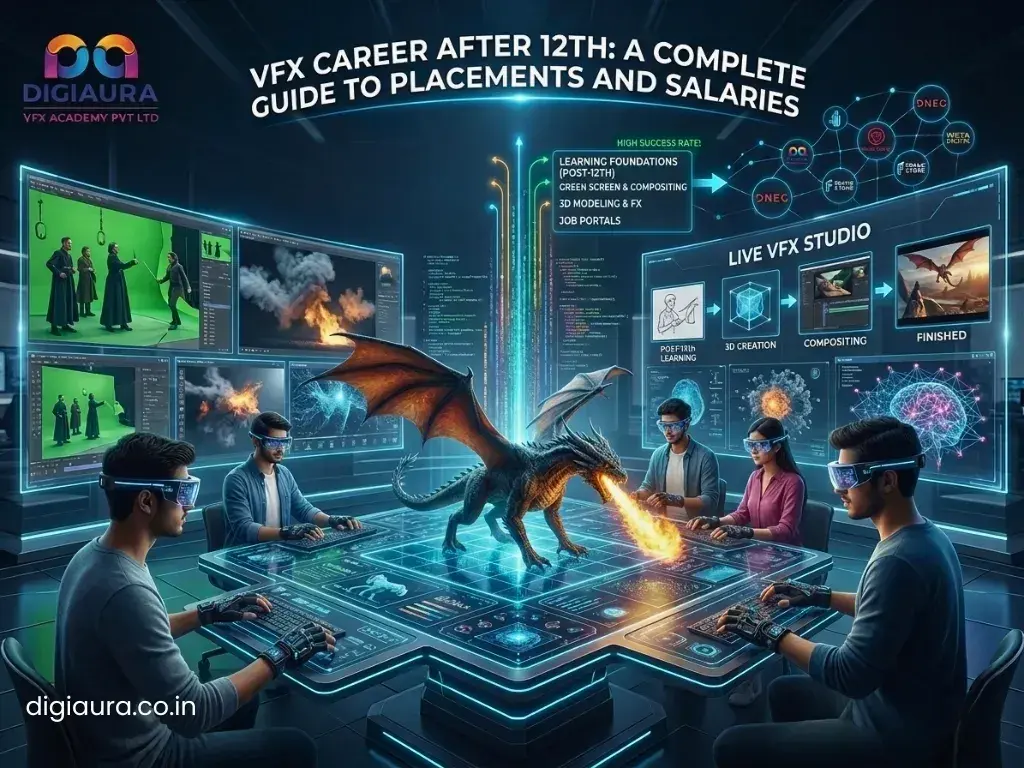
If you have just finished your 12th boards and are considering a VFX career, the direct answer is: yes, you can start right now, regardless of whether you studied Science, Commerce, or Arts. India had 3,592 active VFX job vacancies in August 2026 (Naukri.com), government policy at both state and central levels now funds VFX skill development, and certificate programs can put you on a production floor within 3 to 12 months. This guide covers everything a 12th-pass student needs to know — courses, eligibility, salaries, job market data, and what separates candidates who get hired from those who don't. Explore VFX courses at DigiAura →
Why 2026 Is the Right Time to Start a VFX Career in India
India's Animation, VFX, and Post-Production segment generated ₹105 billion in 2025 and is projected to grow at 10% CAGR to ₹138 billion by 2028 — FICCI-EY Media & Entertainment Report 2026. India's standalone VFX market was USD 1.1 billion in 2025 and is forecast to reach USD 1.8 billion by 2034 at 5.58% CAGR — IMARC Group. Three structural forces are driving this growth.
The OTT boom. India's OTT audience reached 664.9 million in 2026 — 45% of the entire population — growing 11% from 601.2 million in 2025 (Ormax Media OTT Audience Report, August 2026). Active paid subscriptions crossed 172.6 million — a 16% increase year-on-year. Digital subscriptions grew 60% to INR 163 billion in 2025, and digital media crossed INR 1 trillion for the first time (FICCI-EY 2026). Every new original series on Netflix India, Amazon Prime Video, Disney+ Hotstar, or SonyLIV requires dedicated VFX work that flows directly to Indian studios.
Global outsourcing. Hollywood and European studios route VFX workloads to India because of competitive costs and high output quality. DNEG, Scanline VFX (which expanded into Hyderabad in 2024–25), MPC, and Makuta VFX all run active production pipelines out of Indian studios. PhantomFX in Chennai and Hyderabad handles shots for major international releases alongside domestic Kollywood and Tollywood productions. The demand for trained VFX artists consistently outpaces the supply.
Government backing. India's AVGC Task Force (PIB, December 2022) set a target of 20 lakh skilled AVGC professionals by 2030. Union Budget 2026 announced 15,000 AVGC Content Creator Labs in secondary schools and 500 in colleges nationwide. Tamil Nadu's AVGC-XR Policy 2026, notified on 12 March 2026, commits ₹50 crore for the ELCOT Viyan Centre of Excellence in Chennai and aims to generate 2 lakh AVGC jobs in the state by 2030. Students training in Chennai today are entering a policy-backed industry — a level of structural support that did not exist three years ago.
Do You Need Science or Maths? VFX Eligibility After 12th Explained
No — you do not need a Science or Maths background for a VFX career. For certificate and diploma programs (the fastest path to employment), any student who has completed Class 12 from a recognised board — TN HSC, CBSE, ICSE, or equivalent — is eligible, regardless of stream. A student who studied Tamil Literature, History, or Economics is as eligible as one who studied Physics or Computer Science. The core VFX disciplines — compositing in Nuke, animation in Maya, motion graphics in After Effects — are taught from scratch in all professional programs (Shiksha).
Most VFX institutes accept students who are 17 or older at enrollment. No entrance examination is required for certificate and diploma tracks. For university-affiliated B.Sc programs in Animation and VFX, standard university norms typically require 45–50% aggregate in Class 12, but stream remains irrelevant. Academic percentage rarely determines admission to professional VFX programs. Commitment to the craft and visual curiosity are what institutes actually evaluate at the entry level.
Types of VFX Courses Available After 12th
After 12th, five course formats are available — each suited to a different goal and timeline. Short certificates get you employed fastest; degree programs provide academic credentials but take longer. The table below compares them across the factors that matter most for a 12th-pass student.
| Course Type | Duration | Typical Focus | Best For |
|---|---|---|---|
| Certificate in VFX | 3 months | Rotoscopy, Paint, Basic Compositing | Fastest entry into roto / paint pipeline |
| Certificate in VFX & Compositing | 6 months | Nuke, After Effects, Colour Grading | Compositor or motion graphics entry |
| Diploma in VFX | 1 year | Full pipeline: roto, matchmove, comp, 3D | Broad skill set + paid internship |
| Advanced / PG Diploma | 18 months–2 years | Houdini FX, Lighting & Rendering | Technical specialisation, higher starting salary |
| B.Sc in Animation & VFX | 3 years | Theory + production + academic credential | Academic route / further study / teaching |
For most 12th-pass students aiming to enter the workforce quickly, the 1-year diploma with a paid internship component gives the best balance between depth of training and speed to employment. The 3-month Rotoscopy certificate is the fastest single-skill entry point and directly maps to the largest category of entry-level VFX vacancies in India.
VFX Career Paths After 12th: 10 Roles You Can Target
VFX is a collection of specialised roles within a production pipeline. Entry-level artists typically start in roto, paint, or matchmove, then move into compositing or 3D specialisations as they build experience. Here are the 10 most in-demand roles at Indian studios for fresh candidates.
- Rotoscope (Roto) Artist — Frame-by-frame masking of live-action footage for compositing. High-volume entry role, available across all studio sizes. The most fresher-friendly pipeline position.
- Paint / Cleanup Artist — Removing wires, rigs, and unwanted elements from frames. Often paired with roto work. Standard entry-level position at most studios.
- Matchmove / Tracking Artist — Solving camera and object motion data so that 3D elements integrate accurately with live footage. Analytical and technical; good entry for students who enjoy data-driven problem-solving.
- VFX Compositor — Assembling all visual elements (CG, live-action, matte paintings) into the final shot. Core VFX discipline; 2,488 compositor vacancies on Foundit as of June 2026.
- 3D Animator — Creating character, creature, or prop motion using Maya or Blender. Used in film, gaming, and advertising pipelines.
- Lighting & Rendering Artist — Setting up digital lighting rigs and rendering CG scenes to photorealistic quality using Arnold, V-Ray, or Redshift. Mid-career role once 3D foundations are solid.
- Motion Graphics Designer — Animated titles, lower thirds, broadcast graphics, and digital advertising content using After Effects. High demand in OTT platforms and ad agencies.
- FX / Simulation Artist — Creating digital fire, water, destruction, and crowd simulations using Houdini. Technical specialist role commanding premium pay (₹8–20 LPA at mid-career).
- Matte Painter — Painting photorealistic environments and background extensions for shot plates. Digital painting skill is essential.
- Character Modeller — Building digital 3D characters and creatures for film, gaming, and advertising. Sculpture and anatomy knowledge valued.
VFX Artist Salaries in India: What to Expect at Every Stage
Entry-level VFX artists in India earn a median of ₹3,05,082 per year in their first year, rising to ₹3,91,439 in early career (1–4 years) and ₹5,00,152 at mid-career (5–9 years), according to PayScale's February 2026 survey (n=65 verified profiles). Senior artists and supervisors at studios like DNEG earn ₹4.8–19.2 LPA. The chart below shows salary progression by career stage.
VFX Artist median annual salary by career stage, India. PayScale, February 2026 (n=65 profiles).
Salary varies significantly by specialisation. VFX Supervisors earn ₹9–18 LPA at studios like DNEG and Red Chillies Entertainment. FX / simulation specialists (Houdini) command ₹8–20 LPA at mid-career given the technical depth required. Compositors at major studios earn ₹2.4–9.6 LPA depending on experience (GUVI / AmbitionBox, 2026). Mumbai and Bengaluru-based studios generally pay 15–20% more than the national median due to higher cost of living and concentration of international production work.
VFX Job Market 2026: Vacancies by City
India's VFX job market had 3,592 active vacancies on Naukri as of August 2026. Mumbai leads with 530 VFX vacancies, followed by Bangalore (429), Hyderabad (273), and Chennai (244). For students training in Chennai, the 244 local vacancies are supplemented by remote and hybrid opportunities, and by the steady pipeline of Kollywood productions using Chennai-based VFX vendors.
Active VFX job vacancies by city, India. Naukri.com, August 2026.
Key studios hiring freshers include PhantomFX (Chennai, Mumbai, Hyderabad — known for Vikram, Ayalaan), Makuta VFX (Hyderabad — RRR, Baahubali), MPC (Bangalore), DNEG India (Hyderabad, Mumbai), Red Chillies Entertainment (Mumbai), and Scanline VFX (Hyderabad). Studios in the roto and prep pipeline — matchmove, paint, cleanup — account for the highest volume of fresher hiring. Certificate programs focused on these skills deliver the fastest employment outcomes.
Government Policy Making VFX a Secure Career Choice in 2026
Three policy interventions have structurally changed the VFX career landscape for students completing 12th in 2026:
1. National AVGC Task Force (PIB, December 2022). India's Ministry of Information & Broadcasting established a Task Force that recommended a National Centre of Excellence at IIT Bombay and FTII Pune, a 25% PLI-type incentive for international studios using Indian post-production infrastructure, and a "Create in India" campaign. The headline target: 20 lakh skilled AVGC professionals by 2030 — against a current base of 2.6 lakh. This policy is the foundation that state governments are now implementing.
2. Tamil Nadu AVGC-XR Policy 2026 (notified 12 March 2026). Tamil Nadu's policy is the most comprehensive state-level AVGC intervention in India. It allocates ₹50 crore for the ELCOT Viyan Centre of Excellence in Chennai, ₹250 crore for an R&D fund, and grants of up to ₹1 crore per startup. Students are directly impacted: 60 full and 110 partial scholarships per year for VFX and AVGC courses, and 300–400 colleges to receive Digital Arts Centers. Targets: 200+ AVGC startups and 2 lakh industry jobs in Tamil Nadu by 2030 — 20% of India's national AVGC market.
3. Union Budget 2026. The central government announced 15,000 AVGC Content Creator Labs in secondary schools and 500 in colleges nationwide. This creates a direct feeder pipeline from school-level exposure to professional training programmes — meaning students entering VFX courses in 2026 and 2027 are joining a sector with institutional support embedded at every level.
What a VFX Career Looks Like: A Practical Overview
Portfolio and Skills: How to Stand Out When Applying
Studios hiring fresh VFX artists consistently report two gaps in candidates from unstructured training: weak demo reels and poor understanding of production pipeline context. Your portfolio does more work than your certificate in getting you hired. Three principles matter most.
- Quality over quantity in your showreel. Three well-executed shots that demonstrate clean roto, solid paint cleanup, or technically accurate compositing beat ten mediocre ones. VFX supervisors spend fewer than 90 seconds reviewing a reel; make the first 30 seconds count. Use production-quality reference footage, not tutorial projects.
- Demonstrate pipeline awareness, not just tool use. Knowing Nuke is not the same as knowing how to use Nuke in a production context. Show that you understand shot continuity, plate management, and the relationship between your role and the departments upstream and downstream from you. Studios hire people who can slot into a team.
- Master one role before branching. The biggest mistake entry-level candidates make is presenting a reel that shows moderate skill across five disciplines. Studios do not hire generalists at the fresher level. Pick one entry point — roto, compositing, or matchmove — and present work that shows you are genuinely ready to contribute in that lane from day one.
Software to learn by path: Rotoscopy and paint use Silhouette and Nuke. Compositing uses Nuke (industry standard) and After Effects (for broadcast and ad work). Matchmove uses 3DEqualizer or SynthEyes. 3D animation uses Maya or Blender. FX simulation uses Houdini. Lighting uses Arnold, V-Ray, or Redshift within Maya. Studios expect software proficiency; what differentiates hired candidates is production-context judgment.
How DigiAura Prepares Students for VFX Careers After 12th
DigiAura VFX Academy in Chennai is backed by Spellbound VFX, an active production studio. Students work on real client briefs alongside training — not simulated exercises. The curriculum is built around production pipeline logic: students learn why each tool decision matters, not just which buttons to press. The placement programme includes portfolio and demo reel review by industry professionals, mock studio-style interviews, direct referrals to studio partners across Chennai, Mumbai, and Hyderabad, internship placement, and support building a professional ArtStation profile.
Entry points available after 12th at DigiAura include Rotoscopy Basic (3 months — fastest path to employment), Compositing Basic (6 months), and the flagship 3D Animation & VFX with Placement Assured program (1 year, includes paid internship). Browse all DigiAura courses →
Is VFX the Right Career for You After 12th?
VFX is the right choice if you have visual curiosity, enjoy problem-solving in a technical creative environment, and are willing to put in focused practice to build a competitive showreel. You do not need to be a top scorer or a Science student. What you need is consistent effort in training and a clear entry-point skill developed to professional standard.
The industry data supports the decision: 3,592 active vacancies in August 2026, government-backed skill development funding at both state and central levels, and an OTT-driven demand pipeline that is still accelerating. India's AVGC-XR sector currently employs 2.6 lakh people. The government's 2030 target is 20 lakh. That gap represents the opportunity available to every 12th-pass student who invests in the right training today.
Ready to start your VFX career after 12th?
Talk to a DigiAura counsellor to find the right course for your timeline. Whether you want to be employed in 3 months (Rotoscopy Basic) or fully pipeline-ready in a year (3D Animation & VFX with Placement Assured), there is a structured path from 12th boards to a studio floor. Contact DigiAura VFX Academy →