
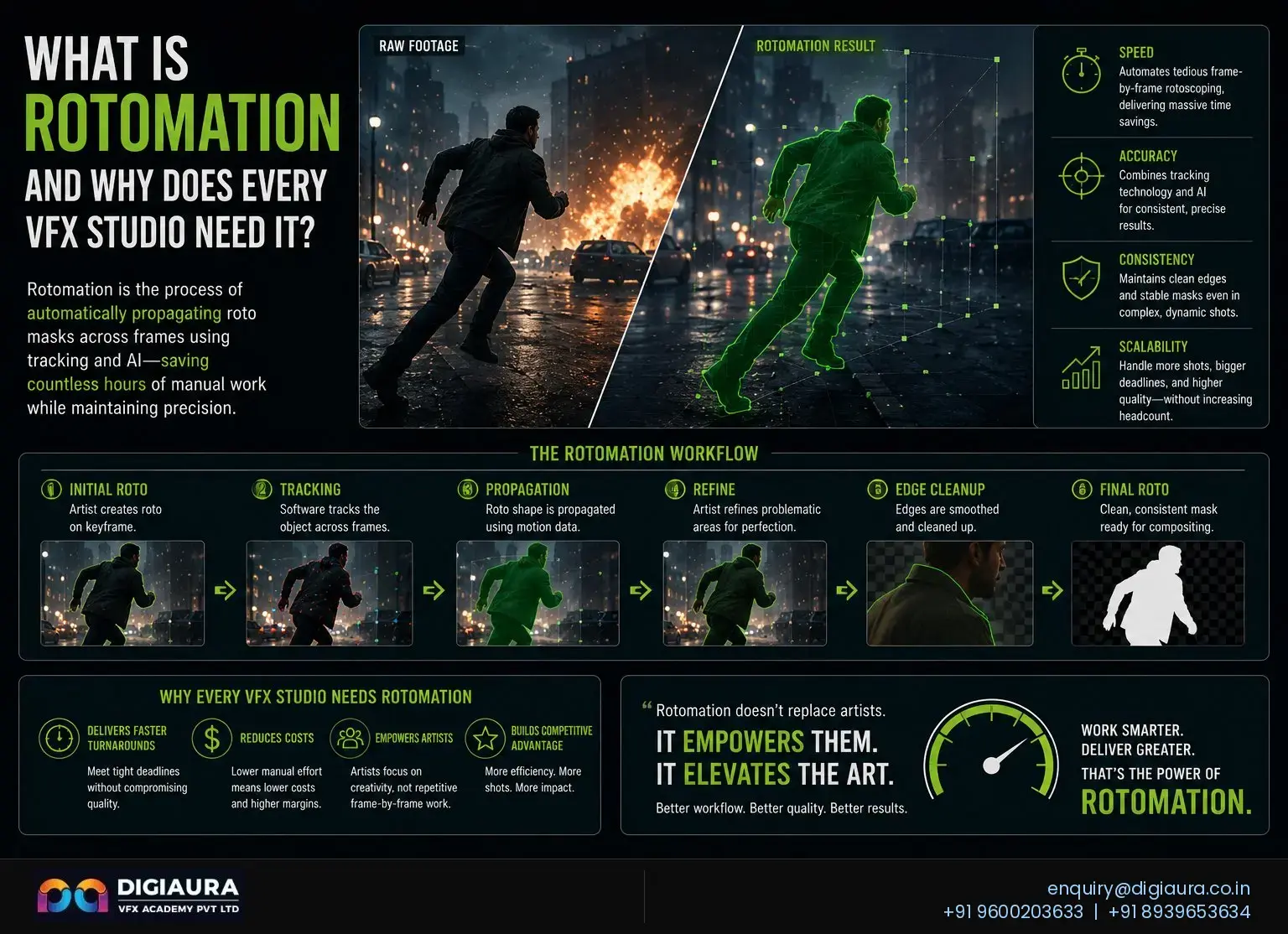
Every time a digital double leaps across a rooftop, a CG creature matches an actor's fighting stance, or a superhero's armoured suit moves in perfect sync with the performer inside it — rotomation is the discipline that makes it possible. It is one of the most technically demanding roles in professional visual effects, one of the least understood outside the industry, and one of the most consistently hired specialisations in Indian VFX studios. Learn rotomation at DigiAura VFX Academy →
Key Takeaways
- Rotomation is the process of extracting 3D skeleton and joint animation data from 2D live-action footage, allowing CG characters and digital doubles to replicate the exact motion of a real actor.
- The three core software tools used by professional rotomation artists are Autodesk Maya (for skeleton rigging and joint placement), PFTrack (for 3D camera tracking), and 3DEqualizer (for advanced lens distortion and matchmove workflows).
- Rotomation sits between the rotoscoping and compositing stages in the VFX pipeline — it uses roto mattes as its input and produces animated skeleton data as its output for the CG department.
- Entry-level rotomation artists in India earn ₹2.5–4 LPA; mid-level artists with 3–5 years of experience earn ₹5–8 LPA; senior rotomation artists and leads earn ₹10+ LPA.
- India's AVGC sector faces a 2.3 million talent gap (FX & Beyond Report, 2024), making trained rotomation artists among the most employable VFX professionals in the country right now.
- DigiAura VFX Academy offers a dedicated Rotomation course built on real Spellbound VFX production footage, teaching Maya, PFTrack, and 3DEqualizer at professional studio standards.
What Is Rotomation in VFX?
Rotomation — short for roto animation — is the VFX process of analysing 2D live-action film footage to extract the 3D movement of an actor's body, limbs, and joints, and then replicating that movement in the form of an animated 3D skeleton or rig. The result is a set of keyframed joint data inside a 3D application (typically Autodesk Maya) that drives a digital double — a CG version of the actor, creature, or vehicle — to move exactly as the real subject moved in the original footage.
In simpler terms: rotomation is how studios teach a CG character to move like a real person. When you watch a superhero's digital double perform a stunt that no human actor could safely do, or when a creature interacts with a performer with perfect physical accuracy — that match between the real and the digital is the work of a rotomation artist.
Citation Capsule: Rotomation is the VFX technique of tracking 2D film footage to reconstruct 3D skeleton animation data, driving digital doubles to replicate the exact body movement of a live-action actor frame by frame. It is distinct from rotoscopy (which produces 2D mattes) and matchmove (which tracks the camera), though all three disciplines share roots in footage analysis.
Rotomation vs Rotoscoping vs Matchmove: What Is the Difference?
These three terms are frequently confused — even by people working adjacent to VFX departments. Each describes a distinct discipline, uses different software, and produces a different type of deliverable. Here is a direct comparison:
| Discipline | What It Tracks | Output Delivered | Primary Software | Used By |
|---|---|---|---|---|
| Rotoscoping | Subject outlines (2D) | 2D matte / alpha mask | Silhouette FX, Nuke | Compositing dept. |
| Rotomation | Actor body joints (2D → 3D) | 3D skeleton animation | Maya, PFTrack, 3DEqualizer | CG / Animation dept. |
| Matchmove | Camera position (3D) | 3D camera solve | PFTrack, 3DEqualizer, SynthEyes | CG / Lighting dept. |
The key distinction between rotomation and rotoscoping is the dimension of the output. Rotoscoping traces a flat 2D shape around a subject for compositing. Rotomation goes deeper — it reconstructs where that subject's joints and bones were in three-dimensional space during every frame of the shot. Rotomation and matchmove are often performed by the same artist at smaller studios, since both require strong 3D spatial reasoning and the same core software toolkit.
What Is the Difference Between Rotomation and Mocap?
Motion capture (mocap) records actor movement using physical sensors, reflective markers, or optical cameras during the shoot — before any footage is edited. Rotomation extracts motion data from already-filmed footage, without any on-set tracking equipment. This makes rotomation essential for productions where mocap was not used, where footage arrives from practical sets rather than dedicated mocap stages, or where motion data needs to be reconstructed from archival, documentary, or second-unit footage.
Rotomation is also used to correct or supplement mocap data — for example, when a mocap suit records incorrect foot placement relative to the filmed ground surface, a rotomation artist can re-derive the correct foot contact data from the actual footage.
How Rotomation Works: The Step-by-Step Process
A rotomation task begins the moment a VFX supervisor assigns a shot requiring a digital double or a CG creature interaction. Here is how a professional rotomation artist works through that shot from first frame to delivery:
- Step 1 — Camera Solve: Before any skeleton work can begin, the camera motion for the shot must be solved in 3D. The rotomation artist (or matchmove team) analyses the footage in PFTrack or 3DEqualizer, placing 2D tracking points on fixed reference features in the scene — wall corners, floor edges, practical objects — and solving the camera's position, rotation, focal length, and lens distortion across every frame. The result is a 3D camera that moves exactly as the real camera did.
- Step 2 — Scene Geometry Reconstruction: A rough 3D representation of the physical set or location is created — floor planes, walls, vehicles, obstacles — so that the skeleton being animated will interact with the environment correctly. Depth references, set surveys, or LIDAR scans may be provided by the production; if not, the artist estimates geometry from the footage.
- Step 3 — Skeleton Placement in Maya: A pre-rigged human skeleton (or creature rig if the shot involves a non-human character) is imported into Autodesk Maya and placed into the 3D scene. The rotomation artist then works through the footage and manually places each joint — hips, spine, shoulders, elbows, wrists, knees, ankles — to match the actor's body position in the 2D footage. This is done frame by frame, or using a key-frame-and-refine approach for longer shots.
- Step 4 — Joint Animation and Refinement: The initial skeleton placement is progressively refined. Each joint's position and rotation is adjusted until the 3D skeleton, when viewed through the solved 3D camera, aligns precisely with the actor's silhouette in the 2D footage. For shots involving fast movement, the artist sets dense keyframes and smooth spline curves in Maya's Graph Editor to replicate acceleration and deceleration accurately.
- Step 5 — Contact Point Validation: The artist verifies that every contact point — foot-on-floor, hand-on-surface, object-interaction — is physically grounded. A digital double that floats millimetres above the ground or slides during a footstep creates immediate visual incoherence. Contact validation is often the most time-consuming refinement pass.
- Step 6 — Delivery to CG Department: The finalised skeleton animation data is exported (typically as an Alembic or FBX cache) and handed off to the CG character animation, lighting, and compositing teams. The CG department uses this data to drive the digital double's geometry, apply skin deformation, generate cloth simulation, and integrate the character into the compositing pipeline.
Citation Capsule: A single rotomation shot involving a full-body digital double typically takes between 4 and 16 hours depending on shot length, complexity of movement, number of camera angles, and quality of production reference material. Action sequences with multiple characters, fast movement, and complex environmental interactions can take significantly longer.
Why Every VFX Studio Needs Rotomation
Rotomation is not a niche specialisation used by a handful of studios on prestige productions. It is a foundational pipeline requirement for any project that integrates CG characters with live-action footage — which, in 2026, means almost every major film, streaming series, and OTT production above a modest budget. Here is why studios cannot operate without it:
1. Digital Doubles Are Now a Production Standard
Performer safety regulations in most jurisdictions require stunt work to be performed by stunt professionals, not lead actors. When the stunt performer's face must appear to be the lead actor's, a digital double is required — and a digital double requires rotomation to match the stunt performer's movement exactly. This applies to every car chase, every rooftop chase, every fall, and every fight sequence where the director wants to cut between stunt and actor seamlessly.
2. Creature and Character Interaction Demands It
Every time a CG creature — a dinosaur, a dragon, an alien — physically interacts with a human actor in a shot, the creature's animator needs a reference skeleton that matches what the actor's body was doing at every frame. If the actor reaches out to grab the creature, the creature's corresponding limb must react to the exact position of the actor's hand. Without rotomation-derived skeleton data, creature animators are working from guesswork, and the interaction will look physically implausible.
3. Indian Cinema Is Using VFX at Scale
Indian productions — particularly Tamil, Telugu, and Hindi tentpole films — are now allocating 25–30% of total production budgets to VFX (FICCI-EY Media & Entertainment Report 2026). Films like Brahmastra (4,500+ VFX shots), Adipurush (4,000+ VFX shots), and Kalki 2898 AD used digital doubles, creature interactions, and CG costume integrations that required rotomation across hundreds of individual shots. Indian studios handling this work domestically need rotomation artists on staff to compete for these projects.
4. AI Has Not Eliminated the Need for Human Rotomation Artists
AI-assisted pose estimation tools can generate initial skeleton placements for controlled footage with simple movement. However, complex shots — fast action, occlusion (body parts hidden behind objects), non-standard body proportions, or multi-character interactions — still require human artists to correct AI output to feature-film quality standards. According to the FICCI-EY 2026 report, AI tools are generating up to 40% time savings across roto and paint workflows — but this means human artists do 60% of the refinement work that determines final quality. AI accelerates rotomation; it has not automated it.
5. International Outsourcing Drives Volume Demand
Approximately 70% of Indian VFX studio revenue is generated through international partnerships (IBEF, April 2025). Hollywood and European productions outsource rotomation, roto, paint, and compositing work to Indian studios because production costs in India are 40–60% lower than in Western countries. This creates a structural, ongoing demand for trained rotomation artists at Indian studios — independent of domestic production volumes.
Software Every Rotomation Artist Uses
Professional rotomation work requires fluency in three primary applications and familiarity with several pipeline-adjacent tools. Here is the standard toolkit used at studios across Mumbai, Hyderabad, and Chennai:
| Software | Role in Rotomation | Why Studios Use It |
|---|---|---|
| Autodesk Maya | 3D skeleton rigging, joint placement, keyframe animation, Graph Editor refinement | Industry standard for character animation — every studio CG pipeline uses Maya |
| PFTrack | 3D camera tracking, scene geometry reconstruction, object tracking | The most widely used matchmove and tracking application at commercial VFX studios |
| 3DEqualizer (3DE) | Precision lens distortion, anamorphic lens solve, advanced camera tracking for complex shots | Preferred at high-end facilities (ILM, DNEG, MPC) for shots with challenging optics |
| Foundry Nuke | Review and QC — viewing rotomation output against the live-action footage in compositing context | Universal compositing standard; rotomation deliverables are validated in Nuke before handoff |
| Silhouette FX | Roto matte reference (used by roto team; rotomation artists review mattes as alignment reference) | Standard roto tool — rotomation artists need to read and use roto output accurately |
At entry level, studios expect proficiency in Maya and basic familiarity with either PFTrack or 3DEqualizer. At mid and senior levels, deep expertise in both tracking applications — including handling anamorphic lenses, rolling shutter distortion, and multi-camera rigs — is required. Studios running Unreal Engine 5 in their pipeline increasingly expect rotomation artists to understand how to transfer skeleton data into UE5's animation system for virtual production workflows.
Rotomation Career Path and Salary in India
Rotomation is a technically specialised discipline that commands higher salaries than entry-level roto or paint roles. The career path is clearly defined at most Indian studios:
| Career Stage | Experience | Typical Salary (India) | Key Responsibilities |
|---|---|---|---|
| Rotomation Artist (Junior) | 0–2 years | ₹2.5–4 LPA | Camera solves, basic skeleton placement, single-character shots |
| Rotomation Artist (Mid-level) | 3–5 years | ₹5–8 LPA | Complex action shots, creature interactions, multi-character scenes |
| Senior Rotomation Artist | 5–8 years | ₹8–12 LPA | Lead on complex sequences, QC review, mentoring juniors |
| Rotomation Lead / Supervisor | 8+ years | ₹12–18 LPA | Pipeline oversight, client communication, team management, deliverable scheduling |
Artists who combine rotomation expertise with compositing or character animation skills typically progress faster — moving from junior to mid-level in 2 years instead of 3, and reaching lead roles within 5–6 years. Cross-disciplinary skills are highly valued at mid-size Indian studios that need artists who can move between departments based on project load.
Citation Capsule: Entry-level rotomation artists in India earn ₹2.5–4 LPA, with mid-level artists (3–5 years experience) earning ₹5–8 LPA and senior leads reaching ₹12–18 LPA. Salary data is aggregated from Glassdoor India (2024–2025) and ITM Education (2025). Rotomation commands a 20–35% salary premium over comparable roto-only roles due to the additional 3D software competencies required.
Rotomation Jobs in India: Where Are the Roles?
Rotomation roles are concentrated in India's major VFX production centres. Each city has a distinct character in terms of the type of work and which studios are hiring:
Mumbai
Mumbai is India's largest VFX hub, with major studios including Prime Focus, DNEG India, Red Chillies VFX, and Technicolor India all operating large facilities. Bollywood tentpole productions drive a steady stream of rotomation work — particularly for action sequences, creature integrations, and the digital doubles increasingly required by major directors. Mumbai studios also handle significant international outsourcing, with Hollywood productions regularly sending rotomation-heavy sequences to Indian facilities.
Hyderabad
Hyderabad has grown into India's second-largest VFX production centre, driven largely by Telugu-language productions from Tollywood. Films in this market are known for ambitious VFX sequences with high digital double requirements. Hyderabad is also home to Makuta VFX and Annapurna Studios' VFX facilities, which hire rotomation artists for both domestic and international projects.
Chennai
Chennai's VFX industry is anchored by Tamil-language productions and a growing base of mid-size studios handling international work. Spellbound VFX, DigiAura's parent studio, is one of Chennai's active production facilities. Tamil productions increasingly invest in VFX-heavy sequences, particularly in action and fantasy genres, generating consistent rotomation demand at Chennai studios. Chennai is also geographically well-positioned for international collaboration given its time-zone alignment with European production schedules.
Bengaluru
Bengaluru is the fastest-growing VFX hiring market in India, driven by its established technology ecosystem and expanding capacity for international outsourcing work. Studios here tend to attract artists with strong technical backgrounds, and rotomation roles in Bengaluru are increasingly combined with pipeline technical director responsibilities.
India's VFX Industry and Why Rotomation Demand Is Rising
The structural conditions driving rotomation demand in India are well-documented and reinforced by the most recent industry data:
- Market growth: India's VFX segment is projected to reach ₹48 billion revenue by 2028, up from ₹5,400 crore in 2023 (FICCI-EY 2026; IBEF April 2025). This growth requires proportionally more skilled artists at every pipeline stage.
- Talent gap: India's AVGC sector currently employs 260,000 professionals but faces a 2.3 million talent gap (FX & Beyond Report, via Storyboard18, August 2024). Trained rotomation artists enter a market where demand structurally exceeds supply.
- International volume: Approximately 70% of Indian VFX revenue comes from international projects. Global VFX market is growing from US$15 billion (2023) to US$30 billion by 2030 at 10.7% CAGR (IBEF). India captures an increasing share of this as quality rises and costs remain competitive.
- Over 4,000 active studios: India has more than 4,000 VFX studios of varying sizes (IBEF). Even mid-size studios handling 20–50 shots per project need access to rotomation capability — either in-house or through specialist teams.
- AI creates new demand, not less: AI tools are generating up to 40% time savings in roto and paint workflows (FICCI-EY 2026). This accelerates project throughput — meaning studios can take on more projects, requiring more artists overall — rather than reducing headcount.
Citation Capsule: India's AVGC sector faces a 2.3 million talent gap (FX & Beyond Report, Storyboard18, August 2024). The global VFX market will reach US$30 billion by 2030 (IBEF, April 2025). India captures approximately 70% of its VFX revenue from international work — meaning rotomation artists trained to international studio standards are directly employable on both domestic and global productions.
How DigiAura VFX Academy Trains Rotomation Artists
DigiAura VFX Academy (Chennai) offers a dedicated Rotomation course built from the production requirements of Spellbound VFX, an active film VFX studio and DigiAura's founding studio. The curriculum teaches Autodesk Maya, PFTrack, and 3DEqualizer on real production footage — not synthetic tutorial material — so graduates enter the job market with a portfolio containing studio-standard deliverables rather than training exercises.
The rotomation programme is structured across three levels:
- Rotomation Basic (3 months): Introduction to 3D camera tracking fundamentals in PFTrack, Maya skeleton rigging and joint hierarchy, single-character rotomation on controlled footage, Graph Editor animation principles, and delivery pipeline basics. Students complete their first professional-quality rotomation shot within the first eight weeks.
- Rotomation Intermediate (6 months with paid internship): Advanced tracking in PFTrack and 3DEqualizer, multi-character shots, creature rigs, anamorphic lens distortion correction, integration with Nuke compositing pipeline, and a structured paid internship at Spellbound VFX or a partner studio. Students earn income before completing the programme.
- Advanced Diploma (1 year with placement assurance): Full pipeline coverage including matchmove, rotomation, CG integration, and an introduction to Unreal Engine 5 virtual production workflows. Graduates receive 100% placement assurance through DigiAura's active studio network across Chennai, Mumbai, Hyderabad, and Bengaluru.
The defining characteristic of DigiAura's training is the source of the footage. Students work on actual frames from Spellbound VFX's production pipeline — the same material their professional rotomation team processes for commercial releases. By the time a DigiAura student graduates, their showreel contains shots produced to the standard a studio QC team would accept, not portfolio exercises that only look like real work.
Talk to DigiAura's team about the rotomation course intake schedule and fees →
Frequently Asked Questions About Rotomation
What is rotomation in VFX in simple terms?
Rotomation is the process of studying filmed footage of an actor and recreating their movement as an animated 3D skeleton inside software like Maya. That skeleton data then drives a digital double — a CG version of the actor — to move exactly as the real person moved in the shot. It is how studios make CG characters interact realistically with live actors.
What is the difference between rotomation and rotoscoping?
Rotoscoping traces the outline of a subject in 2D to create a matte — a flat mask used in compositing. Rotomation goes further: it reconstructs the full 3D movement of the subject's body as an animated skeleton. Roto gives you a flat cutout; rotomation gives you a 3D character that moves exactly like the real actor.
What software is used for rotomation?
The three core applications used by professional rotomation artists are Autodesk Maya (for 3D skeleton rigging and animation), PFTrack (for 3D camera tracking and scene reconstruction), and 3DEqualizer (for advanced lens distortion and precision camera solves). Nuke is used for reviewing rotomation output in the compositing context.
Is rotomation a good career in India?
Yes. Rotomation is one of the most in-demand specialisations in India's VFX industry right now. The country's AVGC sector faces a 2.3 million talent gap (FX & Beyond Report, 2024), and trained rotomation artists enter a market where studios are actively competing to hire qualified candidates. Entry-level salaries of ₹2.5–4 LPA progress to ₹10+ LPA at the senior level, with consistent demand from both domestic Bollywood/Kollywood productions and international outsourcing clients.
How long does it take to learn rotomation?
A beginner can learn the fundamentals of rotomation in a structured 3-month Basic course. Reaching professional production speed — handling single-character shots at the quality level studios require — typically takes 6–9 months of training on real production footage. Full professional proficiency, including complex multi-character and creature shots, requires approximately 12 months of structured training plus early studio experience.
Can I learn rotomation after 12th standard?
Yes. Rotomation courses are open to students from any 12th-standard stream — Arts, Science, or Commerce. There are no maths or physics prerequisites. The discipline requires 3D spatial reasoning, patience, and precision — all of which are developed through training. DigiAura VFX Academy accepts students directly after 12th and offers both 3-month certificate courses and full year-long diploma programmes.
What is the difference between rotomation and matchmove?
Matchmove tracks the camera — its position, rotation, and lens characteristics across every frame of a shot — so CG elements can be placed into a scene with accurate perspective. Rotomation tracks the subject — the body, limbs, and joints of an actor — to drive a CG character. Both use similar software (PFTrack, 3DEqualizer) and are often handled by the same team at smaller studios, but they produce different outputs for different departments.
How much does a rotomation artist earn in India?
Entry-level rotomation artists in India earn between ₹2.5 LPA and ₹4 LPA depending on the studio, city, and portfolio quality. Mid-level artists with 3–5 years of experience earn ₹5–8 LPA. Senior artists and leads earn ₹10–18 LPA. Artists who combine rotomation with matchmove or compositing skills typically progress faster and earn at the upper end of each range.
Rotomation is where live-action performance and digital character creation meet. It requires technical rigour, a strong spatial sense, and genuine expertise in the tools studios use at production scale. If you are drawn to the craft of making digital characters move exactly like real people — and you want to build a career in one of India's fastest-growing creative industries — rotomation is a skill worth investing in properly. Speak to DigiAura's admissions team about starting your rotomation training →