
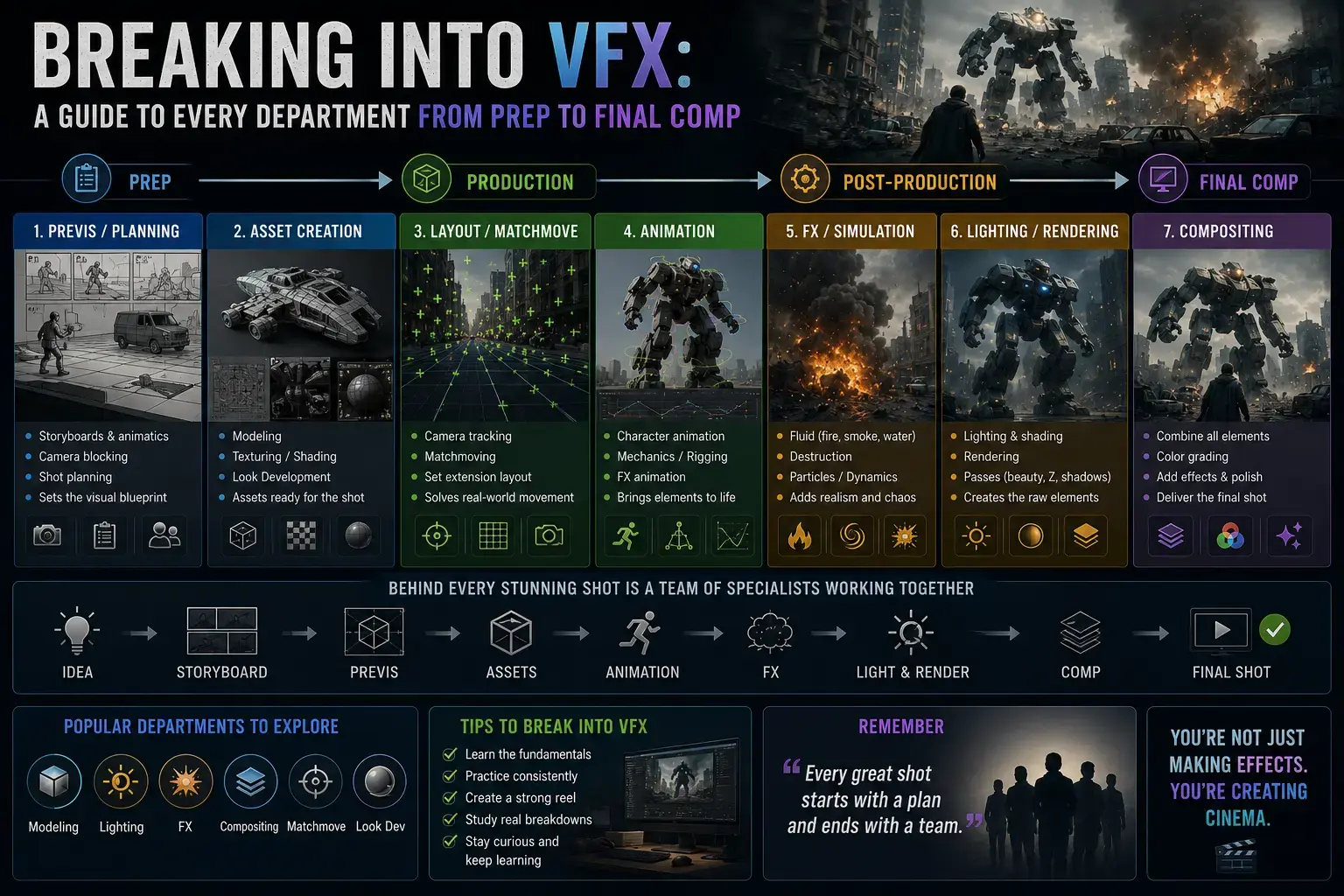
Every VFX shot on screen is the result of a long, carefully organised production pipeline. Behind every seamless digital effect is a team of specialists, each responsible for a distinct stage of work. Rotoscoping artists isolate subjects frame by frame. Paint artists remove wire cables and rig shadows from plates. Matchmove artists reconstruct camera movement in 3D space. CGI artists build worlds and characters. Lighting technical directors shade those elements to match real-world photography. FX artists simulate fire, water, and destruction with physics-based tools. And compositors assemble every piece into the final frame the audience sees on screen. Breaking into VFX means understanding which of these departments fits your skills, learning the right software, and building a focused portfolio that gets you noticed by a real studio. This guide covers every department in the VFX pipeline, what each role involves, what software it requires, and how to launch your career in visual effects in India in 2026.
Key Takeaways
- The VFX production pipeline has seven core departments: rotoscoping, paint and prep, camera tracking and matchmove, 3D modeling and animation, lighting and rendering, FX and simulations, and compositing.
- Rotoscoping and paint and prep are the most accessible entry points into the VFX industry for beginners, requiring the shortest training period and hiring junior artists regularly across India.
- Compositing is the final creative stage in the pipeline and requires the broadest range of technical and artistic skills of any single VFX role.
- India's animation and VFX industry is projected to reach Rs 48 billion by 2028 (FICCI-EY Report 2026), sustaining strong demand for trained VFX artists across Mumbai, Hyderabad, and Chennai.
- Junior roto artists in India earn Rs 15,000 to Rs 30,000 per month. Junior compositors earn Rs 18,000 to Rs 40,000 per month. Senior compositors and leads earn Rs 1,00,000 to Rs 2,00,000 per month or more (Glassdoor India, 2025 to 2026).
- Industry-standard software by department: Silhouette for roto and paint, 3DEqualizer for matchmove, Maya and Houdini for 3D and FX, Arnold and Mantra for rendering, and Nuke for compositing.
- Your showreel gets you hired in VFX. A focused reel of five polished shots in one specialisation is more effective than a broad reel of fifteen average pieces across multiple disciplines.
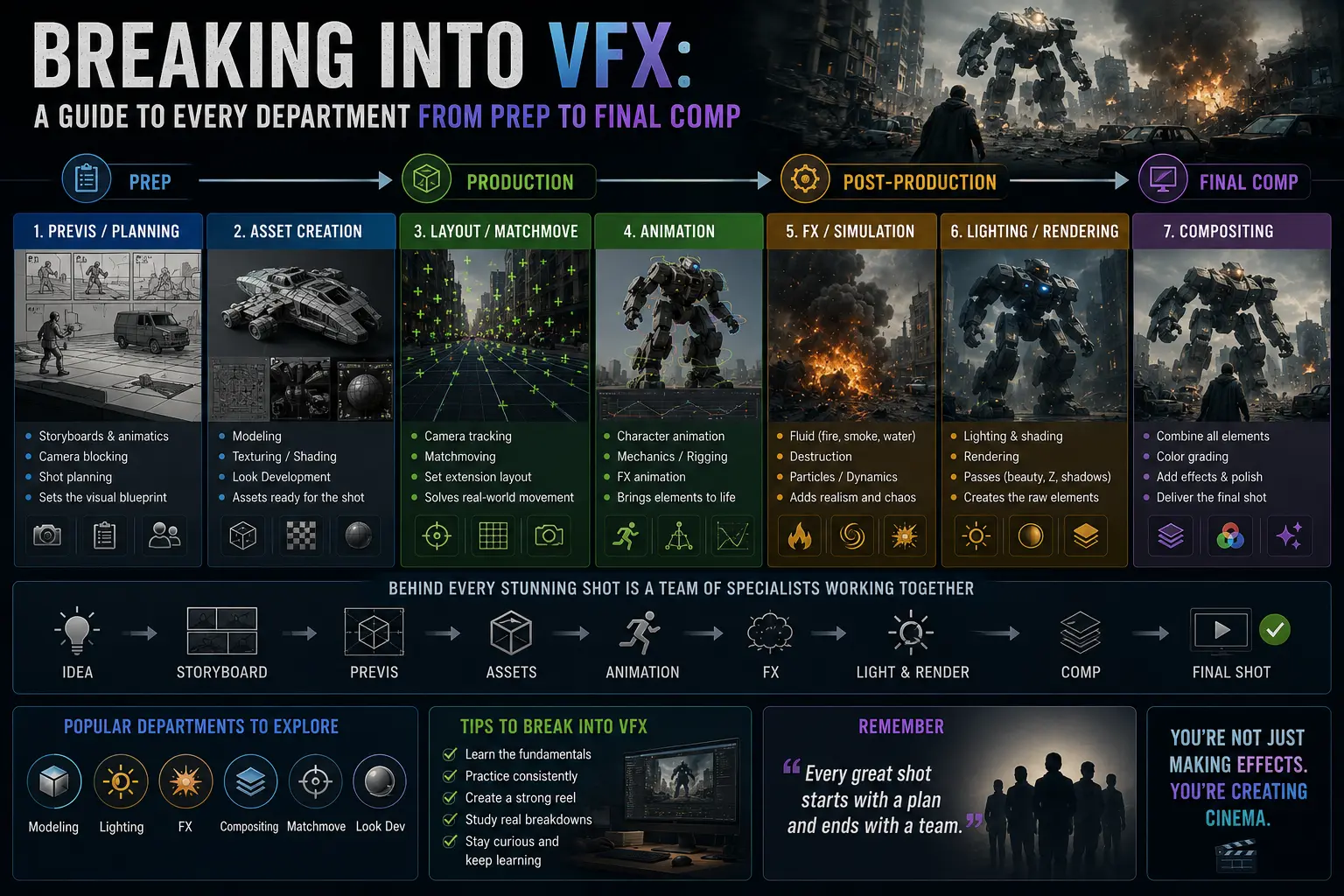
Every VFX shot moves through seven departments: from pre-production planning and asset creation through animation, FX simulation, and lighting to the final composite. Understanding this pipeline is the foundation of any VFX career.
What Is the VFX Production Pipeline?
The VFX production pipeline is the sequence of departments and handoffs that transforms raw live-action footage into a finished visual effects shot. Each department receives work from the upstream stage, completes their specific contribution, and delivers their output to the next team. No department works in isolation. The pipeline is designed so that every artist knows their role and every output serves a purpose downstream.
A live-action plate, the original camera footage from a film or streaming production, enters the VFX pipeline the moment it arrives from set. From that point, the shot travels through a defined series of specialist stages. The order is not arbitrary: each stage requires the output of the one before it. Rotoscoping mattes are needed before compositing can begin. Camera tracking data is needed before 3D artists can position their elements correctly. Render passes from the lighting department must exist before the compositor can integrate CGI into the plate.
Understanding the pipeline as a whole is the single most important foundation for any VFX career. Artists who understand how their work serves the departments downstream are more effective collaborators, faster troubleshooters, and stronger candidates for senior and leadership roles. For a focused breakdown of how all pipeline stages connect into the final composite, the DigiAura guide to the VFX compositing pipeline from roto to final comp covers the final stages in detail.
| Stage | Department | Key Deliverable | Entry Accessibility |
|---|---|---|---|
| 1 | Rotoscoping | Alpha matte sequences isolating subjects from backgrounds | Very High |
| 2 | Paint and Prep | Cleaned plates with wires, rigs, and artifacts removed | Very High |
| 3 | Camera Tracking / Matchmove | 3D camera solve, point cloud, and scene geometry | Moderate |
| 4 | 3D Modeling, Rigging, and Animation | Fully modelled, rigged, and animated CG assets | Moderate |
| 5 | Lighting and Rendering | Multi-pass rendered EXR sequences per CG element | Lower |
| 6 | FX and Simulations | Simulated fluid, fire, destruction, and particle sequences | Lower |
| 7 | Compositing | Final colour-graded shot approved for editorial delivery | Moderate |
Department 1: Rotoscoping
Rotoscoping is the process of manually drawing and animating precise masks around subjects in live-action footage, frame by frame, to create alpha matte sequences. These mattes are binary image sequences: black where the background is, white where the subject is, and soft-edged where the boundaries fall. Compositors use these mattes to isolate actors, objects, or elements so they can be placed over different backgrounds, integrated with CGI, or treated independently in a shot.
A roto artist spends their day working through shots frame by frame in Foundry Silhouette or Nuke, placing spline shapes around subjects, and carefully animating those shapes to follow the motion of the footage. The quality of a roto matte is measured by its accuracy to the original subject edge, its temporal consistency from frame to frame, and its handling of difficult areas like hair, fabric edges, and motion blur.
Rotoscoping is widely recognised as the most accessible entry point into the VFX industry. It requires no prior 3D knowledge, no compositing software proficiency, and no understanding of render pipelines. A junior roto artist needs attention to detail, patience with repetitive frame-by-frame work, and the ability to maintain consistent quality under production deadlines. For a complete introduction to rotoscopy techniques and workflow, the DigiAura guide to what rotoscopy is and how frame-by-frame VFX works covers the fundamentals in full.
Rotoscoping: At a Glance
Primary Tools
- Foundry Silhouette (industry standard)
- Foundry Nuke (roto node)
- Mocha Pro (planar tracking-assisted roto)
- Adobe After Effects (broadcast roto)
Key Skills
- Bezier and B-spline shape control
- Frame-accurate edge tracing
- Hair and soft-edge matte handling
- Temporal consistency and motion blur awareness
Roto Artist Career Path in India
A junior roto artist in India earns approximately Rs 15,000 to Rs 30,000 per month (Glassdoor India, 2025 to 2026). With 3 to 5 years of experience, a mid-level roto artist earns Rs 35,000 to Rs 60,000 per month. Senior roto artists and roto supervisors earn Rs 70,000 to Rs 1,20,000 per month at leading studios in Mumbai, Hyderabad, and Chennai. Studios that hire roto artists regularly in India include Prime Focus, Bot VFX, Red Chillies VFX, and Makuta VFX. Many senior roto artists transition into compositing roles after developing working knowledge of Nuke through continued training.
Department 2: Paint and Prep
Paint and prep, often referred to as prep, is the department responsible for cleaning the live-action plate before it reaches the compositor. The plate is the original camera footage. It often contains elements that must not appear in the final shot: safety wires attached to stunt performers, camera rigs, lighting stands, motion capture markers, lens dust, and continuity errors between takes. The paint department removes all of these elements so cleanly that no trace of the removal remains in the footage.
A paint artist works in Foundry Nuke, Silhouette, or dedicated prep tools, frame-painting unwanted content out of shots using a combination of techniques: cloning from adjacent frames, warping clean areas over problem pixels, using 2D tracking to lock replacement patches to moving footage, and in complex cases, rebuilding background elements from scratch. The work is invisible by design. A good paint artist's output looks exactly like the original footage, except the problem element is simply gone.
Like rotoscoping, paint and prep is among the most accessible VFX roles for beginners. Junior prep artists need a sharp eye for colour matching and patience with frame-intensive work. Paint work requires slightly more software knowledge than roto, particularly around cloning, patching, and 2D tracking techniques. Studios in India typically hire junior paint artists who have completed a dedicated VFX training programme and can demonstrate clean wire removal and rig deletion test shots in their portfolio.
Paint and Prep: At a Glance
Primary Tools
- Foundry Silhouette (dedicated paint tools)
- Foundry Nuke (RotoPaint node)
- Adobe Photoshop (static frame repair)
- Mocha Pro (tracking-assisted painting)
Key Skills
- Wire and rig removal across moving footage
- Colour matching and texture cloning
- 2D tracking and patch stabilisation
- Background reconstruction and clean plating
Paint Artist Career Path in India
Junior paint artists in India earn approximately Rs 15,000 to Rs 32,000 per month (AmbitionBox, 2025 to 2026). Mid-level artists with 3 to 5 years of experience earn Rs 40,000 to Rs 70,000 per month. Senior paint artists and prep supervisors earn Rs 80,000 to Rs 1,30,000 per month. Paint artists who develop strong compositing skills frequently transition into junior compositor roles, using their deep familiarity with the plate as an advantage when integrating CG elements accurately.
Department 3: Camera Tracking and Matchmove
Camera tracking, also called matchmove, is the department that reconstructs the 3D movement of a physical camera from live-action footage so that computer-generated elements can be accurately positioned in the same 3D space. When a digital creature walks through a real environment or a CGI vehicle drives down a real road, the reason those digital elements appear to exist in the physical world is because the VFX team knows exactly where the camera was at every moment. That knowledge comes from the matchmove department.
A matchmove artist analyses the footage, selects tracking points on identifiable high-contrast features in the plate, and uses specialised software to solve for the camera's position, rotation, and focal length over the duration of the shot. The output is a fully animated 3D camera that moves identically to the real camera that captured the footage. This camera, along with the solved point cloud of the real-world environment, is handed to 3D artists who position and animate their CG elements within this reconstructed 3D space.
For a full technical walkthrough of the matchmove process, including manual tracking, automatic solving, and quality checking, the DigiAura guide to camera tracking 101 and matchmove in VFX covers the workflow step by step for beginners.
Camera Tracking: At a Glance
Primary Tools
- 3DEqualizer (industry standard at major studios)
- SynthEyes (widely used at mid-tier studios)
- PFTrack (Pixel Farm)
- Blender Camera Solver (free, for training)
Key Skills
- Manual tracking point selection and analysis
- Lens distortion analysis and correction
- Scene survey data interpretation
- FBX export and Maya integration
Matchmove Artist Career Path in India
Junior matchmove artists in India earn approximately Rs 18,000 to Rs 35,000 per month (Glassdoor India, 2025 to 2026). Mid-level matchmove artists with 3 to 5 years of experience earn Rs 45,000 to Rs 80,000 per month. Senior matchmove artists and tracking supervisors earn Rs 90,000 to Rs 1,50,000 per month at top studios. 3DEqualizer proficiency is the single most valuable skill for this role, used at almost every major VFX studio globally. Matchmove artists with Python scripting skills can significantly accelerate their progression into technical supervision roles.
Department 4: 3D Modeling, Rigging, and Animation
The 3D department in a VFX studio covers a wide range of specialisations that together are responsible for building the digital objects, characters, creatures, and environments that will be integrated into live-action footage. In large studios, these specialisations split into separate teams: modellers who build the geometry, texture artists who apply surface materials, rigging technical directors who create the controls animators use to pose and move characters, and animators who bring those characters and objects to life.
VFX 3D work differs from game art and animated film 3D work in specific ways. VFX models must integrate photorealistically with live-action footage, which places heavy demands on surface realism, texture detail, and scale accuracy. VFX animation must match the weight, timing, and physical plausibility of real-world objects and creatures placed in the same environment as real actors. This demands a strong understanding of reference footage, physics, and cinematographic principles in addition to software proficiency.
3D Modeling and Animation: At a Glance
Primary Tools
- Autodesk Maya (industry standard for VFX)
- ZBrush (high-resolution sculpting)
- SideFX Houdini (procedural modeling)
- Substance Painter (PBR texturing)
Sub-Roles in 3D
- 3D Modeller
- Texture and Lookdev Artist
- Rigging Technical Director
- Character Animator
- Creature Animator
3D Artist Career Path in India
Junior 3D artists in India earn approximately Rs 20,000 to Rs 40,000 per month depending on their sub-specialisation. Mid-level 3D artists with 3 to 5 years of experience earn Rs 50,000 to Rs 1,00,000 per month. Senior 3D artists and leads earn Rs 1,00,000 to Rs 2,00,000 per month or more. 3D animation and character rigging roles at India's major VFX studios in Mumbai and Hyderabad are consistently in demand for streaming content produced for global platforms including Amazon Prime, Netflix, and Disney.
Department 5: Lighting, Shading, and Rendering
Lighting and shading is the department responsible for ensuring that every CG element, once modelled, textured, and animated, looks as if it was photographed by the same camera under the same physical lighting conditions as the live-action plate. This is one of the most technically and artistically demanding specialisations in VFX, requiring a deep understanding of physics-based rendering, colour science, and the photographic characteristics of cinema cameras and lenses.
A lighting technical director places virtual lights in the 3D scene that reproduce the lighting captured on set. They adjust the material properties of surfaces so light interacts with them as it would with real-world materials: skin scatters light differently than metal, which reflects differently than fabric. They manage the render settings that control how accurately the rendering software simulates the behaviour of light, balancing realism against rendering time and computational cost.
The final output of the lighting department is a set of multi-pass render outputs in OpenEXR format delivered to compositors for final assembly. These render passes, the beauty pass, diffuse, specular, shadow, ambient occlusion, and depth passes, give compositors full control over each component of the CG element's appearance without requiring any re-rendering from scratch.
Lighting and Rendering: At a Glance
Primary Tools
- Autodesk Maya with Arnold renderer
- SideFX Houdini with Karma or Mantra
- Chaos V-Ray (broadcast and advertising)
- RenderMan by Pixar (feature film)
Key Skills
- HDRI and light matching from reference
- PBR materials and lookdev
- AOV and render pass management
- Colour management with ACES and OpenColorIO
Lighting TD Career Path in India
Junior lighting artists in India earn approximately Rs 25,000 to Rs 45,000 per month. Mid-level lighting TDs with 3 to 5 years of experience earn Rs 60,000 to Rs 1,10,000 per month. Senior lighting TDs and lighting supervisors earn Rs 1,20,000 to Rs 2,50,000 per month at leading feature film studios. Lighting is a more complex entry-level role than roto or paint, typically requiring 18 to 24 months of dedicated training in 3D software and rendering before a candidate is production-ready. The role is consistently one of the highest-paid mid-career positions in the VFX industry.
Department 6: VFX Simulations and FX
The FX department, also called effects technical directors or simulation TDs, is responsible for creating physically simulated visual effects that cannot be practically achieved on set or through traditional animation. Fire, smoke, explosions, ocean water, rain, destruction, cloth dynamics, rigid body fracture, and crowd simulations are all within the scope of the FX department. These elements are created using physics-based simulation tools that compute how particles, fluids, and rigid bodies behave under defined physical forces.
FX work is among the most technically demanding specialisations in VFX. It requires a strong understanding of physics principles, computational fluid dynamics, and the mathematics behind simulation algorithms. It also demands significant computing resources: complex fluid and destruction simulations can take hours per frame to calculate on powerful workstations. FX artists must balance visual quality against production deadlines and rendering budgets, which requires both technical skill and practical judgement developed through studio experience.
FX and Simulations: At a Glance
Primary Tools
- SideFX Houdini (industry-standard FX tool)
- Autodesk Maya nParticles and nCloth
- Chaos Phoenix for fluid simulation
- Embergen for real-time FX previz
Key Skills
- FLIP fluid simulation in Houdini
- Pyro fire and smoke simulation
- Rigid body destruction and fracture
- VEX scripting in Houdini
FX Artist Career Path in India
FX is one of the harder departments to enter at the junior level due to the significant technical training required before production-ready work is achievable. Junior FX artists in India earn approximately Rs 30,000 to Rs 55,000 per month. Mid-level FX TDs with 3 to 5 years of experience earn Rs 70,000 to Rs 1,30,000 per month. Senior FX TDs and supervisors earn Rs 1,50,000 to Rs 3,00,000 per month or more at tier-one studios. Houdini is non-negotiable for this role, and deep Houdini proficiency including VEX scripting is required for mid-level and above positions globally.
Department 7: VFX Compositing
Compositing is the final creative stage in the VFX pipeline and the role that receives deliverables from every upstream department. The compositor's job is to combine all the visual elements: the live-action plate, the rotoscoped mattes, the cleaned paint plates, the CGI renders with all their passes, the FX simulations, and the colour grades, into a single, seamless, photorealistic final frame. The compositor determines whether all of those separately created pieces look as if they were photographed together by a single camera in a single physical location.
This makes compositing one of the most technically broad and artistically demanding roles in VFX. A compositor needs to understand what every upstream department delivered, know whether it is correct, and know how to compensate when it is not. A compositor who understands roto quality can fix a substandard matte. A compositor who understands render passes can relight a CG element without asking the lighting department for a re-render. A compositor with strong colour science knowledge can match any element to any plate without the shot looking like a visual effect at all.
For a complete breakdown of the compositing workflow including render passes, green screen keying, and the Nuke node graph structure, the DigiAura VFX Compositing Course covers the full pipeline from first principles to professional-grade shots.
Compositing: At a Glance
Primary Tools
- Foundry Nuke (industry standard globally)
- Adobe After Effects (broadcast and advertising)
- Blackmagic Fusion (growing adoption, free)
- Autodesk Flame (high-end broadcast and commercials)
Key Skills
- Node-based compositing in Nuke
- Green screen keying and matte extraction
- Render pass integration and relighting
- Colour science and ACES colour management
Compositor Career Path in India
Junior compositors in India earn approximately Rs 18,000 to Rs 40,000 per month (Glassdoor India and AmbitionBox, 2025 to 2026). Mid-level compositors with 3 to 5 years of experience earn Rs 50,000 to Rs 1,00,000 per month. Senior compositors and compositing leads earn Rs 1,00,000 to Rs 2,00,000 per month or more at top studios. Compositing supervisors can earn Rs 2,50,000 to Rs 5,00,000 per month at major VFX houses. Nuke proficiency significantly increases earning potential versus After Effects alone, particularly for feature film and streaming studio positions.
How the VFX Pipeline Connects Every Department
No VFX shot is completed by a single artist or a single department. Every shot is the product of multiple handoffs across the pipeline. A matchmove solve enables 3D artists to position their geometry. Those positioned assets go to lighting for rendering. The lighting passes go to compositing along with the roto mattes from the roto department and the cleaned plates from paint. The compositor assembles all of this into the final shot. If any one department delivers substandard work, the problem ripples downstream to every department that follows.
This interdependence is why pipeline literacy matters more than any single software skill. Artists who understand what their downstream colleagues need are faster, more accurate contributors to production. A roto artist who understands how compositors use their mattes will deliver cleaner edges and better-timed soft masks. A matchmove artist who understands how lighting TDs use their camera solve will structure their exports in the right format and naming convention. A compositor who understands how render passes are built will know how to fix a shot without requesting a re-render from the lighting department.
Learning the full pipeline before specialising is one of the most effective career investments a VFX artist can make, even if they only ever work in one department. Breadth of pipeline understanding is the consistent differentiator between junior artists who progress quickly and those who plateau at entry-level work for years.
Which VFX Department Should You Start In?
Choosing a starting department in VFX depends on your existing skills, your learning timeline, and your long-term career goals. The table below compares the key factors across every department to help you identify the best fit for your circumstances.
| Department | Training to Entry Level | Prior Skills Needed | India Entry Salary | Career Ceiling |
|---|---|---|---|---|
| Rotoscoping | 6 to 9 months | None (patience and detail focus) | Rs 15k to Rs 30k/month | Roto Supervisor, Compositing |
| Paint and Prep | 6 to 9 months | Photoshop colour matching helpful | Rs 15k to Rs 32k/month | Prep Supervisor, Compositing |
| Matchmove | 9 to 12 months | Basic 3D awareness helpful | Rs 18k to Rs 35k/month | Tracking Supervisor, CG Team |
| 3D Modeling / Animation | 12 to 18 months | Drawing and proportion skills helpful | Rs 20k to Rs 40k/month | Lead Animator, CG Supervisor |
| Lighting and Rendering | 18 to 24 months | 3D fundamentals, colour knowledge | Rs 25k to Rs 45k/month | Lighting Supervisor, CG Supervisor |
| FX and Simulations | 18 to 30 months | 3D knowledge, scripting helpful | Rs 30k to Rs 55k/month | FX Supervisor, VFX Supervisor |
| Compositing | 12 to 18 months | Colour awareness, photography helpful | Rs 18k to Rs 40k/month | Comp Supervisor, VFX Supervisor |
If you are choosing your first VFX specialisation and your priority is getting your first studio job as quickly as possible, rotoscoping or paint and prep offer the shortest path from training to employment. Both departments hire junior artists regularly at studios across India, and both provide genuine pipeline exposure that benefits later transitions into compositing or upstream roles.
If your long-term goal is compositing and you are willing to invest more training time upfront, you can train directly in Nuke compositing without passing through roto or paint first. Many successful senior compositors started their careers in roto, however, and credit that foundation for their strong understanding of mattes, edges, and plate quality when building complex composites.
VFX Career and Salary in India for 2026
India's animation and VFX industry is one of the fastest-growing sectors in the country's creative economy. The industry is projected to reach Rs 48 billion by 2028 according to the FICCI-EY Report 2026, driven by domestic film and streaming demand, international production outsourcing from the United Kingdom, United States, Canada, and Australia, and significant investment in VFX infrastructure across Mumbai, Hyderabad, and Chennai.
The salary ranges below are based on data from Glassdoor India, AmbitionBox, and 6figr.com for the period covering 2025 to 2026. Salaries vary by studio size, city, and individual negotiation.
| Role | Junior (0 to 2 yrs) | Mid-Level (3 to 5 yrs) | Senior / Lead |
|---|---|---|---|
| Roto Artist | Rs 15k to Rs 30k/mo | Rs 35k to Rs 60k/mo | Rs 70k to Rs 1.2L/mo |
| Paint / Prep Artist | Rs 15k to Rs 32k/mo | Rs 40k to Rs 70k/mo | Rs 80k to Rs 1.3L/mo |
| Matchmove Artist | Rs 18k to Rs 35k/mo | Rs 45k to Rs 80k/mo | Rs 90k to Rs 1.5L/mo |
| 3D Artist / Animator | Rs 20k to Rs 40k/mo | Rs 50k to Rs 1L/mo | Rs 1L to Rs 2L/mo |
| Lighting TD | Rs 25k to Rs 45k/mo | Rs 60k to Rs 1.1L/mo | Rs 1.2L to Rs 2.5L/mo |
| FX / Sim Artist | Rs 30k to Rs 55k/mo | Rs 70k to Rs 1.3L/mo | Rs 1.5L to Rs 3L/mo |
| Compositor | Rs 18k to Rs 40k/mo | Rs 50k to Rs 1L/mo | Rs 1L to Rs 2L/mo |
| VFX Supervisor | N/A | Rs 1.5L to Rs 3L/mo | Rs 3L to Rs 6L/mo+ |
Cities with the highest VFX studio concentration in India are Mumbai (Prime Focus World, Red Chillies VFX, NY VFXwaala), Hyderabad (Makuta VFX, Anibrain, DQ Entertainment), Chennai (Bot VFX, Pixelloid, Spellbound VFX), and Bengaluru with growing presence from global outsourcing studios. Remote work opportunities increased significantly after 2021 and continue to offer India-based artists access to international studio work from within the country.
Building Your VFX Showreel and Portfolio
In VFX, your showreel is your resume. Every hiring decision at a VFX studio at the junior and mid-level begins and ends with the quality of the work in your reel. Academic certificates confirm that you completed a training programme, but the reel confirms that you can actually do the work. The two most consistent pieces of advice from VFX studio hiring supervisors are to specialise your reel and to prioritise quality over quantity.
Roto and Paint Showreel
Show five to eight shots with before-and-after breakdowns. Demonstrate variety: a hair shot, a motion blur shot, a fast-motion shot, and a wire removal example. Keep the reel under two minutes. If your mattes are clean and your paint work is invisible, the reel will speak for itself. Avoid including any shot where the edge quality is noticeably poor, even if the overall shot looks decent. Hiring roto supervisors zoom in on edges.
Matchmove Showreel
Show the solved camera output with a visible point cloud and CG geometry locked to the plate. Include a diverse range of track difficulties: a wide locked-off shot, a handheld track, and at least one complex shot with limited tracking features. Show your error graph and reprojection error statistics where possible. Hiring matchmove supervisors want evidence that you understand what a good solve looks like, not just that you can run the software.
Compositing Showreel
Show finished, polished shots with breakdown slates between each piece. Include at least one keying shot, one CG integration shot with render passes, and one paint-cleanup-supported composite. Never include a shot where the CGI integration looks obviously wrong. A reel of four genuinely photorealistic composites is more effective than fifteen shots where half look like obvious visual effects. The Nuke script structure and node graph can be included as supplementary material if you are applying for a role that values technical workflow.
Frequently Asked Questions About Breaking Into VFX
What is the best VFX department for beginners to start in?
For most beginners, rotoscoping is the most accessible entry point into the VFX industry. It requires no prior 3D or compositing knowledge, and studios in India hire junior roto artists year-round. Paint and prep is the second most accessible route. Both departments teach fundamental pipeline literacy and provide a realistic path to a first studio job within 9 to 12 months of focused training.
How do I break into the VFX industry with no experience?
Complete a focused training programme in one specialisation. Build a targeted showreel of five to eight polished shots demonstrating your specific skills. Apply to junior and trainee positions at studios in your city. In India, studios in Mumbai, Hyderabad, and Chennai actively hire junior roto, paint, and compositing artists year-round. Your showreel matters more than your certificate at the entry level.
What is the difference between rotoscoping and compositing in VFX?
Rotoscoping produces alpha matte sequences that isolate subjects from backgrounds frame by frame. Compositing uses those mattes, along with CGI renders, cleaned plates, and colour grades, to assemble the final shot. Roto creates an input for compositing. Compositing is the final assembly stage. They are distinct roles with different software, career paths, and salary ranges.
How long does it take to learn VFX professionally?
A structured training programme takes 9 to 12 months to reach a junior roto or paint role. Junior compositor readiness typically takes 12 to 18 months. Reaching a senior position in any department takes 3 to 5 years of combined training and studio experience. FX and lighting are the most training-intensive specialisations, often requiring 18 to 24 months before a candidate is production-ready.
Is VFX a good career in India in 2026?
Yes. India's VFX industry is projected to reach Rs 48 billion by 2028 (FICCI-EY Report 2026). Demand for trained artists in roto, compositing, 3D, and FX is consistent across Mumbai, Hyderabad, Chennai, and Bengaluru. Entry-level roles are actively hiring and salary progression from junior to senior is significant, with senior compositors and leads earning Rs 1,00,000 to Rs 2,00,000 per month or more at leading studios.
How do I build a VFX showreel with no studio experience?
Complete a training programme that includes supervised project work. Work on freely available practice plates to demonstrate skills on realistic footage. Select five to eight of your strongest pieces and edit a focused reel under two minutes. Present each piece as a before-and-after breakdown. A specialised reel of five strong finished shots will secure more interviews than a general reel with fifteen mediocre pieces across multiple disciplines.