
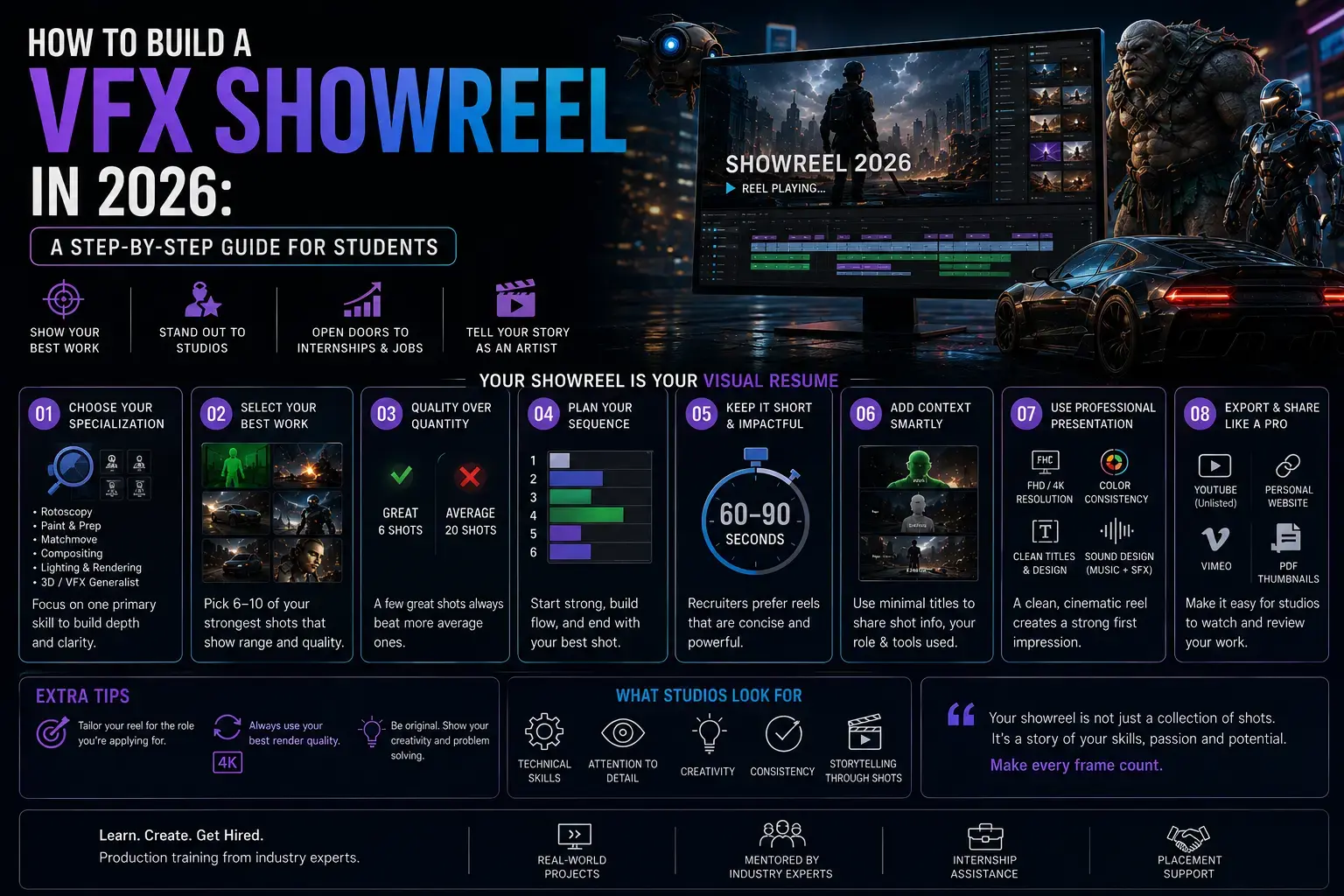
Your showreel is the single document that determines whether a VFX studio calls you in for an interview. Not your degree. Not your resume. Not your cover letter.
A weak reel from a top-name graduate school gets rejected. A strong reel from an unknown institute gets shortlisted. Studios at DNEG, NY VFXwaala, Prime Focus, and Prana Studios all apply the same filter: play the reel, make a decision in the first 10 seconds, decide on shortlisting by the 30-second mark.
This guide covers every step — shot selection, reel length, breakdown techniques, software, hosting, and the specific mistakes that get student reels rejected before they reach a hiring manager.
Key Takeaways
- ✓ Recruiters decide within 10 seconds — your first shot is the most important creative decision you make
- ✓ Students should target 45–60 seconds; never exceed 2 minutes at any career stage
- ✓ Label every shot with your exact contribution — studios cannot shortlist ambiguous work
- ✓ Host on Vimeo (primary), ArtStation (discovery), YouTube (backup)
- ✓ Specialise your reel for the role you are applying for — 80% of the reel should match the target department
- ✓ Breakdowns are mandatory for roto, paint, compositing, and matchmove reels
Step 1: Decide Your Specialisation Before Building the Reel
The first decision is not which shots to include. It is which department you are targeting. Compositing is the most in-demand VFX role — required on every production even when animators and modellers are not (CG Spectrum). Matchmove, roto, and paint are established entry points. Houdini FX and lighting are higher-ceiling specialisations.
Once you have chosen, your showreel should be 80% dedicated to that one discipline. If you are applying for a compositing role, 80% of the reel is compositing work. Not modelling, not animation, not a bit of everything. Studios hire for specific roles. A generic reel says "I do not know what I am" and gets set aside.
If you are genuinely strong in two adjacent disciplines — roto and paint, for example — you can build two separate short reels (one for each) and submit the relevant one per application. Do not combine them into one long generalist reel.
Step 2: Select Shots by a Simple Rule
Outpost VFX summarise the selection rule clearly: "Your reel is only as good as your worst shot." Every shot you include sets an implicit quality standard for everything else. If your weakest shot is significantly below your best, it damages the entire reel.
Selection criteria for each shot:
- Does this demonstrate a skill the role requires? If not, it does not belong.
- Is the technical execution clean? Crawling roto edges, mismatched defocus, colour discrepancies, and compression artifacts are disqualifying.
- Can I clearly explain what I did on this shot in one sentence? If not, do not include it.
- Is this the most challenging version of this technique I can do? Always show your ceiling, not your average.
For a fresher reel, 4–6 strong shots is the right target. Six weak shots is worse than four excellent ones. The Rookies 2026 guide notes that building a portfolio capable of getting hired typically requires 2–4 years of focused study — be honest with yourself about whether you are there yet before submitting.
Step 3: Structure the Reel for the 10-Second Decision
The structure of a VFX showreel follows a known formula used across studios:
- Title card — Your name, your specialisation ("VFX Compositor" or "Roto & Paint Artist"), and contact email. Clean, 3–5 seconds maximum.
- Shot 1 — Your absolute best work. This is the hook. It must arrest attention. If you only have one great shot, it goes here.
- Shot 2 — Second-best. Sustain the momentum. Do not let the reel drop in quality after the opening.
- Shots 3–N — Supporting work. These can show range within your specialisation, but must maintain quality.
- Last shot — A strong finish. Your second or third best piece. Do not end on weaker work.
- End card — Name, email, phone number, Vimeo link, ArtStation link. No studio has time to search for your contact information.
The FMX 2025 session on VFX applications confirmed the same structure: best shot first, second-best last, contact details at the end. No music that distracts — many recruiters watch reels on mute.
Step 4: Know the Right Length for Your Career Stage
Reel length is one of the most common errors in student showreels. A longer reel signals to a recruiter that you lack the editorial judgment to know what is good. A 4-minute student reel, regardless of content, looks like padding.
Source: VanArts (2024), CG Spectrum (2025), Outpost VFX (2022), FMX 2025 industry session
The 10-second window is also worth understanding. CG Spectrum describes it precisely: you have roughly 15 seconds to capture attention and 30–45 seconds to maintain it. Everything in your reel should be built around that reality, not around how much work you want to show.
Step 5: Create Proper Breakdowns
Breakdowns are non-negotiable for roto, paint, compositing, and matchmove reels. Without a breakdown, a recruiter cannot know whether the quality in the final frame is your work or someone else's from a multi-artist production.
Breakdown techniques that work:
- Linear wipes — Slide between the raw plate and the finished composite. Standard and effective for compositing and paint work.
- Side-by-side splits — Show before and after simultaneously. Works well for matte painting and paint & prep work.
- Layer reveals — Fade in individual VFX elements over the plate to show how they build up. Useful for compositing reels.
- Wireframe overlays — Essential for matchmove reels. Show the tracking geometry aligned to the plate to prove the solve accuracy.
- Roto matte display — Show the isolated matte output over a high-contrast background to prove clean edges, especially on hair and motion-blurred subjects.
Do not over-engineer breakdowns. ActionVFX recommends 3–4 breakdown wipes maximum. More than that, and you are explaining rather than demonstrating. The shot quality should do the speaking; breakdowns provide the evidence of authorship.
Step 6: Label Every Shot — Contribution Clarity Is a Hiring Requirement
The ArtStation State of the Art report (2025 survey of 2,000+ artists) identified "unclear role in team projects" as one of six disqualifying portfolio red flags for recruiters. A recruiter looking at a studio-quality shot with no label does not assume you are talented — they assume the shot was not yours.
Label format that works: [Department] — [Specific task]. For example:
- "Roto — multi-layer hair isolation with motion blur integration"
- "Paint — wire and rig removal across 342 frames"
- "Compositing — CG creature integration, colour grade, volumetric interaction"
- "Matchmove — handheld camera solve, rigid body tracking"
If the shot was a collaborative project, state which elements were your contribution and which were a colleague's. Ambiguity is not neutral — it reads as evasiveness.
Step 7: Assemble the Reel in the Right Software
The reel itself — the final video file — needs to be assembled and exported cleanly. Two tools dominate in 2026:
- DaVinci Resolve — The recommended tool for showreel assembly. Professional colour science is built in, the Fusion tab handles breakdown overlays and animated wipes, and the free version covers everything a student needs. DaVinci Resolve 20 released in 2025 with improved timeline performance. No subscription required.
- Adobe Premiere Pro — Equally capable if you are already in the Creative Cloud ecosystem. Integrates with After Effects for animated title cards and breakdown transitions.
Export at the highest bitrate your hosting platform will accept. Vimeo recommends H.264 at a minimum of 10 Mbps for 1080p, or ProRes/H.265 for 4K. Compressed, blocky reels imply careless presentation — recruiters notice.
Step 8: Host the Reel Where Recruiters Actually Look
Source: Outpost VFX (2022), ArtStation Magazine (Dec 2025), SkillSearch portfolio guide (2025)
The right hosting stack for a VFX student in 2026:
- Vimeo — Primary reel hosting. No ads, superior compression, clean embed. Use a paid Vimeo plan if possible; the free plan limits upload frequency. Set privacy to public or password-protect with the password shared in your application (never force recruiters to request access).
- ArtStation — Portfolio discovery. Studio art leads and talent scouts actively search ArtStation. Keep your portfolio current and tag correctly by discipline and software.
- YouTube — Backup copy. Acceptable but has ads and compression artifacts. Use as a fallback link only.
- Personal website — Embed your Vimeo reel in a minimal portfolio site. Gives you control over presentation and is a signal of professional investment.
- LinkedIn — Link your Vimeo reel in the featured section. Required for network building; not a hosting platform.
One practical warning: do not password-protect your reel without providing the password immediately. Multiple industry sources cite this as a rejection trigger — recruiters do not follow up to request access. If you are concerned about IP, set the Vimeo password and include it in the application email or cover message.
Step 9: Reel Requirements by Specialisation
Different VFX departments require different reel content. The table below outlines what each specialist reel must demonstrate:
| Reel Type | Must Include | Key Technical Proof |
|---|---|---|
| Roto Reel | Hair, focus-pulls, motion-blur subjects | Clean matte edges; no crawling on semi-transparent areas |
| Paint & Prep Reel | Wire removal, rig removal, clean-plate rebuild | Before/after wipes; invisible result over moving background |
| Compositing Reel | CG integration, colour grade, sky replacement, keying | Diversity of techniques; correct defocus and colour matching |
| Matchmove Reel | Nodal, steady, handheld camera solves; object tracking | Wireframe proxy geometry overlay proving solve accuracy |
| FX / Houdini Reel | Fluid, fire, smoke, destruction in live-action plates | Realistic physics; no black-background FX showpieces |
| Lighting / Rendering Reel | CG scene lighting, live-action integration, volumetrics | Master one render engine (Arnold, Redshift, RenderMan) |
The 10 Mistakes That Get Student Reels Rejected
Combined from ActionVFX, Outpost VFX, CG Spectrum, and Filmustage — the mistakes studio art leads cite most frequently:
- Weak opening — Not leading with your best shot. Recruiters decide within 10 seconds.
- Padding with mediocre work — Including weak shots to hit a length target. Every shot dilutes the average.
- Using tutorial outputs directly — Studio art leads recognise standard Houdini tutorial assets and generic online footage. Personalise every shot.
- Missing contribution labels — No text stating what you did on each shot. Ambiguity is disqualifying.
- Password-protecting without providing the password — Recruiters do not follow up; they move on.
- Distracting music — Many recruiters watch on mute. Heavy, genre music makes the reel seem amateurish.
- Exceeding two minutes — Signals poor editorial judgment regardless of content quality.
- Defocus and colour mismatches — The most common technical failure in compositing reels. CG elements that do not match the plate's depth-of-field or colour temperature are immediately visible.
- No contact details on the end card — The reel can play anywhere — via Slack, email forwarding, a shared folder. If your name and email are not in the video itself, you miss referral opportunities.
- Targeting the wrong role — A compositing reel sent to a matchmove role, or a generalist reel sent anywhere. Match 80% of your reel to the specific department.
A Note on Timing: When Is Your Reel Ready?
The Rookies 2026 career guide is direct on this point: "Landing your first job after building a professional reel can take another 3–12 months." This is not discouraging — it is calibrating. A reel you rush before reaching a professional quality standard will get rejected more times than one submitted six months later when your skills have matured.
The honest question before submitting any application: would I be confident showing this reel to the lead compositor at DNEG? If the answer is no, add more shots instead of more applications.
Studios in India hire on a rolling basis. DNEG India, Prime Focus, and NY VFXwaala post roles throughout the year. There is no single recruitment season to target. A strong reel submitted when you are genuinely ready outperforms an average reel submitted to every open role.
For context on what studios pay entry-level artists once you do get hired, see our guide to VFX artist salaries in India by specialisation (2026). For the software fundamentals behind compositing — the most in-demand VFX reel — read our introduction to lighting and rendering in VFX and what compositing involves in a VFX pipeline.
If you are building your reel while still in training, talk to our mentors at DigiAura about showreel feedback and where your current work stands →