
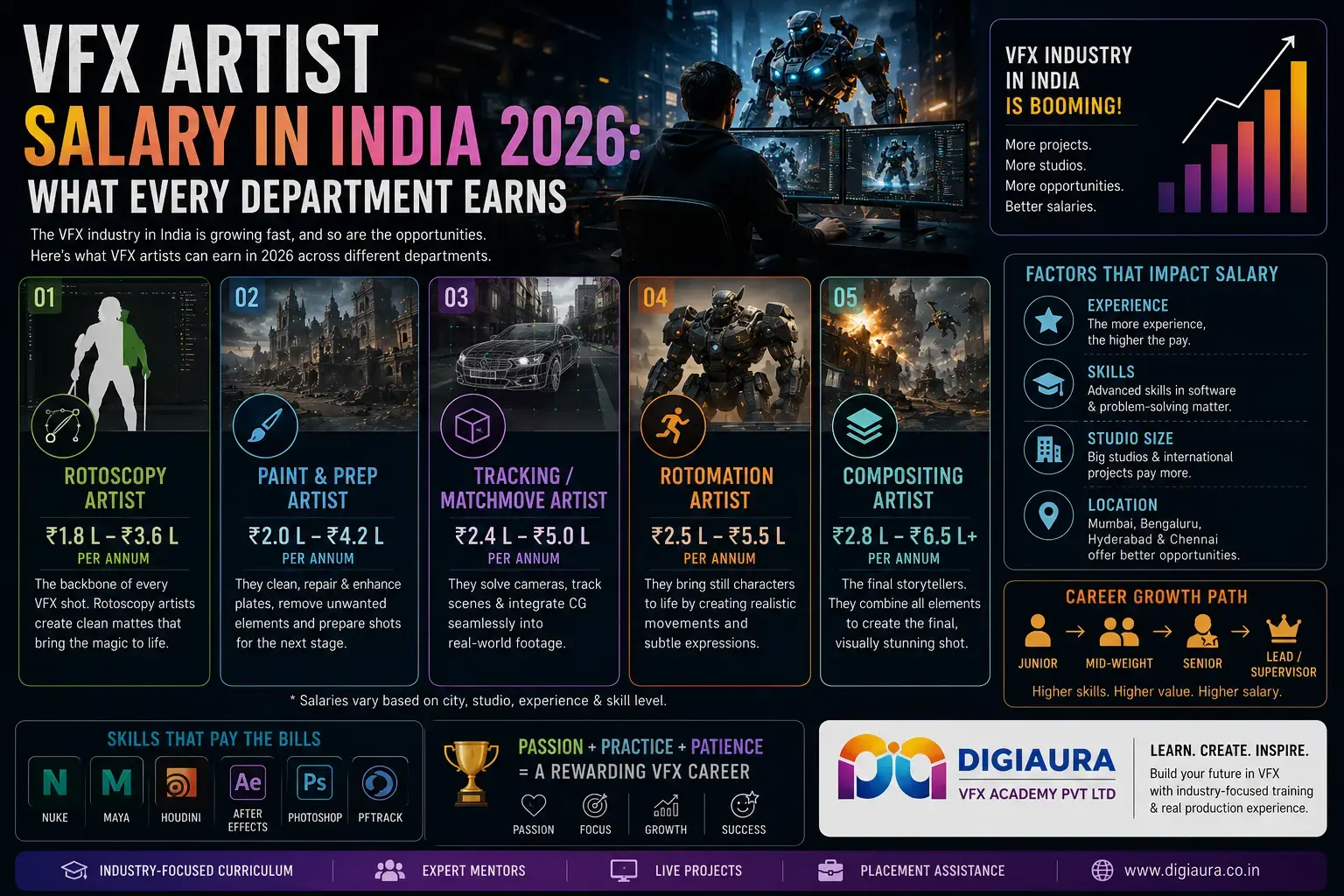
India's AVGC sector — Animation, Visual Effects, Gaming, and Comics — creates more than 1,60,000 new jobs every year according to a CII GT report published in August 2024. But not all VFX roles are built equal. A roto artist and an FX Technical Director both work in VFX, yet their salaries can differ by a factor of eight. If you're choosing a VFX specialisation — or benchmarking your current pay — a generic "₹3 to ₹20 LPA" range doesn't help. This guide maps real 2026 pay data to every major department, from rotoscopy to VFX supervision, so you know exactly what each career path is worth.
Key Takeaways
- The median VFX artist salary in India is ₹4,04,525/year — roughly ₹33,710/month — across all experience levels (PayScale India, Feb 2026).
- FX TDs with Houdini skills earn ₹8–20 LPA, the highest ceiling of any specialist role; roto and paint artists start at ₹2.5–4 LPA.
- Houdini mastery carries a 28% salary premium over the base rate at the same experience level (PayScale, 2024).
- Mumbai pays the most; Chennai is India's fastest-growing VFX hub and offers strong mid-level salaries at a significantly lower cost of living.
- India's Animation & VFX market is forecast to reach US$2.2 billion by 2026, up from US$1.3 billion in 2023 (CII GT / IBEF, 2024).
What Is the Average VFX Artist Salary in India in 2026?
The median VFX artist salary in India is ₹4,04,525 per year, based on 65 salary profiles collected by PayScale India as of February 2026. That median rises significantly with experience — from ₹3.05 LPA at entry level to ₹5.12 LPA for late-career artists with more than ten years of experience. The jump between mid-career and late-career is relatively modest (₹5.00 to ₹5.12 LPA), which means specialisation matters far more than seniority alone at the upper end of the salary curve.
The bonus element adds a meaningful supplement. PayScale's data shows a median annual bonus of ₹15,260, ranging from ₹5,000 to over ₹1,00,000 for experienced artists at premium studios. Total compensation including bonus averages ₹4,27,194 per year. Only 63% of VFX artists in India report having medical insurance coverage — a notable benefit gap compared to IT or engineering roles at equivalent salary levels.
Citation Capsule: The median VFX artist salary in India is ₹4,04,525/year, rising from ₹3.05 LPA at entry level to ₹5.12 LPA for late-career professionals — a 68% increase over a 10-year span, according to PayScale India (Feb 2026, 65 profiles). Specialisation in high-demand skills accelerates salary growth far beyond the experience curve alone.
VFX Salary by Department: The Complete 2026 Breakdown
Department matters more than years of experience when it comes to VFX pay in India. An FX TD with four years of Houdini simulation experience earns more than a roto artist with ten years in the field. The table below compiles 2026 salary ranges from ITM Education and GUVI (both citing AmbitionBox and Glassdoor data) across the eight core VFX departments.
| Department | Entry (0–2 yrs) | Mid (3–7 yrs) | Senior (8+ yrs) |
|---|---|---|---|
| Roto & Paint Artist | ₹2.5–4 LPA | ₹4–6 LPA | ₹6–9 LPA |
| Matchmove Artist | ₹3–4.5 LPA | ₹4.5–7 LPA | ₹7–10 LPA |
| Compositor / VFX Artist | ₹3–5 LPA | ₹5–9 LPA | ₹9–14 LPA |
| 3D Animator | ₹3.5–5 LPA | ₹5–9 LPA | ₹9–15 LPA |
| Rigger Artist | ₹3–5 LPA | ₹5–8 LPA | ₹8–12 LPA |
| Lighting Artist | ₹3.5–5.5 LPA | ₹5.5–10 LPA | ₹10–16 LPA |
| FX TD (Houdini) | ₹3.2–5 LPA | ₹8–14 LPA | ₹14–20+ LPA |
| VFX Supervisor | ₹9–12 LPA | ₹12–18 LPA | ₹18–25+ LPA |
Notice the Houdini jump in the FX TD row. At entry level, an FX TD earns a similar range to a compositor. But from mid-career onwards, the FX TD salary roughly doubles relative to compositing and animation. This gap is driven by the scarcity of Houdini simulation skills in India — specifically fluid, pyro, and rigid-body dynamics in Houdini's FLIP and Pyro solvers — relative to the international outsourcing demand these skills command. Learning 3D fundamentals including rigging before moving into FX is the standard career path into Houdini TD roles.
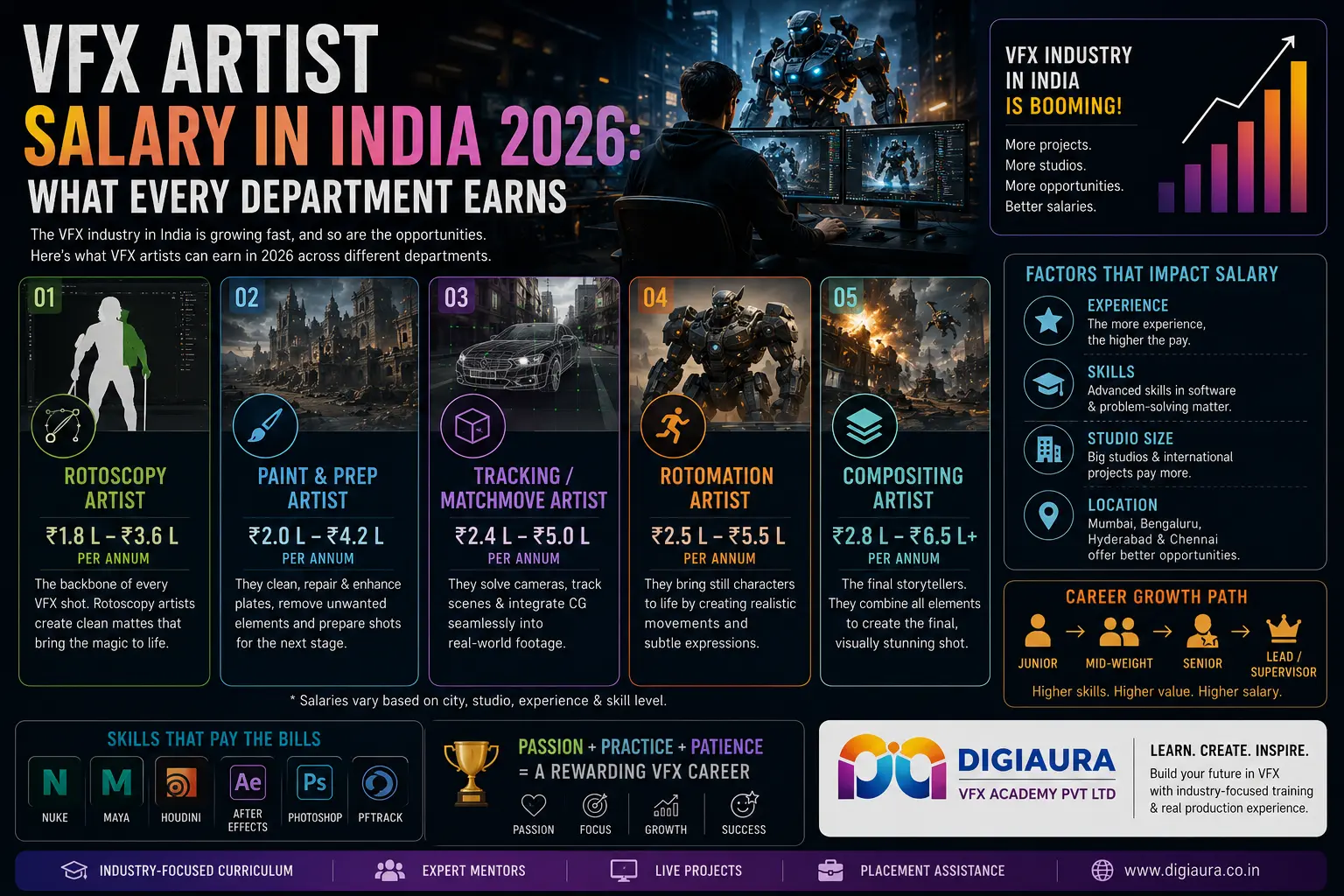
Another notable pattern: the VFX Supervisor entry range (₹9–12 LPA) is already the highest floor of any role in the table. That's because VFX Supervisor is not a fresh-hire role — it's a senior position that requires both technical depth and team leadership. Artists who move into supervision from compositing or CG roles in their mid-career are the ones who hit ₹18–25 LPA. The role carries business accountability that no other position in the list carries, and the salary reflects it.
Citation Capsule: In India's VFX market, FX TDs with Houdini skills earn ₹8–20 LPA at mid-to-senior levels, while roto and paint artists start at ₹2.5–4 LPA — a four-fold pay gap within the same industry driven by skill scarcity rather than years of experience alone (ITM Education / GUVI, 2026, citing AmbitionBox and Glassdoor data).
Which VFX Department Pays the Most — and Why?
FX TDs and VFX Supervisors are the two highest-paid roles — but for entirely different reasons. FX TDs earn premium pay because Houdini simulation is a rare technical skill that takes years to master and is in short supply in India relative to international demand. VFX Supervisors earn premium pay because they carry business accountability: they sign off on the creative and technical quality of entire productions. Both paths require deliberate specialisation — neither is a default landing spot from a generic VFX course.
What does this mean for someone choosing a VFX specialisation today? The lighting artist role is often underrated — it's accessible through a solid 3D foundation in Maya or Houdini, it carries creative prestige, and it hits ₹5.5–10 LPA at mid-career without the steep technical barrier of Houdini FX simulation. If your goal is to work in character-driven visual effects for film or OTT, lighting is an under-supplied, well-paying path that fewer students are pursuing compared to compositing.
Want to understand every VFX department from prep to final comp? Our pipeline overview maps where each of these roles fits in a production, which helps when choosing your entry point.
VFX Artist Salary by City in India: Where Should You Work?
Mumbai is India's highest-paying market for VFX artists — senior artists earn ₹10–15 LPA in the city, driven by Bollywood studio budgets and a concentration of international outsourcing facilities. But Mumbai is not necessarily the smartest move for every career stage. Chennai's VFX market is growing faster than any other Indian city's, and the combination of Kollywood's consistent production volume and a lower cost of living makes it an increasingly attractive base for mid-career artists.
| City | Entry Range | Senior Range | Market Driver |
|---|---|---|---|
| Mumbai | ₹3–5 LPA | ₹10–15 LPA | Bollywood + international studios |
| Bangalore | ₹3–5 LPA | ₹9–14 LPA | Gaming studios + OTT platforms |
| Hyderabad | ₹2.5–4.5 LPA | ₹9–13 LPA | Tollywood + global outsourcing |
| Chennai | ₹2.5–4 LPA | ₹8–12 LPA | Kollywood + fastest-growing hub |
| Pune / Delhi NCR | ₹2.5–4 LPA | ₹8–11 LPA | Mixed: advertising, gaming, smaller facilities |
Source: WikiTechy and GUVI, 2026 — citing Glassdoor and AmbitionBox. Chennai's ₹8–12 LPA senior range is competitive with Hyderabad and offers a substantially lower cost of rent and transport. Among the top VFX institutes in Chennai, DigiAura places graduates directly into Chennai's growing studio network, which serves both Kollywood productions and international outsourcing pipelines.
Top Studios Hiring VFX Artists in India — and What They Pay
Studio name carries real weight in Indian VFX salaries. DNEG India — one of the world's largest visual effects companies, with Indian operations in Mumbai and Bangalore — pays ₹4.8–19.2 LPA across roles, according to AmbitionBox data compiled by GUVI (2026). That's a 4× spread between a junior roto artist and a senior compositor or FX TD. The studios doing international Hollywood and OTT work consistently pay 15–25% more than domestic-only Indian production facilities at equivalent roles.
- DNEG India (Mumbai / Bangalore): ₹4.8–19.2 LPA — international pipeline, Hollywood films and streaming series
- Technicolor India (Mumbai): ₹3.6–14.4 LPA — major international outsourcing work, multiple departments
- Red Chillies Entertainment (Mumbai): ₹3.6–11 LPA — Shah Rukh Khan's studio, high-profile Bollywood productions
- Prime Focus World (Mumbai / Hyderabad): ₹3–12 LPA — large domestic and international slate, multiple locations
- NY VFXWaala / DQ Entertainment: ₹2.5–8 LPA — animation-heavy, OTT content, strong entry-level hiring
- Pixion / Spellbound VFX (Chennai): ₹2.5–9 LPA — Kollywood pipeline, strong local placement network
The 70% international revenue share is worth noting. According to IBEF, 70% of the revenue Indian VFX studios generate comes from international partnerships. This means the studios doing the best-paid work are the ones connected to Hollywood and global OTT content — and getting into one as a junior requires a showreel that demonstrates production-ready skills, not just software familiarity. The studio you join determines your salary ceiling more than almost any other factor in the first five years of your career. Learn more about how India's VFX industry is growing in 2026 and which market forces are driving studio hiring.
How to Increase Your VFX Salary in India
Houdini mastery is the single biggest salary lever available to a mid-career VFX artist in India. PayScale data (2024) shows that Houdini-skilled FX artists in Mumbai earn a median of ₹4,12,707 per year versus the overall VFX artist average of ₹3,22,774 — a 28% premium at the same experience level. The premium grows further at mid-career, where Houdini FX TDs earn ₹8–14 LPA versus ₹5–9 LPA for compositors at the same seniority level. That's a difference of ₹3–5 LPA on an annual basis purely from software specialisation.
What are the five most reliable ways to push your salary upward? Based on the data:
- Master Houdini or Nuke — Premium software creates a premium salary. Houdini FLIP and pyro simulations are scarce in India; Nuke's 3D compositing skills push compositors from mid-tier to lead-tier pay.
- Get Python or scripting skills — Pipeline TDs with Python scripting earn ₹8–16 LPA. Scripting skills are increasingly valuable as studios automate repetitive pipeline tasks and need artists who can write tools as well as use them.
- Work on international productions — Artists who have credits from Hollywood or premium OTT shots command 15–25% more in their next role. One strong international credit is worth more in salary negotiation than two years of domestic-only work.
- Specialise rather than generalise — At mid-career, depth beats breadth. Generalist artists plateau at ₹5–7 LPA. Artists who are genuinely the go-to person for one thing — hair simulation, crowd systems, sky replacement at scale — earn lead rates.
- Move from doing shots to leading them — The transition from senior artist to team lead or supervisor is the single biggest salary event in a VFX career. It typically adds 40–65% to annual compensation. The transition requires communication and project management skills that most VFX training doesn't explicitly teach. See how VFX careers progress after 12th for a full timeline of the specialisation journey.
Citation Capsule: Houdini-skilled FX artists in Mumbai earn a median of ₹4,12,707 per year — a 28% premium over the overall VFX artist median of ₹3,22,774 at the same experience level (PayScale India, 2024, 27 profiles). Moving into team leadership adds a further 40–65% above base artist pay.
Is VFX a Good Career in India in 2026?
India's Animation and VFX market is on track to reach US$2.2 billion by 2026, up from US$1.3 billion in 2023 — a 70% increase in three years, according to a CII GT report released in August 2024. The sector creates more than 1,60,000 new positions annually, and NASSCOM projects 2 million total AVGC jobs in India by 2030. OTT platforms — Netflix, Amazon Prime, Disney+Hotstar — are commissioning more Indian-origin content that requires VFX at scale, which directly creates hiring demand across compositing, FX, and supervision departments.
Ultimate VFX Careers Guide 2025 — with salary breakdown by role and department
What about AI's impact? This is the honest version: AI tools — particularly rotoscopy assistants, sky replacement systems, and generative background fill — are automating the most repetitive entry-level tasks. Demand for pure roto-only roles is flattening. Studios that previously hired 10 roto artists for a project can now do the initial pass with AI and hire 6–7 artists for cleanup and QC. This is real pressure on entry-level roto and paint salaries.
But the same technology is creating new demand higher up the value chain. Someone has to supervise and quality-control AI-generated roto passes. Someone has to run the Houdini simulation pipelines that AI can't replicate. Someone has to composite the AI-generated elements convincingly. The answer to AI automation in VFX isn't to avoid the industry — it's to specialise into the departments where human craft remains irreplaceable. FX TDs, lighting artists, compositors, and supervisors are all benefiting from AI-expanded production capacity. Read our 2026 VFX industry trends guide for a deeper analysis of where AI is reshaping workflows.
Citation Capsule: India's Animation and VFX market is set to reach US$2.2 billion by 2026, up from US$1.3 billion in 2023, creating more than 1,60,000 new jobs per year — with NASSCOM projecting 2 million total AVGC jobs by 2030 (CII GT Report, IBEF, August 2024). Demand growth is concentrated in compositing, FX, and supervision roles rather than entry-level roto.
Frequently Asked Questions About VFX Salaries in India
What is the starting salary for a VFX artist fresher in India?
VFX freshers in India typically earn ₹2.5–4.5 LPA for entry-level roles like roto artist or junior compositor. The median salary across all experience levels is ₹4,04,525 per year, according to PayScale India (Feb 2026, 65 profiles). Roto and paint roles start at the lower end; junior compositors and animators start slightly higher. Graduating from a programme with a production-quality showreel typically pushes starting offers toward the top of the entry range.
Which VFX department has the highest salary in India?
FX Technical Directors (FX TDs) with Houdini skills earn ₹8–20 LPA at mid-to-senior level, making it the highest-paying specialist role. VFX Supervisors earn ₹12–25 LPA at senior level but typically require ten or more years of experience. At mid-career, FX TDs earn more per year than any other department without requiring the management experience that supervision demands.
Does learning Houdini increase VFX salary in India?
Yes. Houdini-skilled FX artists in Mumbai earn a median of ₹4,12,707 per year versus the overall industry average of ₹3,22,774 — a 28% premium at the same experience level (PayScale, 2024). The premium grows significantly at mid-career as Houdini simulation skills remain scarce in India relative to international outsourcing demand. Learning Houdini after building a 3D foundation in Maya is the standard path into FX TD roles.
Which city pays VFX artists the most in India?
Mumbai offers the highest VFX salaries — ₹10–15 LPA for senior artists — driven by Bollywood studios and international outsourcing facilities. Bangalore and Hyderabad follow closely, especially for gaming and OTT-focused studios. Chennai is India's fastest-growing VFX hub, offering ₹8–12 LPA for senior roles with a significantly lower cost of living than Mumbai or Bangalore, making it an attractive base for mid-career artists.
Is a VFX career in India affected by AI in 2026?
AI tools are automating basic rotoscoping and paint cleanup, which is reducing demand for pure entry-level roto roles at some studios. However, demand is growing for FX TDs, compositors, and supervisors who can direct AI-assisted pipelines. India's AVGC sector still projects 2 million total jobs by 2030 (NASSCOM), and the overall market is growing at 15–18% CAGR. Specialising beyond roto into compositing, FX, or supervision is the most durable career strategy in the AI era.
VFX salaries in India in 2026 are shaped almost entirely by two variables: which department you're in and which studio you work for. The market rewards specialisation — roto artists who move into compositing, compositors who learn Nuke, Houdini artists who master simulation — with significant salary jumps at every transition. The industry backdrop supports that investment: 1,60,000+ new jobs per year, a US$2.2 billion market by 2026, and 70% of revenue driven by international partnerships that consistently pay higher rates than domestic-only production. DigiAura's VFX programmes in Chennai are structured specifically around the departments where this demand is growing — compositing, FX, and the full production pipeline. Talk to our team about which programme fits your target department →