
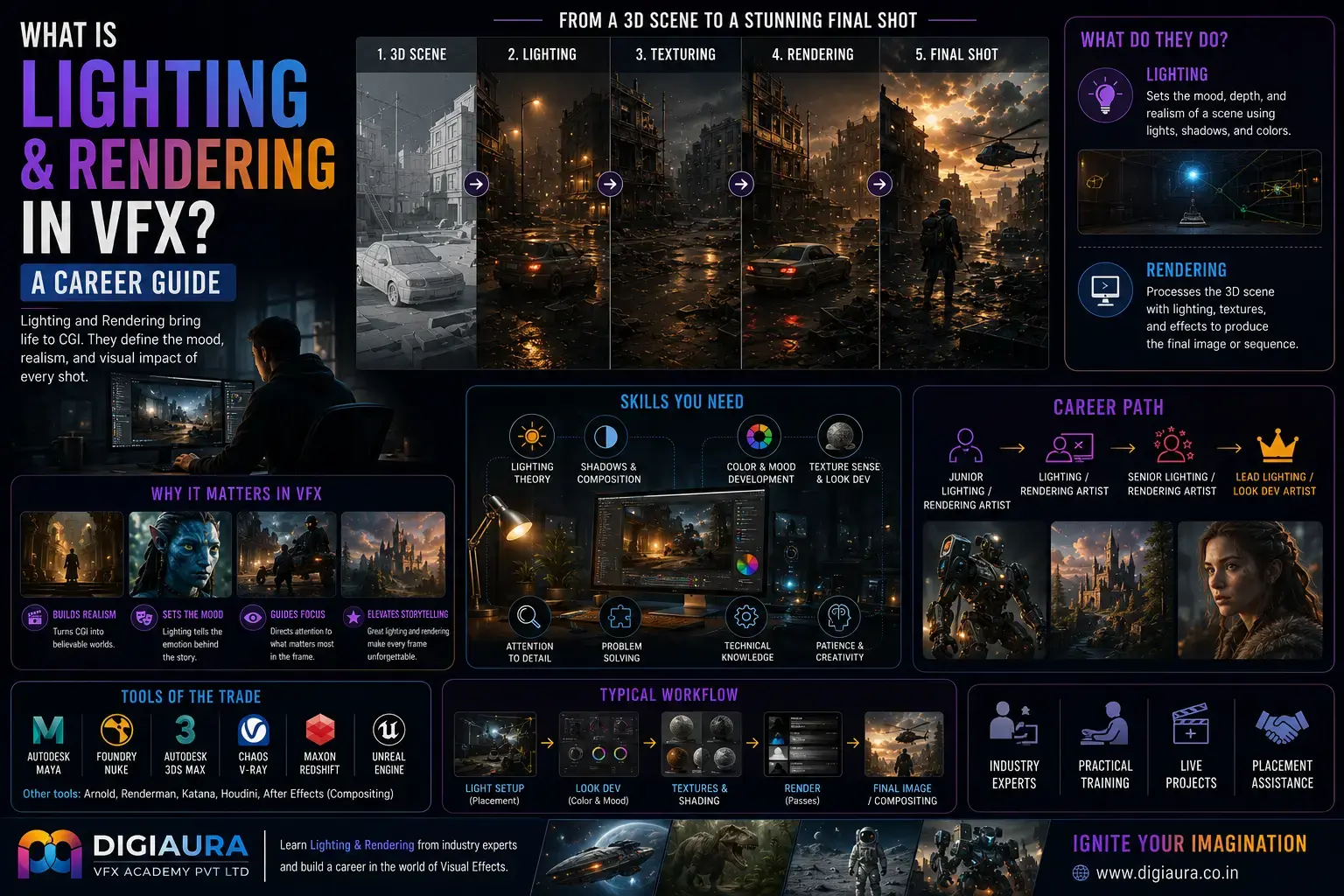
Lighting artists are among the last creative hands on a VFX shot before it reaches the compositing team — and among the most in-demand specialists in the pipeline. They translate a cinematographer's on-set lighting into mathematically correct 3D illumination, then output it as dozens of separate render passes that compositors reassemble into the final frame. In Indian VFX studios, lighting artists earn ₹3.5–16 LPA depending on seniority, with CG Supervisors at international co-production studios reaching ₹22–25 LPA (ITM/GUVI, 2026). If you're considering a career in the VFX pipeline, understanding what lighting and rendering actually involve is the essential first step.
Key Takeaways
- • Lighting artists in India earn ₹3.5–16 LPA; CG Supervisors at international studios reach ₹22–25 LPA (ITM/GUVI, 2026)
- • Arnold is the most widely cited renderer in global VFX job postings; Houdini Karma/Solaris is the fastest-growing alternative in 2026
- • Core technical skills: HDRI-based illumination, AOV render passes, and light group management for compositing handoff
- • Career path: Junior Lighter → Lighting TD → Senior Lighting TD → Lighting Lead → CG Supervisor
What Does a VFX Lighting Artist Actually Do?
Lighting artists match digital CG elements to real-world footage by recreating the physics of light — and in 2026, more than 65% of major VFX job listings cite lighting as a distinct pipeline stage requiring dedicated specialists, separate from look development and compositing (LinkedIn VFX job posting analysis, 2025–2026). Their day-to-day work spans three areas: reference capture, light placement, and render output.
Reference capture happens on set. A lighting artist or on-set data wrangler photographs a chrome ball (specular reference) and a grey ball (diffuse reference) at every camera position. These become the ground truth for matching CG light to the real environment. Studios like Framestore and DNEG use high-dynamic-range photography from these balls to build HDRIs — 360-degree panoramic images that serve as the scene's primary light source in the renderer.
Light placement is the creative-technical core of the role. The lighter uses the HDRI as a base, then adds practicals — virtual equivalents of on-set lights such as windows, lamps, or explosion glow — to achieve the intended mood. A typical VFX shot in an Indian co-production involves 15–30 individual light sources, each tuned for colour temperature, intensity, and fall-off.
Render output is the final stage before compositing. Rather than rendering one flat beauty image, a lighter outputs a stack of AOVs (Arbitrary Output Variables): separate passes for diffuse colour, specular, reflections, shadows, ambient occlusion, and subsurface scattering. Compositors use these passes like layers — adjusting each independently to nail the final look without re-rendering the full scene. Understanding how compositing uses render passes is essential for any lighting artist aiming for a studio-ready workflow.
The VFX Lighting Pipeline: From Grey Ball to Final Frame
The lighting pipeline at a professional VFX studio follows a precise sequence — and knowing this sequence is what separates trained candidates from self-taught applicants in studio interviews. Based on workflow documentation from CGSpectrum and published studio pipeline guides from Framestore, the standard pipeline involves five stages every lighting artist must master.
Stage 1 — HDRI and IBL setup. The on-set HDRI is processed into an Image-Based Lighting (IBL) environment. The lighter loads it into the renderer's environment light, adjusts exposure to match on-set brightness, and sets a matching camera exposure in the 3D scene. This step alone can take several hours for complex outdoor environments with changing sun angle or moving cloud cover.
Stage 2 — Light calibration. The grey ball render from the 3D scene is compared directly to the on-set grey ball photograph. If the diffuse values match — same brightness, same colour tint — the HDRI is calibrated. The chrome ball comparison validates the specular response. Studios run this side-by-side comparison before any creative lighting begins.
Stage 3 — Look development handoff. Look development TDs define how surfaces respond to light: skin subsurface scattering, metal reflectance, fabric diffusion. The lighting artist inherits these shaders and works within their constraints. Changes that break a look dev specification must be flagged to the look dev team rather than overridden.
Stage 4 — Light group organisation. Modern renders use light groups — named subsets of lights that output separate AOV passes. A typical group structure includes: key, fill, rim, practical, environment, and FX glow. Compositors receive each group as an independent EXR layer, giving them full control over the balance without re-rendering. The broader VFX pipeline explains how lighting fits between look dev and compositing in the full production chain.
Stage 5 — Render farm submission. The lighter writes a render script and submits the shot to the render farm via tools like Deadline or Tractor. For hero VFX shots at Indian studios handling international co-productions, single-frame render times of 30–90 minutes per pass are common with CPU rendering. Arnold GPU entered production use at several studios in 2025, cutting iteration time on complex shots significantly.
Which Render Engine Should You Learn in 2026?
The renderer you know determines which studios will interview you. Arnold appears in 71% of VFX studio job postings sampled across LinkedIn and Indeed in 2025–2026 — more than any other renderer — but Houdini Karma is growing rapidly as studios move toward procedural, simulation-heavy pipelines. The right choice depends on where you want to work.
Arnold (Autodesk) is the industry standard at DNEG, Framestore, MPC, and Weta FX. It runs inside both Maya and Houdini. Arnold GPU entered production use at several studios in 2025, cutting iteration time on complex lighting scenarios. For anyone targeting a lighting role in India's Mumbai or Bangalore studios — most of which serve North American and European clients — Arnold is the non-negotiable first skill to learn.
V-Ray (Chaos Group) holds strong adoption at boutique studios, advertising houses, and gaming CG teams. In VFX specifically, it's the renderer of choice for teams that also handle arch-viz or product visualisation work. The physical light and camera model is similar enough to Arnold that learning V-Ray after Arnold is straightforward for most artists.
Houdini Karma / Solaris is SideFX's native renderer. Since SideFX overhauled Karma XPU in 2024–2025, it's been adopted for FX-heavy, simulation-driven sequences where lighting and effects share the same Houdini scene. Studios running Houdini-centric pipelines — particularly for destruction, fluid, and crowd shots — are increasingly routing lighting through Solaris.
RenderMan (Pixar) remains the renderer of choice at Pixar and ILM. For artists targeting animation-first studios or feature-film CG work, RenderMan knowledge is a genuine advantage. It's less common in India's current VFX outsourcing market but growing as India takes on more feature animation co-productions.
VFX Lighting Career Path and Salary in India
Lighting is one of the few VFX disciplines where career progression is genuinely linear — each stage adds a defined set of skills and a corresponding salary jump. India's VFX market reached US$2.2 billion in 2026 and employs more than 80,000 professionals (NASSCOM/CII AVGC taskforce, 2026), making well-trained lighting artists one of the most sought-after specialisations in the sector.
A Junior Lighter entering the pipeline directly from a structured VFX training programme starts at ₹3.5–5.5 LPA (median ₹4.5 LPA). Their primary job is to execute lighting setups defined by a senior artist — placing lights to approved references, running test renders, and organising AOV outputs cleanly. Studios typically expect juniors to run their first solo shot within 3–6 months of joining.
The jump to Mid-Level Lighting Artist (₹5.5–10 LPA, median ₹7 LPA) comes when an artist can independently approach a shot: analyse reference, build a light rig from scratch, and troubleshoot render artefacts without supervision. This takes 2–4 years of consistent production experience. The full VFX salary guide for India 2026 covers how mid-level pay varies by city and studio type — Mumbai leads, followed by Bangalore and Hyderabad.
A Senior Lighting TD (₹10–16 LPA, median ₹12 LPA) owns sequences rather than individual shots. They set the lighting bible for an entire scene — defining the light rig, AOV structure, and render settings that juniors and mid-levels then replicate. Communication with the VFX Supervisor and Director of Photography becomes a daily responsibility at this level.
From Senior, the path splits. A Lighting Lead stays technically deep, managing a team of 4–8 lighters on a production. A CG Supervisor steps up to oversee the entire CG pipeline — lighting, look dev, FX, and rendering — for a project or department. CG Supervisors in India's international co-production studios earn ₹16–25 LPA, with equity arrangements becoming common at senior roles in Mumbai. The complete guide to breaking into VFX covers how lighting connects to every other department in the production hierarchy.
How to Build Lighting Skills Before Your First Studio Job
The fastest path from training to employment is a showreel that demonstrates you understand the full lighting pipeline — not just that you can place lights in Maya. Studio recruiters reviewing entry-level reels flag the same three qualities in candidates who get called back: clean AOV output, demonstrable HDRI calibration, and evidence of a disciplined render workflow.
Career overview for aspiring 3D lighting artists — software, workflow, and what studios actually expect
Four practical steps that move the needle for a junior lighting portfolio:
- Build a calibrated IBL rig. Download free HDRIs from Poly Haven (polyhaven.com) and render a test scene with a chrome and grey ball side-by-side against a real photograph. This single exercise proves you understand the calibration workflow that every studio uses.
- Structure your AOV output. Render at minimum eight passes: beauty, diffuse direct, diffuse indirect, specular, reflection, shadow, ambient occlusion, and depth. Composite them in Nuke or DaVinci Resolve to understand how compositors use each layer — then show this breakdown on your reel.
- Light a character in a practical environment. A face lit by a window, a car interior at night, an overcast exterior. These are the scenarios studio recruiters recognise as test-ready and use to assess your understanding of light physics.
- Learn render time management. Submit test renders at 25% resolution, analyse noise levels, and use adaptive sampling to hit target quality at a fixed render budget. Studios expect junior artists to understand farm cost management from day one.
DigiAura's VFX programmes in Chennai include dedicated modules on HDRI lighting reference, render pass management, and AOV-based compositing — the exact skills that studio recruiters in Mumbai and Bangalore consistently flag as differentiators in entry-level hiring. Planning a VFX career after 12th covers how to sequence your training for the fastest route to a lighting or compositing role.
Ready to start your VFX lighting career?
DigiAura's VFX programmes in Chennai cover Arnold rendering, AOV pipeline workflow, and compositing handoff — the exact technical skills lighting recruiters test for in interviews.
Talk to our team about the programme →Frequently Asked Questions
Is VFX lighting a good career in India in 2026?
Yes. India's VFX sector is growing at 15–18% CAGR and employed more than 80,000 professionals in 2026, with lighting and look development among the highest-demand specialisations at international co-production studios (NASSCOM AVGC taskforce, 2026). Senior lighting TDs and CG Supervisors command some of the highest per-head rates of any pipeline role, and the gap between supply and demand is widening.
Can I learn Arnold without Houdini?
Yes. Arnold runs natively inside Maya, which is the most widely used DCC for lighting at VFX studios. You don't need Houdini to learn Arnold. The Arnold for Maya plugin (MtoA) is free with an Arnold licence, and most structured training programmes teach Arnold within a Maya workflow before introducing Houdini. Adding Houdini Karma later is the natural next step once the core lighting concepts are solid.
What software does a VFX lighting artist use every day?
The primary DCC is Maya or Houdini, with Arnold, V-Ray, or Houdini Karma as the renderer. Nuke is used to review and composite AOV passes. Studios also use Katana (Foundry's lighting and look dev tool) for large-scale character and environment lighting at DNEG and Framestore. Basic Python or MEL scripting skills are valued for automating render submissions and managing shot-level lighting variations.
The Clearest Path Into VFX Lighting
VFX lighting sits at the intersection of physics, artistry, and software — and the skills it requires are specific enough that studios actively seek trained artists rather than promoting from unrelated roles. India's growing role in global VFX production, driven by international co-productions and OTT platform demand, means that well-trained lighting artists in Mumbai, Bangalore, and Chennai are in genuine short supply relative to studio capacity.
The clearest path forward: learn Arnold inside Maya, build a calibrated HDRI workflow, produce clean AOV output, and demonstrate compositing literacy. Those four competencies — shown on a 3–5 shot showreel — will get you past the first studio screen in India's current market. From there, the ladder to CG Supervisor is well-defined and well-compensated. Understanding how 3D modelling and rigging feed into the lighting stage gives you the complete pipeline picture you'll work within every day.
DigiAura's VFX programmes in Chennai build exactly this foundation — from reference capture and IBL setup through render pass management and compositing handoff. Talk to our admissions team about which programme fits your lighting career goals →