
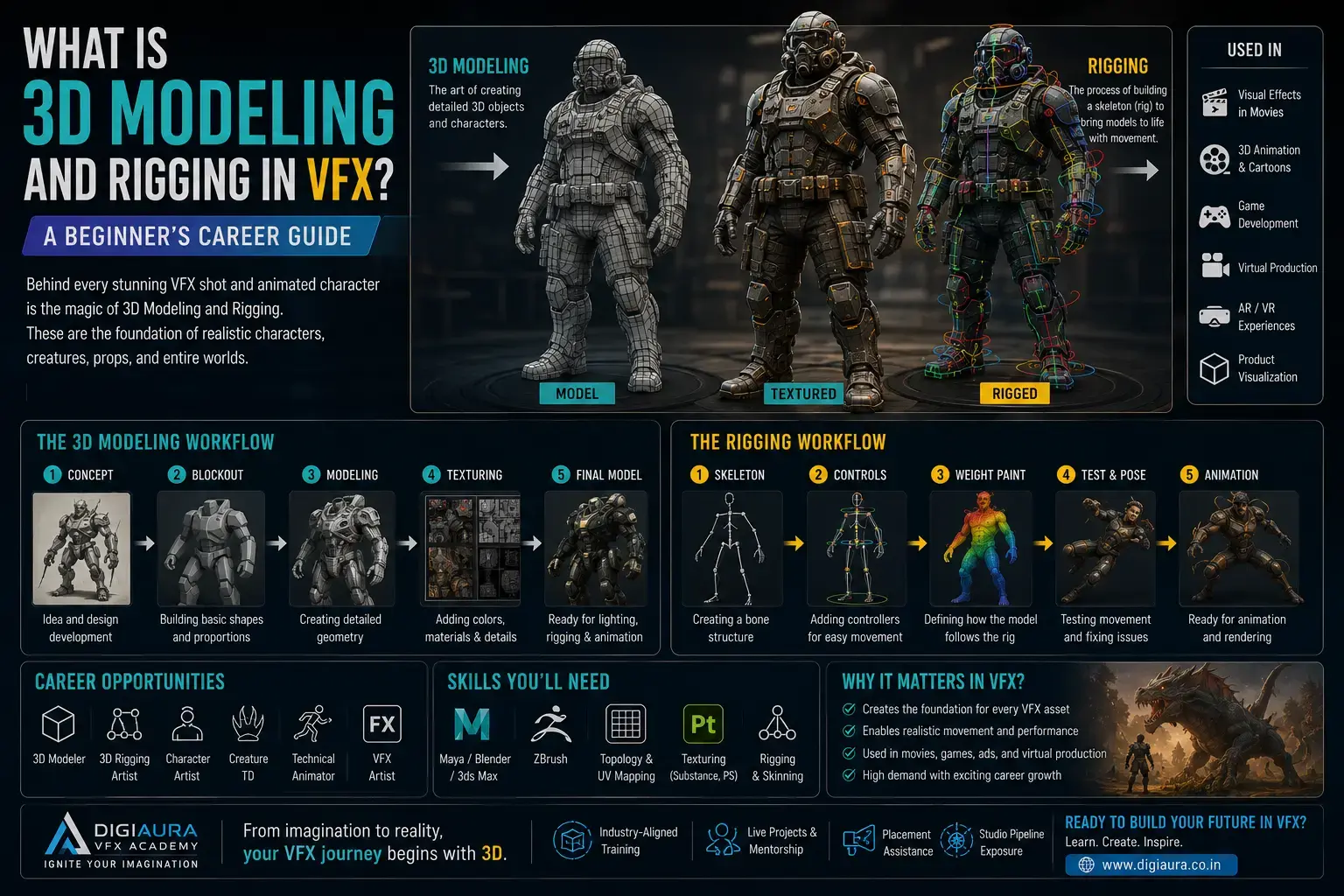
India's animation and VFX industry is on track to reach Rs 138 billion by 2028, growing at 10% annually (FICCI-EY Report 2026). Behind every blockbuster visual effect — every creature, every digital environment, every destroyed building — are 3D modelers and riggers. Yet most students exploring a VFX career have only a vague idea of what these roles actually involve day to day.
3D modeling and rigging are often confused with 3D animation. They aren't the same thing. This guide explains exactly what 3D modelers and riggers do inside a professional VFX studio, what software they use, how long it takes to train to a job-ready standard, and what artists earn in India in 2026. Whether you're deciding which VFX department to pursue or preparing for your first junior application, this is where to start.
Key Takeaways
- 3D modeling and rigging are mid-pipeline roles: modelers build digital assets; riggers build the control systems that make those assets move.
- India's animation and VFX sector is projected to reach Rs 138 billion by 2028, growing at 10% annually (FICCI-EY 2026), with studios in Mumbai, Hyderabad, and Chennai actively hiring.
- Over 170 active 3D modeling and texturing positions were listed on Glassdoor India in May 2026 (Glassdoor, 2026).
- Entry-level 3D artists earn ₹2.5–4.5 LPA. Experienced Rigging TDs earn ₹15–20 LPA or more (Glassdoor India, MAAC Education Salary Guide 2026).
- Autodesk Maya is the industry-standard tool for both modeling and rigging at every major professional VFX studio.
- AI is displacing roto and paint work (40–55% efficiency gains) but is not replacing 3D modeling and rigging, which require artistic and technical judgment that current AI tools cannot replicate (FICCI-EY 2026).
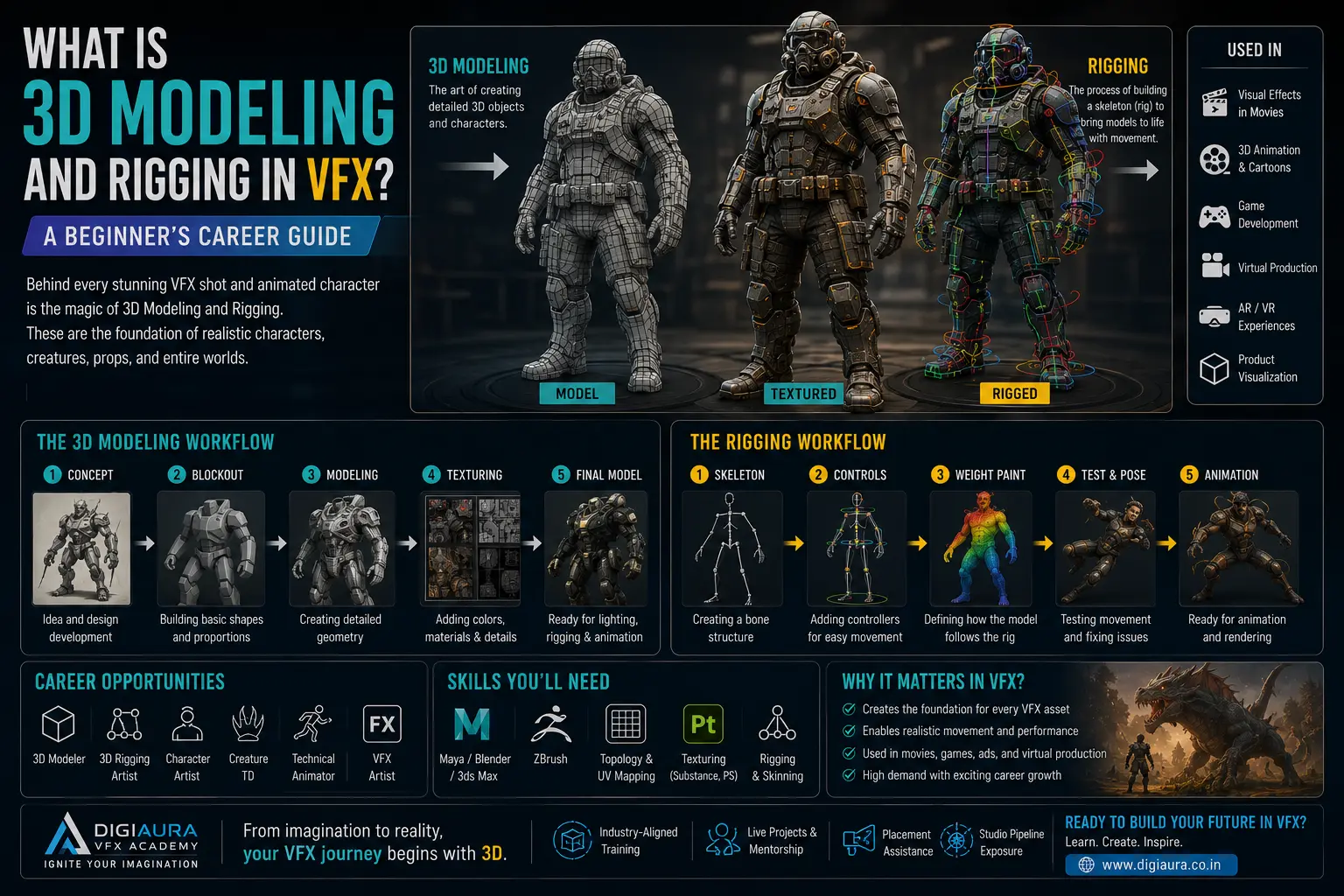
A 3D character moves through the pipeline from wireframe modeling to rigging to final rendered output — all before compositing begins.
What Is 3D Modeling in VFX?
More than 170 active 3D modeling and texturing positions were listed on Glassdoor India in May 2026 (Glassdoor, 2026). That demand exists because 3D modeling is the foundation of almost every visual effects shot. Without models, compositors, animators, and lighting artists have nothing to work with. A 3D modeler's job is to create the digital version of every object that appears in a VFX shot but doesn't exist on the real-world set.
There are two broad types of 3D modeling work in professional VFX production:
Organic modeling covers characters, creatures, skin, and any form with biological curves and asymmetry. Organic modeling requires a strong understanding of anatomy, because a creature's surface must deform naturally when it moves. The primary tool for organic work is ZBrush, which functions like digital sculpting clay — artists push, pull, and shape polygons directly.
Hard-surface modeling covers vehicles, spaceships, weapons, buildings, and mechanical props — anything with clean geometry, flat surfaces, and precise edges. Autodesk Maya is the go-to tool for hard-surface work in VFX studios, with Blender used at smaller and indie productions.
Once a model is built, it travels downstream through the pipeline. The modeler delivers the asset to the UV and texturing team, who add surface detail and material properties. From there it goes to the rigging department, who build the animation controls. The rigged asset then moves to animation, then lighting, and finally to compositing — where it becomes part of the finished shot.
Most articles on 3D modeling describe it as "making 3D objects" without explaining the constraint that matters most to studios: topology. Topology refers to how the polygons in a mesh are arranged and connected. A model with poor topology deforms incorrectly during animation, causes problems in UV unwrapping, and slows rendering. Studios review topology before accepting any asset delivery. Understanding clean topology is what separates a student portfolio model from a production-ready one — and it's the single area where most first-year 3D students need the most coaching.
What Is Rigging in VFX?
Rigging is the process of building the digital skeleton and control system that allows an animator to pose and move a 3D model. A Rigging TD — the senior version of this career — typically requires 3–5 years of prior modeling or VFX experience before reaching the technical director level (ScreenSkills UK, 2024). No rig means no animation. Every character, creature, or complex prop that moves in a VFX shot has a rig underneath it.
A rig has three core components:
Joints and bones form the internal skeleton. Every joint is a point in 3D space that can rotate or translate. A basic humanoid character has 50–100 joints covering the spine, limbs, fingers, jaw, and facial controls. Creature characters can have significantly more.
Control curves are the handles that sit on top of the rig and are what the animator actually touches. A rigger designs these controls to make the animator's workflow as intuitive as possible. A well-designed rig feels responsive and natural; a poorly designed rig produces stiff, robotic movement that shows up in the final shot.
Skin weighting tells the rig which part of the mesh to move when a specific joint rotates. If the skin weighting on a shoulder is wrong, the mesh collapses or pinches when the arm raises. Skin weighting is where most junior riggers spend the majority of their time — and where the most visible quality failures occur. It requires both technical accuracy and an eye for anatomy.
The career path in rigging runs from Junior Rigger to Mid Rigger to Senior Rigger and, at the top level, to Rigging TD. The TD role typically involves writing Python or MEL scripts to build automated rig components — tools that other riggers on the team use across multiple productions. Riggers working on creature and character productions develop a strong foundation in anatomy; those working on vehicles and props develop mechanical kinematics knowledge.
3D Modeling vs Rigging — Key Differences
Modeling and rigging are sequential, not competing. Modeling always comes first in the pipeline; rigging follows. A rigger cannot work without a finished model to rig. Understanding the pipeline sequence helps students decide which entry point better matches their strengths — and it helps clarify why most riggers start as modelers before specialising.
| 3D Modeling | Rigging | |
|---|---|---|
| Pipeline stage | Stage 1 — asset creation | Stage 2 — asset preparation for animation |
| Primary tools | Maya, ZBrush, Blender, Substance Painter | Maya (Rigging Tools), Python scripting |
| Skill emphasis | Artistic — topology, proportion, surface detail | Technical — anatomy, kinematics, scripting |
| Entry accessibility | Moderate — results are immediately visual | Lower — requires prior 3D experience to evaluate quality |
| India salary — entry | ₹2.5–4.5 LPA | ₹1.8–3.5 LPA (junior rigger) |
| India salary — senior | ₹10–15 LPA (Lead Modeler) | ₹15–18 LPA (Rigging TD) |
| Path to senior | Modeler → Lead Modeler → Asset Supervisor | Junior Rigger → Mid Rigger → Rigging TD |
The most practical difference for students choosing between these paths is skill emphasis. Modeling rewards artistic ability — a strong sense of proportion, form, and surface quality. Rigging rewards analytical and technical thinking. Most riggers who reach the Rigging TD level started with at least one year of modeling experience, which gives them the foundation they need to make good skin weighting decisions.
What Software Do 3D Modelers and Riggers Use?
Autodesk Maya is the non-negotiable foundation for both modeling and rigging at professional VFX studios in India. Studios hiring 3D artists in India in 2026 — including 88 Pictures, DNEG India, and Phantom FX — consistently list Maya as the required tool in job postings. ZBrush is listed as required for all character and creature modeling roles.
| Tool | Used For | Who Uses It |
|---|---|---|
| Autodesk Maya | Polygon modeling, rigging, animation | Modelers and riggers — industry standard at all major studios |
| ZBrush | High-poly sculpting, organic surface detail | Character and creature modelers — required for organic work |
| Blender | Modeling, rigging, rendering | Generalists, indie productions, smaller studios |
| Substance Painter | Texturing and material creation | Modelers at the post-modeling, pre-rigging stage |
| Mari | High-resolution texture painting | Senior character artists at large studios (Dneg, Framestore) |
| Houdini | Procedural modeling, FX-adjacent rigging | Advanced technical artists — not required at entry level |
Don't let the full list overwhelm you. The realistic learning priority for a student entering 3D modeling is: Maya first, then ZBrush for organic work, then Substance Painter for texturing. Blender is worth knowing for its procedural workflows, but it won't get you hired at a major Indian VFX studio on its own.
At Spellbound VFX, 3D models are delivered to the rigging department with a specific polygon budget and clean edge-loop topology designed around the deformation requirements of each shot. Getting that brief right — and knowing how to troubleshoot when a model doesn't deform cleanly — is what the studio's modelers practise on every production. This production-specific discipline is something student portfolios rarely demonstrate without real studio guidance.
Intro To Maya 2026 — a foundational walkthrough of the interface and tools every VFX modeler and rigger needs to know
3D Modeling and Rigging Career Path in India
Most 3D artists in India enter as junior modelers, develop rigging skills over 2–3 years, and progress to Lead Modeler, Asset Supervisor, or Rigging TD. Entry-level 3D artists earn ₹2.5–4.5 LPA; experienced Rigging TDs and Asset Supervisors earn ₹15–20 LPA or more (Glassdoor India and MAAC Education Salary Guide 2026). The VFX pipeline guide covers how 3D fits into the broader workflow from roto to final compositing.
| Level | Role | Experience | India Salary (LPA) |
|---|---|---|---|
| Entry | Junior 3D Modeler | 0–2 years | ₹2.5–4.5 LPA |
| Junior | Mid Modeler / Junior Rigger | 2–4 years | ₹4.5–7 LPA |
| Mid | Senior Modeler / Mid Rigger | 4–7 years | ₹7–12 LPA |
| Senior | Lead Modeler / Senior Rigger | 7–10 years | ₹12–15 LPA |
| Principal | Asset Supervisor / Rigging TD | 10+ years | ₹15–20+ LPA |
Cities and studios actively hiring 3D artists in India in 2026:
Mumbai has the highest concentration of VFX studios hiring 3D artists, including 88 Pictures — one of the largest outsourcing facilities globally — and DNEG India. Hyderabad has seen significant growth: Scanline VFX and Barnstorm VFX both opened Hyderabad operations in 2025–2026 (FICCI-EY 2026), signalling direct confidence in India's 3D talent pipeline. Bengaluru hosts Prime Focus World and several mid-size VFX facilities. Chennai studios, including Phantom FX and Spellbound VFX, compete on quality rather than volume, offering stronger creative exposure at the junior level.
For students deciding between cities: the salary premium in Mumbai is real, but so is the cost of living. Chennai and Hyderabad typically offer a better net salary-to-cost ratio for junior-to-mid-level 3D artists.
How Long Does It Take to Learn 3D Modeling for VFX?
Reaching a job-ready standard as a junior 3D modeler takes approximately 12–18 months of structured training in Maya and ZBrush. A junior rigging specialist starting from no prior 3D experience typically needs 18–24 months before being production-ready — because rigging builds on a foundation in 3D modeling.
A realistic training phase breakdown looks like this:
- Phase 1 (months 1–4): Maya fundamentals — interface, polygon modeling workflow, hard-surface object construction, basic scene management
- Phase 2 (months 4–8): Organic modeling in ZBrush — character anatomy, high-poly sculpting, retopology to production-ready mesh
- Phase 3 (months 8–12): Pipeline integration — UV unwrapping, Substance Painter texturing, export formats for Arnold and other renderers
- Phase 4 (months 12–18): Rigging basics in Maya — skeleton setup, skin weighting, building simple character controls and blend shapes
Portfolio requirement: your first junior application portfolio should contain 3–5 polished 3D assets demonstrating clean topology, UV mapping, and basic texturing. Quality over quantity. One production-quality character model is worth more than ten rough ones. Choose assets that show range — at least one hard-surface piece and one organic piece.
DigiAura students completing the 3D module typically produce their first rigging test within 14 weeks of starting the Maya curriculum — once they've worked through polygon modeling, UV unwrapping, and basic joint hierarchy. The most common bottleneck isn't technical knowledge; it's discipline around edge-loop topology, which directly affects the quality of skin weighting downstream in the pipeline. Getting students to understand this connection early is one of the core differences in DigiAura's production-focused training approach.
A step-by-step beginner's guide to 3D modeling in Maya — the same tool used by modelers at major Indian VFX studios
Is 3D Modeling a Good Career in India in 2026?
Yes — with an important qualification. India's VFX segment is projected to reach Rs 48 billion by FY2026 and Rs 138 billion by 2028, growing at 10% annually (FICCI-EY 2026). Demand for trained 3D artists is real and documented. But 2024–2025 also brought visible industry consolidation: the Technicolor Studios closure displaced thousands of VFX artists globally. Students need an honest picture, not just the optimistic headline.
Here's the balanced view:
- OTT demand is growing: Netflix India, Prime Video, and Disney+ Hotstar are commissioning 3D-heavy content for Indian audiences, driving sustained demand for modeling and rigging work at studios across Mumbai, Hyderabad, and Bengaluru.
- International studios are expanding into India: Scanline VFX (Hyderabad) and Barnstorm VFX (Hyderabad) opened Indian offices in 2025–2026 (FICCI-EY 2026) — a direct signal of confidence in India's 3D talent pool that wouldn't happen if the market were contracting.
- AI is not replacing this work: AI tools are delivering 40–55% time savings in roto and paint work (FICCI-EY 2026). They're not delivering comparable automation in 3D modeling and rigging, which require artistic and technical problem-solving that current AI tools cannot replicate. This is one of the most important distinctions students should understand when evaluating which VFX specialisation to pursue.
- Real-time 3D is the new growth lane: Unreal Engine is being adopted by Indian studios for virtual production and game-VFX crossover projects. 3D artists who add Unreal Engine skills to their Maya and ZBrush foundation are significantly more employable in 2026 than those who focus exclusively on traditional render pipeline work.
Verdict: 3D modeling and rigging are solid long-term career choices in India's VFX industry. The winning skill combination for 2026 is Maya + ZBrush + Unreal Engine, with Python scripting for those targeting the Rigging TD level. For a broader look at all VFX departments and where 3D fits in, the complete VFX department guide covers every stage from roto to final composite.
Train in 3D Modeling and Rigging with Studio Professionals
DigiAura VFX Academy offers dedicated 3D courses developed alongside Spellbound VFX's active production pipeline. Train with working artists on real studio briefs, build a production-ready portfolio, and graduate with the Maya and ZBrush skills studios actually hire for.
Frequently Asked Questions
What does a 3D modeler do in a VFX studio?
A 3D modeler creates the digital 3D assets that appear in VFX shots — characters, creatures, vehicles, environments, and props. Every physical object in a VFX scene that cannot be filmed in the real world must be built by a modeler. Modelers work between the design stage and the rigging and animation departments. Over 170 active 3D modeling positions were listed on Glassdoor India in May 2026 (Glassdoor, 2026).
What is the difference between 3D modeling and 3D animation in VFX?
3D modeling builds the 3D asset — its geometry, surface detail, and form. 3D animation moves and poses that asset to create performance. Between them, rigging builds the control system that makes animation possible. A 3D animator works with assets delivered by the modeling and rigging departments — they don't build the assets themselves. Confusing these roles is one of the most common mistakes students make when researching a VFX career.
What is the salary of a 3D artist in India in 2026?
Entry-level 3D modelers earn ₹2.5–4.5 LPA in their first 0–2 years. Mid-level modelers with 2–4 years earn ₹4.5–7 LPA. Senior modelers and mid-level riggers with 4–7 years earn ₹7–12 LPA. Rigging TDs and Asset Supervisors with 10+ years earn ₹15–20 LPA or more. Studios in Mumbai and Hyderabad offer the highest base salaries (Glassdoor India and MAAC Education Salary Guide, 2026).
Do I need to know coding to become a rigger in VFX?
Coding isn't required at the junior rigger level, but it becomes important as you advance. Rigging TDs and senior riggers are expected to write Python or MEL scripts in Maya to build automated rig components and production tools. Build your core Maya rigging knowledge first, then add Python scripting in year two or three as you move toward senior roles.
What software should I learn first for 3D modeling in VFX?
Start with Autodesk Maya — it's the industry-standard tool for both modeling and rigging at every major VFX studio in India. Once you have solid Maya polygon modeling fundamentals, add ZBrush for organic character sculpting. Substance Painter for texturing comes after ZBrush. Don't start with Blender if studio employment in India is your goal — learn Maya first and add Blender later.
How is 3D modeling different from rigging in the VFX pipeline?
Modeling creates the geometry of the asset (stage 1). Rigging builds the control system that allows the model to be animated (stage 2). In production, the modeler's completed asset file goes directly to the rigging team. Rigging must finish before animation can begin. Modeling is more artistic (form, topology, proportion); rigging is more technical (anatomy, kinematics, scripting).
Conclusion
3D modeling and rigging are two of the most in-demand technical roles in India's VFX industry. Modelers build the digital world of every VFX production; riggers bring it to life for the animators downstream. Together, these roles sit at the heart of the CGI pipeline — upstream from animation, lighting, and compositing, and downstream from design and look development.
India's VFX industry is growing, international studios are expanding into Hyderabad and Mumbai, and OTT-driven demand for 3D-heavy content shows no sign of slowing. For students who combine strong Maya and ZBrush fundamentals with an understanding of how the VFX pipeline works and real pipeline discipline, a career in 3D modeling or rigging in India offers strong prospects in 2026 and beyond.
For a broader look at every VFX department — including where 3D modeling and rigging connect to matchmove, compositing, and lighting — see our complete VFX department guide from prep to final comp.