
You have decided you want to work in VFX. Now what?
Most career guides will tell you to "follow your passion" or "enrol in a course." They skip the parts that actually determine whether you get hired — what studios are looking for, what salaries actually look like at entry level, and what happens when the market contracts.
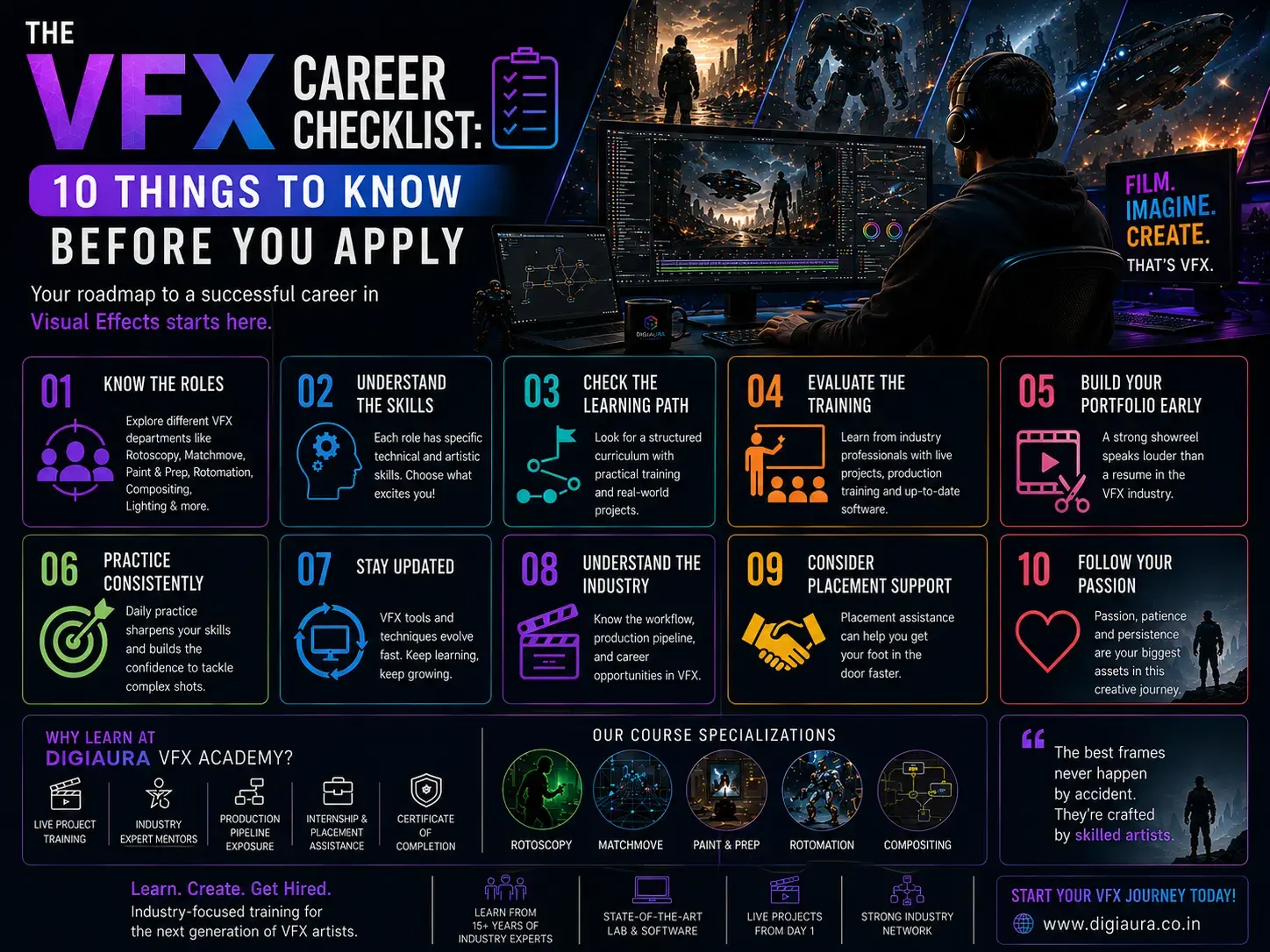
This checklist covers the 10 things that matter before you apply to any VFX studio or training programme.
Key Takeaways
- ✓ India has over 4,000 VFX studios; 70% of revenue comes from international projects (IBEF, 2024)
- ✓ India VFX segment reached Rs 48 billion in 2025; projected Rs 138 billion by 2028 (FICCI-EY 2026)
- ✓ Median entry salary is ₹3,05,082; median overall VFX salary is ₹4,04,525 (PayScale, Feb 2026)
- ✓ Tamil Nadu AVGC-XR Policy 2026 targets 2 lakh VFX/AVGC jobs by 2030
- ✓ Studios hire on showreel quality, not degree — your reel is your CV
- ✓ AI is reshaping roto and paint roles — specialise into mid-pipeline skills early
1. Know the Software Stack That Studios Actually Use
Before applying anywhere, know which tools studios require. The standard stack in Indian VFX production:
- Nuke (The Foundry) — industry-standard compositing. Required for compositor and VFX supervisor roles at any serious studio.
- After Effects — used in motion graphics and broadcast VFX; less common in film-grade work.
- Maya — the dominant 3D package for modelling, rigging, animation, and lighting.
- Houdini (SideFX) — essential for FX, simulation (fluid, fire, destruction), and procedural work. Increasingly demanded.
- Blender — strong for self-study; not the studio standard but grows your 3D fundamentals.
- Unreal Engine — fast-growing demand for virtual production and in-camera VFX workflows.
The mistake most beginners make: spending months learning tools studios don't require for entry-level roles. For roto, paint, and matchmove entry positions, studios care more about your accuracy and speed than your software range. For compositor roles, Nuke proficiency is non-negotiable.
2. Understand the Entry-Level Roles — and Which One Fits You
VFX is not one job. It is a pipeline of specialised departments. Entry-level positions in Indian studios typically span five categories:
- Roto artist — frame-by-frame masking of subjects for isolation. Repetitive but foundational.
- Paint & prep artist — wire removal, rig removal, beauty work, clean-plate creation.
- Matchmove / camera tracking artist — tracking camera and object motion so 3D elements integrate with live footage.
- Junior compositor — assembling VFX layers into final images using Nuke or similar tools.
- 3D generalist (junior) — supporting modelling, texturing, or rendering tasks under a senior artist.
Each has a different skill path, salary range, and creative ceiling. Studios often hire for a specific department rather than a generic "VFX artist" role. Knowing which lane you are targeting before training will focus your portfolio and showreel.
3. Your Showreel Is Your CV — Nothing Else Comes Close
VFX studios assess candidates almost entirely on their showreel. Not your academic certificates. Not your resume. Your reel.
Studio feedback from VanArts and ActionVFX consistently highlights the same issues:
- Open with your best shot within the first 10 seconds — reviewers decide fast.
- Label every shot with exactly what you did: "Roto — subject isolation," not just a title card.
- Keep the reel between 60 seconds and 2 minutes; do not pad it with weaker work.
- 80% of the reel should be relevant to the specific role you are applying for.
- Include breakdowns — before/after comparisons — for every compositing or paint shot.
The Rookies 2026 Career Guide recommends 2–4 years of focused study to build a professional-quality portfolio. Students who rush their showreel before reaching professional standard are rejected regardless of their course pedigree.
4. Salary at Entry Level: Realistic Numbers
PayScale India data (65 profiles, February 2026) gives the clearest picture of what VFX artists actually earn:
- Median VFX artist salary in India: ₹4,04,525 per year
- Entry level (<1 year): ₹3,05,082
- Early career (1–4 years): ₹3,91,439
- Mid-career (5–9 years): ₹5,00,152
Role-specific entry ranges vary significantly. The chart below shows where each specialisation sits.
Source: PayScale India (Feb 2026) + GUVI salary aggregation (2026)
A few points worth knowing: salary at entry level for roto and paint is on the lower end, but these roles are a known pathway into the pipeline. Artists who transition from roto to compositing within 3–5 years often reach ₹6–10 LPA mid-career. The higher starting ranges in matchmove and compositing reflect the greater technical difficulty.
5. The Market Corrected in 2024 — Understand the Risk
The India VFX segment fell 14% in 2024 (FICCI-EY 2025 Report). Globally, VFX production volume dropped 10%, with the Americas down 24%. The February 2025 shutdown of Technicolor India displaced over 3,000 VFX and animation professionals in Bengaluru and Mumbai, according to Deccan Herald.
This is not a reason to avoid VFX careers. It is a reason to plan them with more precision. The 2024 dip was driven by the 2023 Hollywood writers' and actors' strikes reducing production volume. Recovery is underway: the India segment reached Rs 48 billion in 2025 and is projected to grow to Rs 138 billion by 2028 at roughly 10% CAGR (FICCI-EY 2026).
Source: FICCI-EY Reports 2025 & 2026 via Animation Xpress; *2028 is FICCI-EY projection
What protects you from market corrections: mid-pipeline specialisation (compositing, Houdini FX, matchmove), international-client-facing skills (fast turnaround, English communication), and senior-level depth in any one discipline. Pure roto work is most exposed to both automation and volume cuts.
6. Specialise Early — "VFX Artist" Is Not a Job Title
No studio posts a vacancy for a generic "VFX artist." They post for roto artists, matchmove TDs, compositors, lighting artists, or Houdini FX artists. Every department has its own career ceiling, workflow, and expected proficiency.
Students who try to learn everything simultaneously often become mediocre at everything. Studios with tight deadlines prefer hiring a strong roto artist over a student who is "okay" at roto, paint, compositing, and 3D simultaneously.
Pick your primary department by your third or fourth month of training. Build your showreel around that lane. Then develop secondary skills in adjacent departments once you are employed.
7. India Has 4,000+ Studios — But Jobs Cluster in Four Cities
As of 2024, India has over 4,000 VFX studios and approximately 70% of their revenue comes from international productions (IBEF). But the actual employment geography is concentrated:
- Mumbai — Bollywood-adjacent; large studios (Prime Focus, Reliance MediaWorks)
- Hyderabad — strong Telugu industry VFX hub; growing international outsourcing
- Bengaluru — international studios (DNEG India, Technicolor formerly, global outsourcing chains)
- Chennai — Tamil industry base; growing with TN AVGC-XR policy investment
Tamil Nadu's AVGC-XR Policy 2026 has committed Rs 50 crore to a Centre of Excellence in Chennai and Rs 250 crore in R&D funding, targeting 2 lakh jobs and 20% of India's AVGC-XR market by 2030. For students trained in Chennai, this is a meaningful local demand signal.
8. AI Is Changing Roto and Paint — Know What That Means for Your Plan
AI rotoscopy tools are reducing the manual roto workload at many studios. This does not mean roto jobs are disappearing — it means studios need fewer roto artists per project, and the remaining roles require more precision and QC skill than before.
For career planning, this means:
- Pure roto as a long-term career has a lower ceiling than it did five years ago.
- Roto is still a valid entry point — but use it to enter the pipeline, then transition toward compositing, paint, or matchmove within 2–3 years.
- Artists who understand AI-assisted roto workflows (Mocha Pro, After Effects Rotobrush 2, Runway) and can QC AI output are more valuable than artists who only do manual frame-by-frame work.
Houdini FX, senior compositing, and virtual production (Unreal Engine) remain areas where AI automation has made the least inroad as of 2026.
9. Your Course Matters — But Not for the Reasons You Think
The quality of a VFX course is not measured by its brochure or fee. It is measured by three things: the proficiency of mentors who are currently working in the industry, the quality of studios where graduates get placed, and the feedback culture during training.
Before enrolling in any course, ask these specific questions:
- What studios have your recent graduates placed into? (Get names, not percentages.)
- Are my mentors currently working professionals or full-time academics?
- How many showreel reviews do I get during training?
- What software and hardware do I train on?
- What are the conditions on your placement rate claim?
On placement: DigiAura provides 100% placement assurance to enrolled students, backed by direct studio referrals through its Spellbound VFX partnership and an active network of Mumbai and Bangalore-based VFX houses. DigiAura is industry-founded and holds a formal MOU with Hindustan College of Arts & Science (September 2025), which gives its placement claims stronger grounding than many competitors.
For more on comparing Chennai institutes, see our guide: Top 5 VFX Institutes in Chennai 2026.
10. Know the India VFX Market Trajectory Before You Commit
The macro picture for VFX in India is positive, but not without conditions. Here is where the industry stands heading into the second half of 2026:
- India VFX segment: Rs 48 billion (2025), recovering from the 2024 correction
- Combined animation+VFX+post-production: Rs 105 billion (2025), projected Rs 138 billion by 2028
- Global VFX market: USD 1.0 billion for India alone, projected USD 1.7–1.8 billion by 2033 (IMARC Group, July 2026)
- India's national AVGC Task Force targets a USD 20 billion industry and 2.5 lakh skilled jobs by 2030
- OTT platforms driving steady demand: 521 million users in India (2025), with Netflix committed to $420M in Indian content
The job market is growing but competitive. Every year, thousands of students complete VFX programmes across India. The ones who get placed quickly share three qualities: a focused showreel, genuine depth in one discipline, and direct connections to studios through their training institution.
The Checklist at a Glance
- Learn the studio software stack — Nuke, Maya, Houdini, Unreal Engine
- Know which entry-level role fits your strengths before starting training
- Build a focused, specialist showreel — it is your CV, nothing else is
- Calibrate salary expectations: ₹3.05 LPA entry; ₹4.04 LPA median (PayScale 2026)
- Understand the 2024 market correction and what causes VFX cycles
- Specialise in one department — "VFX artist" is not a role studios hire for
- Know where the jobs actually are: Mumbai, Hyderabad, Bengaluru, Chennai
- Understand AI's impact on roto/paint; plan a 2–3-year transition path
- Ask hard questions before paying for any training programme
- Know the macro trajectory: Rs 138 billion by 2028, 2 lakh TN jobs by 2030
The VFX industry rewards people who treat it as a craft, not a credential. Start with the right role, build depth in that discipline, and let your showreel make the case for you.
If you are evaluating training options in Chennai, read about DigiAura's industry-founded curriculum or speak directly with our admissions team →
Related reading: VFX Artist Salary in India 2026 | What Is Compositing in VFX? | What Is Rotoscopy?