
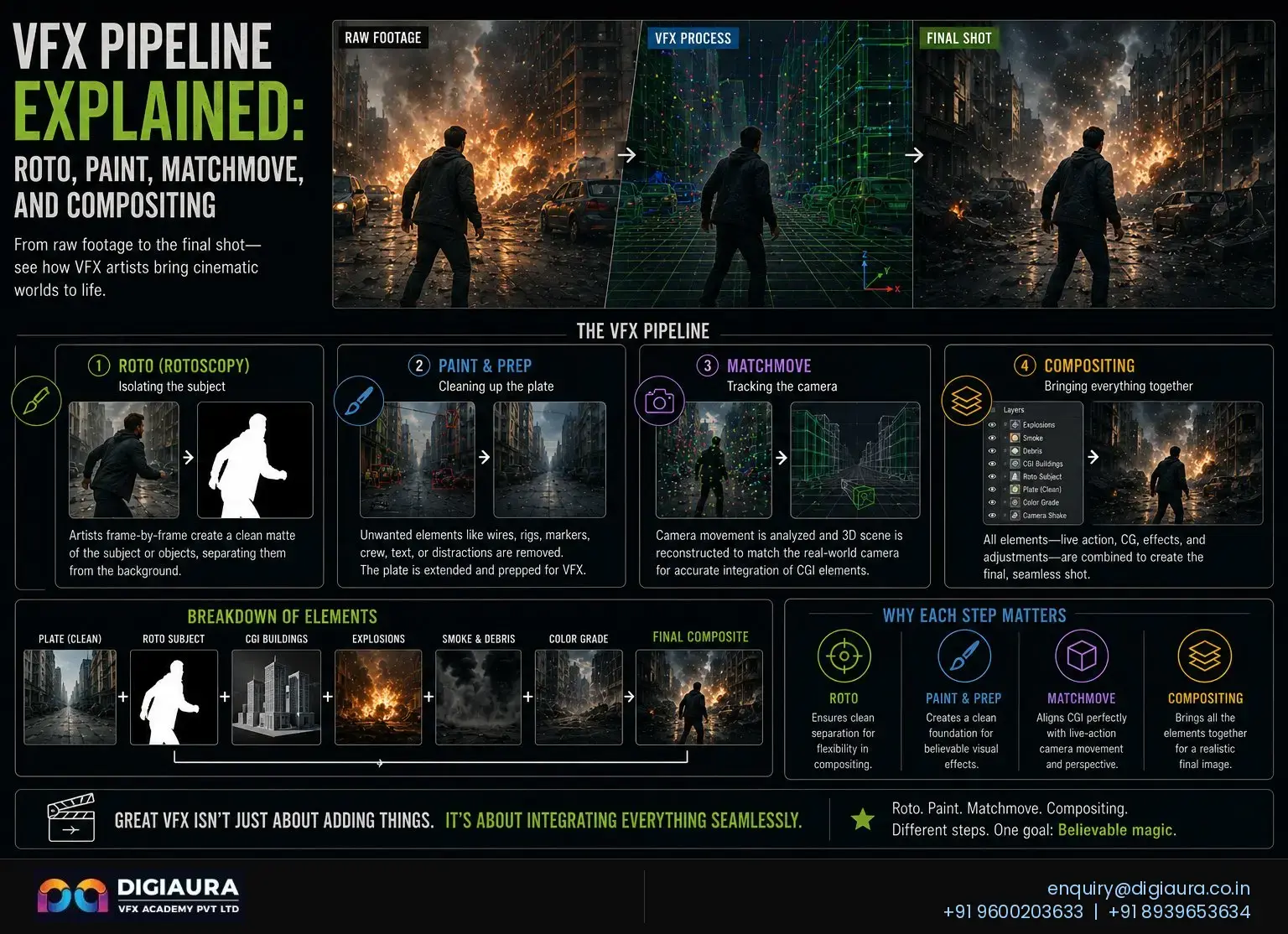
Every film shot that blends a live-action actor with a digital environment, every creature that interacts convincingly with a real performer, every object removal that leaves no trace comes from a structured, multi-stage production workflow known as the VFX pipeline. The pipeline is the sequence of specialised disciplines through which a raw footage shot passes before it becomes a finished visual effect. The four core disciplines that form the backbone of every professional VFX pipeline are rotoscoping (roto), paint and prep, matchmove, and compositing. Understanding what each discipline does, how they depend on each other, and what a career in each looks like is essential knowledge for anyone entering the VFX industry in 2026. Explore DigiAura's VFX pipeline courses →
Key Takeaways
- The VFX pipeline is the ordered sequence of production stages a raw footage shot passes through before becoming a finished visual effect. Roto, paint, matchmove, and compositing are the four core disciplines every studio uses.
- Rotoscoping produces frame-by-frame silhouette mattes that isolate subjects from their background. These mattes are the foundation every other pipeline stage depends on.
- Paint and prep cleans up live-action footage by removing wires, rigs, and unwanted objects before CG elements are added. It is the stage that makes composited shots believable.
- Matchmove reconstructs the 3D camera path from 2D footage using tracking markers and feature points, allowing CG elements to integrate into the scene with correct perspective and motion.
- Compositing is the final integration stage that combines all VFX elements, colour grades, and live-action plates into a single photorealistic frame for delivery.
- India's VFX market is growing at 15 to 18 percent CAGR and is projected to reach 3 billion USD in 2026, creating consistent demand for trained roto, paint, matchmove, and compositing artists across Chennai, Mumbai, and Hyderabad.
What Is the VFX Pipeline?
The VFX pipeline is the structured production sequence that turns raw live-action footage into a finished visual effects shot. Think of it as an assembly line where each station has a specific job, specific tools, and specific deliverables. A shot enters the pipeline as raw camera footage and exits as a polished frame ready for the DI (digital intermediate) and final colour grade before cinema delivery.
Every major VFX studio, from DNEG and ILM to mid-size Indian facilities handling Bollywood and OTT content, organises its work around a version of this pipeline. The specific tools, software versions, and internal naming conventions vary between studios. The core sequence does not vary. Raw plate arrives, gets cleaned and prepared, is matched to a 3D camera, receives CG elements, and is composited into a final frame.
The four disciplines covered in this guide, rotoscoping, paint and prep, matchmove, and compositing, are the departments through which every live-action VFX shot passes. Each is distinct. Each requires specialist training. And each feeds the next stage in the pipeline with the data it needs to function.
Citation Capsule: The VFX pipeline is the sequential production workflow through which raw footage passes before becoming a finished visual effects shot. Core pipeline disciplines include rotoscoping (subject isolation), paint and prep (plate cleaning), matchmove (camera reconstruction), and compositing (final integration). Each stage produces specific deliverables consumed by the next stage in the workflow.
Stage 1: Rotoscoping in the VFX Pipeline
Rotoscoping is the first major department most shots pass through in the VFX pipeline. Roto artists trace the silhouette of subjects in the footage, frame by frame, to produce digital mattes. A matte is a grayscale image that defines which pixels belong to the foreground subject and which belong to the background. This information is used by every other department downstream in the pipeline.
What Does a Roto Artist Do?
A roto artist works inside specialised software such as Silhouette FX (the industry standard), Foundry Nuke, or Adobe After Effects with Mocha Pro. They create vector-based spline shapes around the edges of a subject, animate those shapes across the duration of the shot, and output a clean alpha channel or matte sequence that compositors use to isolate the subject from its background.
The challenge in rotoscoping lies in handling complex edges: hair strands, translucent fabric, fast motion blur, and partially occluded limbs all require careful manual attention. AI tools can assist with initial matte generation on controlled footage, but professional roto work for feature films and premium streaming series still requires trained human artists for refinement and quality control.
What Does Rotoscoping Deliver to the Pipeline?
- Alpha channel matte sequences for compositing departments
- Isolation mattes for paint and prep artists to limit cleanup work to specific areas
- Reference data for rotomation artists building 3D skeleton animations
- Hold-out mattes that allow CG elements to appear behind or around live-action subjects
Learn more about professional rotoscoping training at DigiAura → For a complete breakdown of what rotoscopy is and how it works frame by frame, read our guide: What Is Rotoscopy? A Beginner's Guide →
Stage 2: Paint and Prep in the VFX Pipeline
Paint and prep is the cleanup department of the VFX pipeline. Before CG artists and compositors can integrate digital elements into a scene, the live-action plate must be made clean. That means removing every piece of production equipment that was captured on camera but was never meant to appear in the final film: safety wires, motion capture suits, green screen fringing, rigs, boom shadows, and visible set boundaries all need to be digitally erased from the footage.
What Does a Paint and Prep Artist Do?
Paint and prep artists work frame by frame to remove unwanted elements from live-action footage using software such as Foundry Nuke, Silhouette FX, and Adobe After Effects. Common tasks include wire removal (erasing visible wires from wire-work stunts), rig removal (removing mechanical support structures frame by frame), face replacement preparation, and background extension prep work. The painter uses roto mattes from the roto department to limit their paint work precisely to the areas that need cleaning.
Unlike still-image retouching, which works on a single frame, paint and prep work must be temporally consistent across hundreds or thousands of frames. A removed wire must stay removed, and the texture that replaces it must match the background grain, lighting, and motion across every frame of the shot.
What Does Paint and Prep Deliver to the Pipeline?
- Clean plate sequences with all production equipment and markers removed
- Prepared background plates for compositors to use as the base layer
- Isolated clean elements for CG integration
- Background fills for areas where the roto matte has removed the foreground subject
Explore DigiAura's paint and prep course curriculum → For an in-depth look at the paint and prep stage, read our guide: What Is Paint and Prep in VFX? →
Citation Capsule: Paint and prep is the VFX department responsible for cleaning live-action footage plates before compositing. Tasks include wire removal, rig removal, tracking marker cleanup, and background preparation. Paint artists use roto mattes from the rotoscoping department to confine paint work precisely and deliver clean plates for CG integration.
Stage 3: Matchmove in the VFX Pipeline
Matchmove solves one of the most fundamental problems in visual effects: how do you make a CG object appear to exist in the same physical space as a live-action camera shot? The answer is to reconstruct the exact position, orientation, and movement of the real camera from the 2D footage alone, then use that data to drive a virtual CG camera in a 3D application so the two align perfectly.
What Does a Matchmove Artist Do?
A matchmove artist analyses live-action footage to identify trackable feature points or tracking markers placed on set. Using software such as PFTrack, 3DEqualizer, or SynthEyes, the matchmove artist solves for the camera's lens characteristics, focal length, position in 3D space, and frame-by-frame movement. The result is a solved 3D camera scene that can be imported into Maya, Houdini, or Cinema 4D, where CG artists can add elements with accurate perspective and motion.
Beyond camera tracking, matchmove artists also handle object tracking (tracking moving objects within the scene to attach CG elements to them), geometry reconstruction (building a rough 3D approximation of the set for CG reference), and lens distortion analysis (correcting for camera lens distortion to ensure CG elements align precisely with the plate).
Camera Tracking vs Object Tracking vs Geometry Reconstruction
| Matchmove Task | What Is Being Tracked | Output Delivered | Used For |
|---|---|---|---|
| Camera Tracking | The live-action camera's position and movement | Solved 3D camera scene | Placing CG elements into the shot with correct perspective |
| Object Tracking | A specific moving object within the shot | 3D tracked null or locator | Attaching CG to a moving vehicle, prop, or performer |
| Geometry Reconstruction | The physical dimensions of the set or location | Rough 3D mesh of the environment | Lighting reference, occlusion, and CG ground planes |
| Lens Distortion Analysis | The distortion characteristics of the camera lens | Distortion and undistortion maps | Aligning CG renders precisely with live-action plates |
See DigiAura's matchmove and camera tracking training →
Stage 4: Compositing in the VFX Pipeline
Compositing is the final assembly stage of the VFX pipeline. A compositor takes all the elements that every other department has produced, the clean plates from paint, the roto mattes from the roto department, the CG renders from the 3D department driven by the matchmove camera, and combines them into a single, photorealistic, seamlessly integrated frame. Compositing is where the finished visual effect becomes visible for the first time as a complete image.
What Does a Compositor Do?
Compositors work inside node-based compositing applications, most commonly Foundry Nuke, which is the industry standard across virtually every major VFX facility worldwide. The compositor builds a compositing tree (a visual network of nodes) that controls how every layer of image data is processed, colour-matched, and blended. Key tasks include: integrating CG renders over live-action plates, applying colour grading to match CG to camera footage, adding atmospheric effects (fog, lens flares, depth of field), handling motion blur, and performing final quality checks against the director's reference frames.
A compositor must understand light, colour science, and the physics of how cameras capture images. The skill is not just technical assembly but visual problem-solving: making CG objects feel like they belong in the real world, in the real light of the scene, with the real camera grain and characteristics of the plate they are being integrated into.
What CG Render Passes Does a Compositor Use?
| Render Pass | What It Contains | How Compositors Use It |
|---|---|---|
| Beauty Pass | The full combined render of the CG element | Base layer for compositing over the live-action plate |
| Diffuse Pass | The flat colour of the CG surface without lighting highlights | Colour correction and material adjustments per shot |
| Specular Pass | The shiny highlight layer of the CG surface | Controlling reflectivity to match real-world lighting conditions |
| Shadow Pass | Shadow cast by the CG element onto the scene | Grounding CG elements convincingly in the physical scene |
| Z-Depth Pass | Depth information from the CG camera | Applying depth of field and atmospheric haze effects |
| Motion Vector Pass | The direction and speed of movement per pixel | Applying motion blur to match the live-action plate's camera |
Explore DigiAura's Nuke compositing course →
How the Four Stages Connect: The Full VFX Workflow
These four disciplines do not operate independently. They form a connected sequence where every department's output becomes the next department's input. Understanding this connection separates a professional VFX artist who understands the full pipeline from an artist who understands only their own discipline in isolation.
| Pipeline Stage | Input Received | Output Delivered | Primary Software |
|---|---|---|---|
| Rotoscoping | Raw live-action footage plates | Matte sequences, alpha channels, hold-out masks | Silhouette FX, Nuke, Mocha Pro |
| Paint and Prep | Raw plates plus roto mattes | Clean plate sequences with rigs and wires removed | Nuke, Silhouette FX, After Effects |
| Matchmove | Raw plates plus on-set survey data | Solved 3D camera scenes, object tracks, geometry | PFTrack, 3DEqualizer, SynthEyes |
| Compositing | Clean plates, roto mattes, CG renders, tracked cameras | Final integrated shot for DI and cinema delivery | Nuke, After Effects, Fusion |
A single shot typically moves through all four departments. For a straightforward shot such as a clean background replacement with a single actor, the pipeline might follow this path: the roto artist creates the matte, the paint artist cleans the backdrop, the matchmove artist provides the tracked camera for the new background, and the compositor assembles the final frame. For a complex shot involving a digital double or creature interaction, the same pipeline might also include rotomation and 3D departments working in parallel with paint and roto before compositing receives all elements.
VFX Pipeline Career Paths and Salaries in India
India is one of the world's largest VFX production markets in 2026. The country's AVGC (Animation, Visual Effects, Gaming, and Comics) sector employs hundreds of thousands of professionals and handles significant outsourcing work from Hollywood, Europe, and domestic Bollywood and OTT pipelines. Each of the four core pipeline disciplines supports its own career path, with clear salary progression as artists gain experience and specialise further.
| Discipline | Entry Level (0–2 yrs) | Mid Level (2–5 yrs) | Senior / Lead | Key Hiring Cities |
|---|---|---|---|---|
| Roto Artist | ₹2–3.5 LPA | ₹4–7 LPA | ₹8–14 LPA | Chennai, Mumbai, Hyderabad |
| Paint Artist | ₹2.5–4 LPA | ₹5–8 LPA | ₹9–15 LPA | Mumbai, Chennai, Bengaluru |
| Matchmove Artist | ₹3–5 LPA | ₹6–10 LPA | ₹12–20 LPA | Mumbai, Hyderabad, Chennai |
| Compositor | ₹3.5–6 LPA | ₹7–12 LPA | ₹15–28 LPA | Mumbai, Hyderabad, Chennai, Bengaluru |
Citation Capsule: India's AVGC sector faces a 2.3 million talent gap (FX & Beyond Report, 2024), and the country's VFX industry is growing at 15 to 18 percent CAGR toward a projected 3 billion USD market in 2026 (FICCI-EY Media & Entertainment Report, 2025). Compositing artists have the highest salary ceiling of the four core pipeline disciplines, while roto and paint serve as the most accessible entry points into professional studio work for new graduates.
Which VFX Discipline Should You Learn First?
The most common question from VFX students in India is where to start. The VFX pipeline is interconnected, but each discipline can be entered independently with the right training. Here is a practical guide to which starting point suits which student profile:
Start with Rotoscoping If You Are a Complete Beginner
- You have no prior VFX experience and want the most direct entry point into studio work
- You want the fastest path to paid studio roles (entry-level roto positions are consistently available across all major Indian VFX cities)
- You prefer methodical, detail-focused work over creative output
- You plan to eventually specialise in rotomation or compositing (roto is the foundation for both disciplines)
Start with Paint and Prep If You Have Image Editing Experience
- You have some experience with Photoshop or image editing and want to apply those skills to motion footage
- You are comfortable with detail-oriented cleanup work and have a strong eye for texture and temporal continuity
- You already have roto training and want to expand your pipeline capabilities into the prep stage
Start with Matchmove If You Have an Interest in 3D
- You have an interest in 3D, spatial reasoning, and camera optics
- You are comfortable with software that requires analytical problem-solving rather than frame-by-frame manual work
- You want a relatively higher starting salary compared to roto and paint entry-level positions
Start with Compositing If You Have Prior Pipeline Training
- You have prior training in roto, paint, or 3D and are ready to learn how all elements come together
- You want to work at the most creative stage of the VFX pipeline, making shot-by-shot artistic decisions
- You are interested in the highest salary ceiling across all four disciplines
- You enjoy colour science, lighting theory, and visual problem-solving at a high level
VFX Pipeline Software Reference Guide
| Software | Department | Industry Role | Difficulty Level |
|---|---|---|---|
| Silhouette FX | Roto, Paint | Industry standard for both departments at major studios globally | Beginner to Intermediate |
| Foundry Nuke | Compositing, Paint, Roto | Gold standard compositing tool at every major VFX facility worldwide | Intermediate to Advanced |
| PFTrack | Matchmove | Leading camera tracking software for feature film production pipelines | Intermediate |
| 3DEqualizer | Matchmove | Preferred for high-precision lens distortion and tracking at top-tier studios | Advanced |
| Mocha Pro | Roto, Tracking | Planar tracking widely used for roto assist and compositing prep work | Beginner to Intermediate |
| Autodesk Maya | Matchmove, Rotomation | Primary 3D application for receiving tracked scenes and building animation rigs | Intermediate to Advanced |
How DigiAura VFX Academy Trains You for the Full VFX Pipeline
DigiAura VFX Academy in Chennai is founded by Spellbound VFX, an active production studio that works on Bollywood, Kollywood, and international streaming content. Every course at DigiAura is built from the actual production requirements of Spellbound's VFX pipeline, which means students learn on real production footage at the quality standards studios expect to receive from trained professionals.
DigiAura offers dedicated courses for each of the four core pipeline disciplines:
- Rotoscoping (Basic, Intermediate, Advanced): Training on Silhouette FX using production footage from Spellbound VFX. Students complete their first production-quality roto shot within the first six weeks. View rotoscoping courses →
- Paint and Prep: Nuke and Silhouette FX-based wire removal, rig removal, and background preparation using real production shots. View paint and prep course →
- Matchmove and Camera Tracking: PFTrack and 3DEqualizer training covering geometry reconstruction, object tracking, and lens distortion workflows. View matchmove course →
- Compositing: Nuke-based compositing training covering multi-pass integration, colour matching, and final delivery standards for film and streaming. View compositing course →
Students who complete the Advanced or Diploma-level programme at DigiAura train across all four disciplines and build a showreel that demonstrates full pipeline competency. The Advanced Diploma programme includes a paid internship at Spellbound VFX and 100% placement assurance through DigiAura's active studio network. Speak to DigiAura's admissions team about full pipeline training →
Frequently Asked Questions About the VFX Pipeline
What is the VFX pipeline in simple terms?
The VFX pipeline is the production workflow that transforms raw live-action footage into a finished visual effects shot. It describes the sequence of departments, roto, paint, matchmove, 3D, and compositing, through which every shot passes, with each department adding their specific contribution to the final image. The pipeline ensures that every department works with consistent data and that the output of one stage becomes the reliable input for the next stage downstream.
What is the difference between roto and compositing?
Rotoscoping produces silhouette mattes that isolate a subject from the background. Compositing uses those mattes, along with CG renders and cleaned plates, to assemble the final image. Roto is an input to compositing. A compositor cannot integrate a CG element correctly without the roto mattes that tell the compositing software where the live-action subject ends and the CG layer begins. The two disciplines are interdependent but require distinct specialist skills.
Why is matchmove important in the VFX pipeline?
Matchmove is what allows CG objects to appear to exist in the same physical space as a live-action camera shot. Without a solved 3D camera, CG elements have no information about the perspective, depth, or movement of the real camera and cannot be placed accurately in the scene. Every shot that combines live-action footage with CG elements requires matchmove data, making it one of the most essential disciplines in the entire VFX production pipeline.
Can I learn the full VFX pipeline after 12th standard?
Yes. VFX pipeline courses are open to students from any 12th-standard stream, Arts, Science, or Commerce. The disciplines do not require prior engineering or mathematics backgrounds. Roto and paint are the most accessible entry points for beginners and can be learned in 3 to 6 months. Matchmove and compositing build on those foundations and are typically trained as the next progression in a student's development. DigiAura VFX Academy offers a full pipeline diploma programme structured for students entering directly after 12th standard. Read more about VFX career paths after 12th →
Which is harder to learn: matchmove or compositing?
Both disciplines require specialist training, but they challenge different types of skills. Matchmove requires spatial and analytical thinking, a strong understanding of camera optics, and problem-solving ability when footage is challenging or tracking markers are absent. Compositing requires a strong visual eye, understanding of colour science and lighting, and the technical ability to manage complex node networks in Nuke. Most VFX students find roto and paint the most accessible starting point, with matchmove and compositing as intermediate-to-advanced progressions.
What software do VFX pipeline artists use in India?
The professional standard software used at Indian VFX studios mirrors the global industry: Silhouette FX for roto and paint, Foundry Nuke for compositing and paint, PFTrack and 3DEqualizer for matchmove, and Autodesk Maya for 3D and rotomation. Studios handling international pipelines, particularly those with Hollywood work, require Nuke and 3DEqualizer specifically. Students should train on these professional tools rather than free alternatives if they intend to work at professional studio level in India or internationally.
How long does it take to learn the complete VFX pipeline?
Learning a single pipeline discipline to a professional standard takes 3 to 6 months with structured training on real production footage. Learning the full pipeline across all four core disciplines, roto, paint, matchmove, and compositing, typically takes 12 to 18 months at a structured academy. DigiAura's Advanced Diploma programme covers the complete pipeline in 12 months and includes a paid internship at Spellbound VFX, giving students real studio production experience before they graduate.
The VFX pipeline is the foundation of every visual effects production. Understanding how roto, paint, matchmove, and compositing work together, what each stage delivers, and how these four disciplines connect is essential knowledge for any VFX professional entering the industry in 2026. Whether you are starting from scratch or expanding into new pipeline stages, structured training on real production footage is the most direct path to employment at India's growing studios. Speak to DigiAura's admissions team about full pipeline training →