
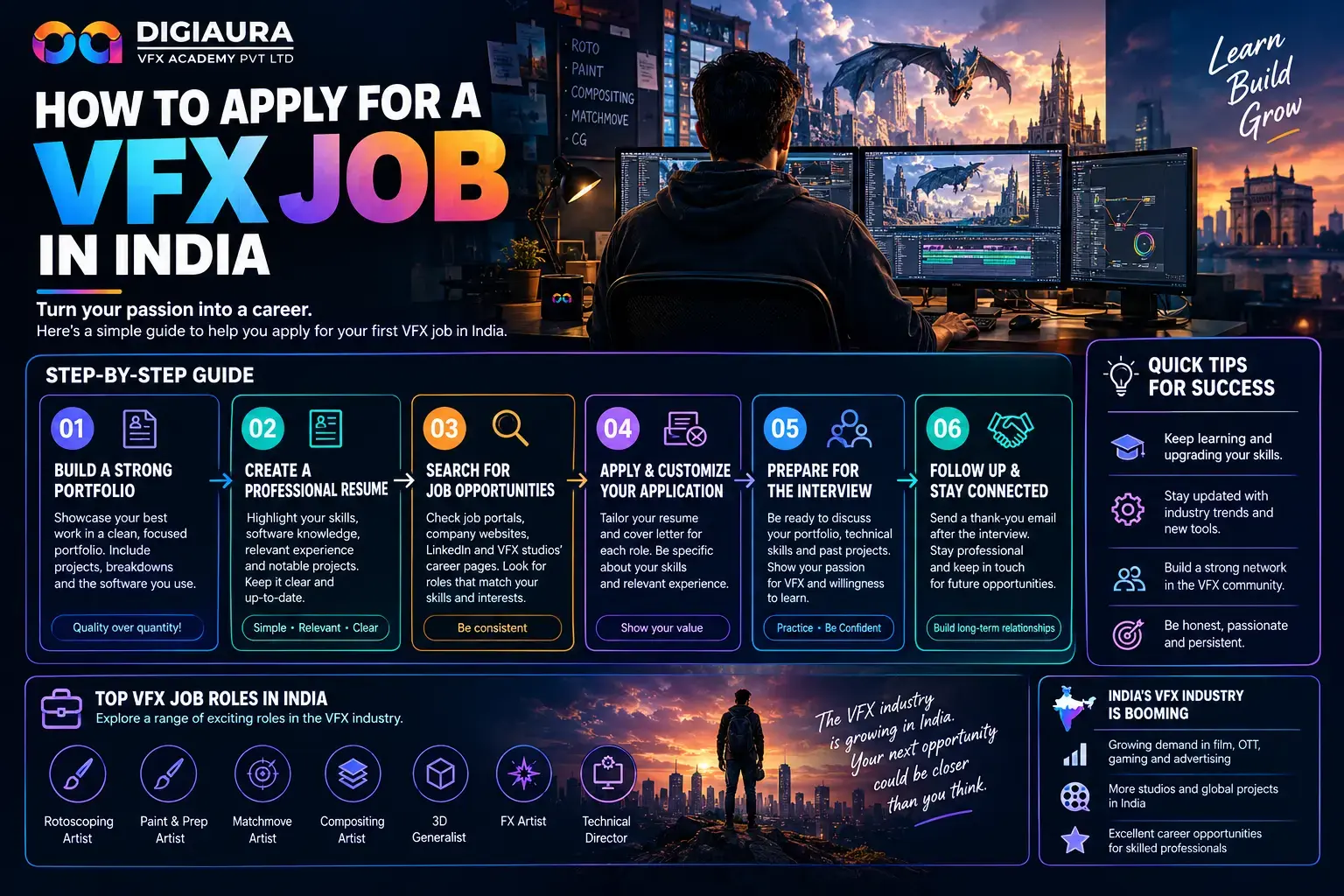
Naukri.com listed 3,592 VFX vacancies in India in August 2026. Foundit.in had 6,478 more. The demand is genuine — but most applications never reach a hiring supervisor’s desk. Recruiters spend an average of 7.4 seconds on an initial resume scan (TheLadders), and hiring supervisors decide whether to continue watching a showreel within the first 10 seconds.
The gap between “there are lots of VFX jobs” and “I have a job” comes down almost entirely to application quality. Not the quality of your skills — the quality of how you present them. A strong artist with a weak showreel link and a two-page resume will lose to an average artist who submitted a clean, targeted 45-second reel and a one-page document with their Nuke version listed upfront.
This guide covers every step: where to find VFX openings in India, how to structure your resume and reel, what Indian studio technical tests look like, and how to handle the interview. Read it alongside the VFX career application checklist before you submit anything.
Key Takeaways
- 3,592 VFX vacancies were active on Naukri.com in August 2026; Foundit.in had 6,478 across all VFX roles — demand is real and ongoing.
- Recruiters spend 7.4 seconds on initial resume screening (TheLadders). Your name, role title, software list, and showreel link must be visible in that window.
- Freshers should keep their showreel under 60 seconds. Supervisors decide within 10 seconds whether to keep watching (CGSpectrum, December 2024).
- Referred candidates are hired at 30% vs 7% for cold applications (Jobvite/ERIN 2025). Networking is not optional — it’s the highest-yield application channel available.
What Does the VFX Job Application Process in India Actually Look Like?
India’s AVGC sector employs 260,000 professionals across 200+ studios, with over 30,000 positions remaining unfilled due to a shortage of production-ready candidates (Storyboard18, 2024). That gap doesn’t mean it’s easy to get hired. It means studios will hire quickly once they find someone who meets their standard.
The typical application process at an Indian VFX studio runs in four stages:
Stage 1 — Showreel and resume submission. You apply via a job board, ArtStation profile, or direct referral. A recruiter or department coordinator screens your showreel link and resume in under 2 minutes. This is the highest-attrition stage: most applications are rejected here without ever reaching a supervisor.
Stage 2 — Technical test. Shortlisted candidates receive a timed brief: a raw plate and specific VFX task. Common tests include a compositing sequence in Nuke, an FX simulation brief in Houdini, or a roto assignment on live footage. You typically have 2 to 4 hours. Project structure, file naming, and output quality are evaluated alongside the work itself.
Stage 3 — Studio interview. Candidates who pass the technical test meet with a department supervisor or CG supervisor. The conversation covers your showreel in detail (“walk me through this shot”), your software workflow, how you handle feedback, and your understanding of the production pipeline. A brief HR round follows at most studios.
Stage 4 — Offer and onboarding. Most Indian studios move quickly once they’ve decided. Expect a verbal offer within 3 to 7 business days of the final interview. Contract terms, software access, and start dates are confirmed in writing.
Understanding this structure matters because most fresher mistakes happen at Stage 1. The goal of your resume and showreel is not to get hired — it’s to get invited to Stage 2. That shift in framing changes everything about how you prepare both documents.
Where Do You Find VFX Job Openings in India?
India’s Media and Entertainment sector saw fresher hiring grow 22% in March 2025 (Naukri JobSpeak Report, March 2025). That growth is distributed across multiple platforms, and the platform you choose affects both the roles you see and how competitive the applications are.
Naukri.com is the highest-volume platform and where most Indian studios post entry-level and mid-level roles. Set up job alerts for “VFX artist”, “compositor”, “roto artist”, and “FX TD” with location filters for your target cities. Update your profile weekly — Naukri’s algorithm surfaces recently active profiles to recruiters first.
LinkedIn has fewer listings but higher signal-to-noise. Senior VFX roles, specialist Houdini positions, and roles at international studios with India operations (DNEG, Prime Focus) appear here more frequently than on Naukri. More importantly, LinkedIn is the primary networking platform where studio supervisors and hiring TDs are accessible.
ArtStation Jobs is essential for any artist who wants to be discovered rather than just applying. ArtStation receives approximately 17 million monthly visits and the State of the Art 2026 report surveyed 2,000+ users including recruiters who actively use the platform to shortlist candidates (80.lv, April 2026). An active, well-tagged ArtStation portfolio generates inbound messages from recruiters without you ever submitting a cold application.
Direct studio careers pages. Studios like DNEG, Phantom FX, Pixelloid, and Prime Focus post roles on their own websites that don’t always appear on aggregator platforms. Bookmark the careers pages of your target studios and check them weekly.
How Should Your VFX Resume Be Structured?
Eighty-one percent of recruiters spend less than one minute on a CV during initial screening; 47% spend between 30 seconds and one minute (ResumeGo, 2024). For a VFX application, that one minute needs to answer four questions: What is your role? What software do you use? Where is your showreel? And what have you worked on before?
One page only. A VFX fresher with no production credits has nothing that justifies two pages. One tight, well-formatted page is always preferable to two sparse ones. If you have significant credits, one page is still the standard for most Indian studio applications.
Showreel link in the header. Your showreel link should appear directly below your name and contact details — not buried at the bottom, not listed as “portfolio: see attached.” Make it a direct Vimeo link with a custom password if needed. Every second a recruiter spends searching for your reel is a second they might stop looking.
Software section, explicitly listed. Include your primary tools with version numbers: “Foundry Nuke 15.1, SideFX Houdini 20.5, Autodesk Maya 2025, Silhouette FX 2024.” Do not write “proficient in industry-standard compositing software.” Recruiters and their ATS systems scan for specific tool names. If your tools aren’t named, your resume won’t match the job description.
Experience or training section. If you have production credits, list them with the studio, production name, and your specific contribution (not just your role title). If you’re a fresher, list your training programme, the institute, and the specific shots or projects you completed as a student. “Completed 6 Nuke compositing briefs on licensed live-action plates” is more credible than “trained in compositing.”
The ArtStation State of the Art 2026 report found that the top recruiter complaint about applicants was missing technical skills or unclear workflows in their portfolio and application materials. Your resume should make your technical capabilities unambiguous.
How Long Should Your VFX Showreel Be in 2026?
Keep your showreel under one minute if you’re a fresher. VFX supervisor Jorge Razon — whose credits include Game of Thrones, The Boys, and Umbrella Academy — advises students explicitly: “keep it short and focused on your strongest work” (CGSpectrum, December 2024). Hiring supervisors at most studios decide whether to continue watching within the first 10 seconds. Your best shot goes first. Not second.
What to include for a fresher reel: Three to six compositing or simulation shots with breakdowns. Every shot must composite into a live-action plate — no black-background renders. Show the breakdown after each finished shot: the raw plate, the isolated elements, your node network or simulation cache. Label your contribution on screen for every shot.
What will get your reel rejected immediately: Tutorial reproductions submitted as original work. Shots without any indication of which part is your contribution. Simulations or composites against pure black backgrounds. Reels padded to 3 minutes with weaker work to fill time. A showreel link that requires filling out a form or downloading a file — make it one click to play.
Hosting. Vimeo is the professional standard for VFX reels. It delivers better compression than YouTube, has no ads, and doesn’t flag licensed audio. A YouTube backup is sensible, but Vimeo is your primary link. If you’re concerned about watermarking, Vimeo’s free tier allows password-protected links.
For a complete step-by-step reel production guide covering file formats, audio, and platform strategy, see the VFX showreel guide for 2026.
What Do Indian VFX Studio Technical Tests Look Like?
Most Indian VFX studios give shortlisted candidates a timed technical test before the in-person or video interview, and the test format varies by department (eDrishyam 2024). Passing the test is a stronger signal than a good showreel — it demonstrates you can deliver under a deadline, not just in your own time.
Compositing tests (Nuke). You receive a raw plate, a CG element, and a brief: “integrate this CG explosion into the background, match the colour grade, and add a lens blur consistent with the camera depth-of-field.” You have 2 to 4 hours. Submitting a well-structured Nuke script with labelled nodes is as important as the final composite quality — supervisors are evaluating your pipeline habits, not just the image.
FX simulation tests (Houdini). A brief specifying a fire, destruction, or fluid effect: “simulate a building corner collapse with appropriate debris.” You’ll be expected to set up a basic RBD or Pyro network, cache the simulation, and submit both the rendered output and the Houdini scene file. Project organisation and HDA usage signal seniority even at the junior level.
Roto and paint tests. A short clip with a clear roto task: “isolate the subject from frame 1 to frame 240.” Evaluated on edge quality, feathering, motion blur handling, and how you manage fast-moving or motion-blurred frames. Silhouette or Mocha are the expected tools.
Practical preparation. Practice timed deliveries before applying. Set a 2-hour timer and complete a sample brief end-to-end. Film industry test briefs are available on VFX school platforms and instructor communities. Submit your test files exactly as specified in the brief — incorrect file naming or missing project files are common reasons for otherwise strong tests being rejected.
How Does Networking Affect Your VFX Hiring Chances?
Referred candidates are hired at a 30% rate compared to just 7% for standard cold applications (Jobvite / ERIN, 2025). In Indian VFX — a community where the same few hundred senior artists rotate between the major studios — a referral from someone who has worked with you is often worth more than the strongest cold application.
LinkedIn. Connect with VFX supervisors, TDs, and artists at your target studios. Don’t send cold messages asking for jobs. Follow their posts, comment on their work, and share your own project progress. Many Indian VFX supervisors post role openings on their personal LinkedIn before the job appears on Naukri. Being in their network means you see those posts first.
ArtStation. Tag your projects with specific tools and techniques. Recruiters use ArtStation’s search to find artists by skill set — “Houdini pyro simulation India” or “Nuke compositor portfolio” are real search terms they use. An active portfolio with 10 to 15 well-tagged projects generates inbound recruiter messages that cold applications don’t.
Industry events. GAFX in Bangalore, animation and VFX summits in Mumbai and Chennai, and studio open days at facilities like DNEG India and Phantom FX bring hiring supervisors and artists together in person. The student who introduces themselves at a GAFX session and follows up on LinkedIn has a significantly different application experience than the student who only applies through a web form.
For a full breakdown of which departments to target and how the VFX pipeline hierarchy affects hiring, read the department-by-department guide to breaking into VFX.
What Salary Should You Expect as a VFX Fresher in India?
The PayScale median for all VFX Artist roles in India is ₹4,04,525 per year, with entry-level at ₹3,05,082 for artists with under one year of experience (PayScale India, February 2026). Those figures are averages across all VFX roles. The reality by specialisation varies significantly.
Roto and prep artists typically start at ₹2.5 LPA. This is entry-level production work — it’s a real job inside a real pipeline, and it’s a valid starting point if you want to understand how a studio operates before specialising. Most roto artists who develop compositing or FX skills within 12 to 18 months move up significantly.
FX TDs with Houdini skills start materially higher. The PayScale data for FX Artist with SideFX Houdini in India puts the median at Rs 322,774 per year with a 90th-percentile ceiling of approximately Rs 12 LPA. Junior FX artists at major studios often start around ₹4 to ₹5 LPA — still entry-level, but 60% above the roto floor.
One important expectation adjustment: the FICCI-EY 2025 report noted a 14% VFX revenue decline in 2024 due to the global production slowdown from the Hollywood strikes. The market has recovered through 2025 and 2026, but this history means most Indian studios are cautious about overpaying freshers without demonstrated production credits. Don’t negotiate aggressively on your first role. Get in, prove yourself on real shots, and the salary conversations become much more straightforward in your second year.
For a complete salary breakdown by department and experience level, see the VFX artist salary guide for India 2026.
Get Placement Support That Actually Works
DigiAura’s placement team works directly with Indian VFX studios through our Spellbound VFX connection. Students don’t just get job board access — they get introductions to the supervisors making hiring decisions, showreel review before they apply, and technical test prep built into the curriculum.
Speak to the Placement Team →Frequently Asked Questions
How do I find VFX job openings in India?
The most active platforms are Naukri.com (3,592 VFX listings in August 2026), Foundit.in (6,478 listings in July 2026), and LinkedIn India (202 roles). For senior and specialist roles, ArtStation Jobs and CG Society are used by international facilities with Indian operations. Check each platform daily — new roles post continuously across all platforms.
How long should my VFX showreel be as a fresher?
Keep your showreel under one minute as a fresher — ideally 45 to 60 seconds. VFX supervisor Jorge Razon (Game of Thrones, The Boys) advises students to keep their reels short and focused on their strongest work (CGSpectrum, December 2024). Hiring supervisors decide within the first 10 seconds whether to keep watching. Four to six shots with breakdowns beats twelve weaker ones without context.
What does a VFX technical test involve at an Indian studio?
Most Indian studios give shortlisted candidates a timed test: a raw plate with a compositing or simulation brief. Common tests include Nuke compositing (keying, colour matching, integration), Houdini FX setup (pyro or RBD), or rotoscopy on a live clip. You’ll typically have 2 to 4 hours. File naming, project structure, and render output quality are all assessed alongside the work itself.
Do Indian VFX studios prefer referrals over cold applications?
Yes, significantly. Referred candidates are hired at a 30% rate versus 7% for standard cold applications (ERIN, 2025). Indian studios are small communities — supervisors at DNEG India, Phantom FX, and Pixelloid regularly share roles via their networks before posting publicly. LinkedIn, ArtStation, and industry events like GAFX in Bangalore are the fastest ways to build a referral network.
What is the starting salary for a VFX fresher in India?
Roto and prep artists typically start at ₹2.5 LPA. Junior compositors earn ₹3 to ₹5 LPA. FX artists with Houdini skills start higher, around ₹4 to ₹8 LPA. The PayScale median for all VFX Artist roles in India is ₹4,04,525 per year (February 2026), with entry-level at ₹3,05,082. Salary grows significantly with specialisation and production credits.
Conclusion
The VFX job market in India in 2026 is active and real: 3,592 Naukri vacancies, 6,478 on Foundit, and a sector projected to grow from USD 1.3 billion to USD 2.2 billion by the end of this year. But the gap between “jobs exist” and “I have one” is almost entirely an application quality problem, not a talent problem.
A one-page resume with your showreel in the header, a sub-60-second reel with breakdowns, a clean technical test submitted with proper file structure, and a LinkedIn network that includes even three or four supervisors at your target studios — that combination outperforms any amount of mass-applying to job boards.
If you’re at the reel-building stage, the VFX showreel step-by-step guide covers everything from shot selection to hosting. If you want to understand which specialisation to pursue before you apply, the 2026 VFX salary guide maps out what each department pays by experience level.