
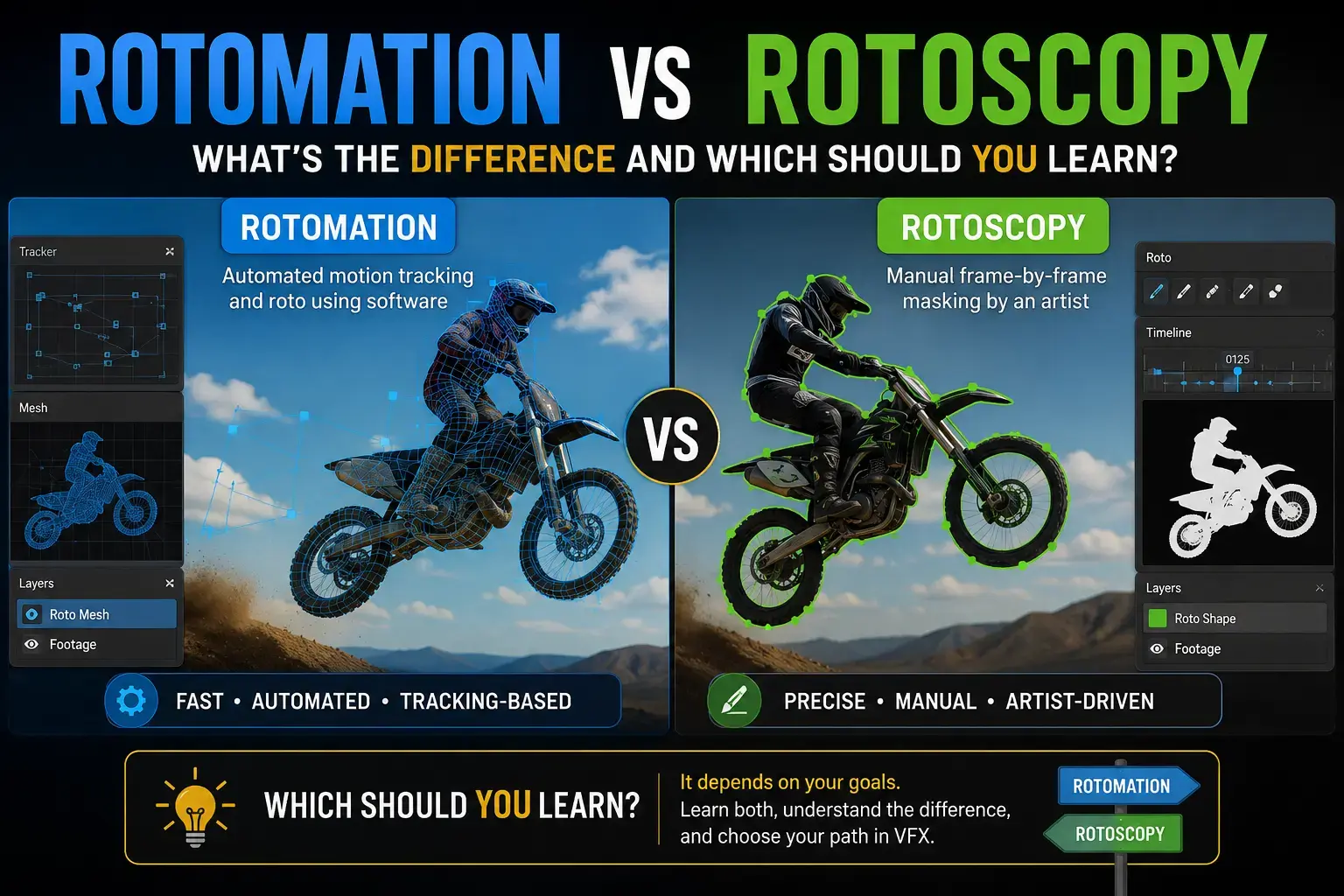
Rotoscopy and rotomation are two distinct VFX disciplines that work in the same pipeline but produce entirely different outputs. Rotoscopy is a 2D technique where artists trace frame-by-frame outlines of subjects to create alpha mattes for compositing. Rotomation is a 3D technique where artists reconstruct the precise movement of a live-action performer using a rigged 3D skeleton overlaid on the footage, enabling CG elements to track, interact with, or replace parts of that performer's body. If you are trying to decide which skill to learn, this guide compares both disciplines side by side across technique, tools, career paths, and salary data specific to India's VFX industry.
Key Takeaways
- Rotoscopy creates 2D silhouette masks (alpha mattes); rotomation creates 3D skeleton rigs that precisely match a performer's movement in live footage.
- Rotoscopy tools: Boris FX Silhouette, Mocha Pro, Foundry Nuke. Rotomation tools: Autodesk Maya, PFTrack, 3D Equalizer, Foundry Nuke.
- Roto artists in India earn Rs 20,000 to Rs 40,000 per month at mid-level. Rotomation artists earn an average of Rs 31,098 per month, with senior artists earning significantly more.
- Rotoscopy is the easier entry point: no 3D knowledge required, faster to learn, and highest job volume in Indian VFX studios.
- Rotomation requires understanding of 3D rigging, camera tracking, and anatomy, making it technically demanding but with a higher career ceiling.
- Many professionals start with rotoscopy and transition to rotomation after 1 to 2 years, using roto experience as a foundation.
- India's VFX sector is projected to grow from US$1.3 billion in 2023 to US$2.2 billion by 2026, creating sustained demand for both disciplines.
What Is Rotoscopy?
Rotoscopy is the process of manually tracing the outline of a person or object in video footage, frame by frame, to produce a silhouette called an alpha matte or roto matte. That matte tells compositing software exactly which pixels in each frame belong to the subject and which belong to the background. The compositor then uses this separation to replace backgrounds, add visual effects that interact with the subject, or integrate digital characters into live-action environments.
The technique dates to the early twentieth century, when animators at the Fleischer Studios first used projected live-action film as a drawing reference. Today, professional rotoscopy is performed digitally in software like Boris FX Silhouette, Foundry Nuke, Mocha Pro, and Adobe After Effects. The core skill remains the same: an artist must accurately define the edge of a subject across hundreds or thousands of frames while maintaining consistency across the motion. For a deeper introduction to how rotoscopy works in modern VFX, see our guide to how movies remove backgrounds without green screen.
In India's VFX industry, rotoscopy represents the highest volume of outsourced work. Studios in Mumbai, Chennai, Hyderabad, and Bengaluru process roto work for productions based in Hollywood, London, and Tokyo. Because rotoscopy does not require prior 3D knowledge, it is one of the most accessible entry points into professional VFX work for students and career changers alike.
What Is Rotomation?
Rotomation is the process of matching a 3D rigged skeleton to the movement of a live-action performer in footage, frame by frame. The word is a portmanteau of rotoscopy and animation. Like rotoscopy, it involves tracing what is in the footage. Unlike rotoscopy, the output is a three-dimensional animated rig, not a 2D matte.
In practice, a rotomation artist imports the raw camera footage into a 3D application such as Autodesk Maya, loads a pre-built character rig, and manually adjusts the rig's joints frame by frame so that the skeleton's movement precisely mirrors the performer in the video. This animated rig is then used by the VFX team to attach digital clothing, armour, creatures, or effects that must follow the performer's body with anatomical accuracy. It is also the technique behind creating CG doubles, digital versions of a performer used to add or remove body parts, extend the performance, or execute dangerous stunts digitally. For a comprehensive overview of what rotomation is and where it appears in film, read our guide on what rotomation is and how it is used in VFX studios.
Rotomation sits at the intersection of camera tracking, 3D animation, and visual effects supervision. It requires understanding of human anatomy, 3D rigging principles, camera tracking, and the VFX pipeline as a whole. This higher technical barrier means fewer artists specialise in it relative to rotoscopy, which contributes to the stronger earning potential at the senior level.
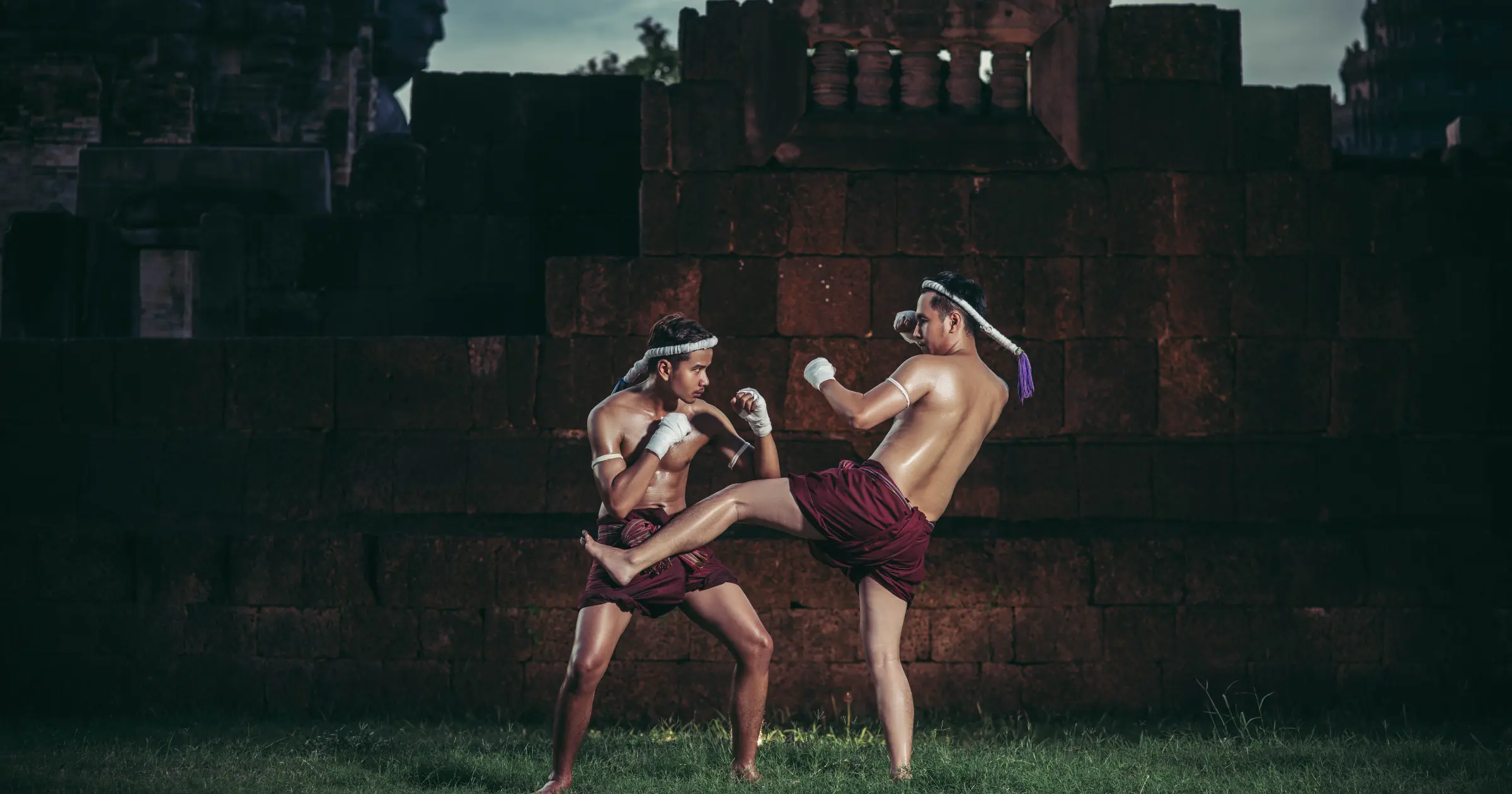
Rotomation artists work in 3D environments like Maya, matching animated rigs to live performers in footage frame by frame.
Rotomation vs Rotoscopy: The Core Differences
Despite both involving frame-by-frame analysis of footage, the two disciplines differ fundamentally in their output, tools, pipeline position, and required skill sets. The table below summarises the most important distinctions between a roto artist and a rotomation artist.
| Aspect | Rotoscopy | Rotomation |
|---|---|---|
| Dimension | 2D | 3D |
| Primary output | Alpha matte (silhouette mask sequence) | Animated 3D skeleton rig matching live performance |
| What it enables | Background replacement, compositing isolation, VFX integration | CG doubles, digital costume and creature attachment, body-part replacement |
| Primary tools | Silhouette FX, Mocha Pro, Nuke, After Effects | Autodesk Maya, PFTrack, 3D Equalizer, Nuke |
| 3D knowledge required | No | Yes: rigging, anatomy, and camera tracking |
| Pipeline position | Early: after scanning, before compositing | Mid-pipeline: after matchmove, before CG integration |
| Learning curve | Moderate: 3 to 6 months to production speed | Steep: 12 to 24 months to professional standard |
| Entry-level jobs in India | Very high volume | Moderate volume, more competitive |
| Related to motion capture? | No | Yes: alternative to mocap for shots without a suit |
How Each Discipline Works in the VFX Pipeline
Both rotoscopy and rotomation plug into the broader VFX pipeline at different stages and serve different downstream departments. Understanding where each sits helps clarify why studios need both disciplines, even on the same shot.
In a typical visual effects workflow, raw camera footage first goes through scanning and conform, where the digital files are prepared and organised. From there, it enters the roto department. Roto artists produce the alpha mattes that compositors and paint artists will use downstream. Once the roto pass is complete and approved, the footage may also go to the paint and prep department for wire removal and cleanup. To understand how paint and prep connects to roto in the pipeline, read our guide on paint and prep in VFX pipelines.
Rotomation enters the pipeline at a different point. It typically begins after matchmove artists have solved the camera's position in 3D space. Once the camera solve exists, the rotomation artist imports it into Maya alongside the footage, loads a character rig, and animates that rig to match the performer. The completed rig is handed to the CG team, who parent their digital assets to it, and then to the compositor, who integrates the final CG elements back into the live plate. Rotomation is therefore a bridge discipline: it sits between the tracking department and the CG department, giving 3D elements a precise human anchor point in real footage.
VFX Pipeline Position at a Glance
Scanning and Conform → Rotoscopy (alpha mattes) → Paint and Prep → Compositing
Matchmove and Camera Solve → Rotomation (animated rig) → CG Integration → Compositing
Tools of the Trade: Roto Artist vs Rotomation Artist
The software stack used by roto and rotomation artists reflects the fundamental difference between the two disciplines. Roto artists work in 2D painting and compositing applications. Rotomation artists work primarily in 3D environments alongside specialists in camera tracking and character rigging.
| Tool | Roto Artist | Rotomation Artist |
|---|---|---|
| Boris FX Silhouette | Primary roto tool | Rarely used |
| Foundry Nuke | Secondary roto and compositing handoff | Compositing integration and review |
| Mocha Pro | Planar tracking-assisted roto | Occasionally for camera assists |
| Autodesk Maya | Not used | Primary rotomation and rigging environment |
| PFTrack | Not used | Primary: camera and geometry tracking |
| 3D Equalizer | Not used | Primary: precision camera solve |
| Adobe After Effects | Entry-level roto (Roto Brush 2) | Not used at studio level |
Career Paths and Salary Comparison in India
Both roto and rotomation offer structured career progression in India's VFX industry, though the paths diverge after the junior level. India's animation and VFX sector is projected to grow from US$1.3 billion in 2023 to US$2.2 billion by 2026 according to the IBEF and CII GT Report, and six of the ten fastest-growing VFX hubs globally are in India according to the Visual Effects and Animation World Atlas 2025. This growth creates sustained demand for professionals at all levels in both disciplines.
Roto Artist Career Ladder
A roto artist career typically follows this progression: Junior Roto Artist (entry level, 0 to 2 years) to Roto Artist (mid-level, 2 to 4 years) to Roto Supervisor (4 to 7 years), with an optional transition into Compositor. The roto track is a well-established pathway at every major Indian VFX studio because demand for roto mattes is constant across all production types, from Bollywood to Hollywood to OTT content.
Rotomation Artist Career Ladder
A rotomation artist career typically follows: Junior Rotomation Artist to Rotomation Artist, then Matchmove and Rotomation Lead, and finally VFX Supervisor or CG Supervisor. Because rotomation sits closer to the 3D and CG departments, senior rotomation artists frequently transition into broader VFX roles with higher responsibility and correspondingly higher compensation.
India Salary Comparison: Roto Artist vs Rotomation Artist
| Experience Level | Roto Artist (Monthly, INR) | Rotomation Artist (Monthly, INR) |
|---|---|---|
| Fresher / Junior (0 to 2 years) | Rs 12,000 to Rs 20,000 | Rs 18,000 to Rs 25,000 |
| Mid-Level (2 to 5 years) | Rs 20,000 to Rs 40,000 | Rs 31,098 (Glassdoor average) |
| Senior (5 or more years) | Rs 70,000 to Rs 1,10,000 | Rs 50,000 to Rs 1,00,000+ |
Salary data sourced from Glassdoor India (April 2026) and BestMultimedia.com (2024). Senior roto artists who have developed supervisory skills or transitioned into compositing can command salaries above Rs 1 LPA. Senior rotomation artists with matchmove experience and VFX supervision credits can earn Rs 12 to Rs 20 LPA at major international co-production studios.
Which Should You Learn First?
If you are entering the VFX industry for the first time, the practical answer in most cases is: learn rotoscopy first. Rotoscopy is the entry level of the VFX craft. It requires no prior 3D knowledge, no understanding of rigging or anatomy, and no experience with camera tracking software. The tools are accessible, and most structured courses can take a beginner to professional production speed within three to six months.
More importantly, roto skills translate directly into rotomation later. The same sense of edge accuracy, temporal consistency, and attention to fine detail that makes a great roto artist also forms the foundation of great rotomation work. Many of India's most experienced rotomation artists began as roto artists and moved into 3D work after developing their foundational visual analysis skills. The transition typically takes 12 to 24 months of dedicated 3D training on top of existing roto experience.
Choose Rotoscopy If You:
- Are new to VFX and want the fastest route to a paying job in the industry
- Have no background in 3D software or animation
- Want to work at scale: Indian roto studios process hundreds of shots per month
- Plan to later move into compositing, paint and prep, or rotomation
- Prefer frame-by-frame precision work that rewards patience and observational skills
Choose Rotomation If You:
- Already have 1 to 2 years of roto experience and want to develop a 3D skill set
- Have some background in 3D software such as Maya, Blender, or Cinema 4D
- Are interested in working closer to the CG and character animation pipeline
- Want to specialise in a rarer skill with stronger long-term earning potential
- Are comfortable learning camera tracking concepts alongside animation principles
Rotomation vs Motion Capture: Clearing Up the Confusion
A common question asked by students comparing these disciplines is how rotomation differs from motion capture. Both techniques produce animated 3D skeletons that mirror human performance. The difference is in how the data is acquired.
Motion capture uses sensors, suits, or cameras to record a performer's movement in real time in a controlled studio environment. The data is captured digitally and automatically mapped to a 3D rig. It is fast and accurate but requires a dedicated mocap stage and the performer must wear a suit during filming.
Rotomation is used when no mocap data exists because the shot was filmed on location without a suit. The rotomation artist watches the existing footage and manually creates the animated rig to match what the camera recorded. It is slower and more labour-intensive than motion capture, but it can be applied to any existing footage, including shots filmed years before VFX was even planned for a scene. This is why rotomation is indispensable for feature film work: productions do not always know during principal photography which shots will require CG integration in post-production.
AI and the Future of Both Disciplines
AI tools are affecting both rotoscopy and rotomation, but in different ways and to different degrees. In rotoscopy, tools like Adobe Roto Brush 2 and RunwayML can generate initial matte passes for clean, controlled footage automatically. However, complex edges involving hair, translucent fabrics, motion blur, and subjects partially occluded by foreground objects continue to require frame-by-frame human refinement. A 2025 survey by Animost found that 88.5% of VFX artists believe AI will act as an aid to their work rather than replace them.
In rotomation, AI and deep learning tools are beginning to assist with initial skeleton placement estimation, but the fine-tuning of joint rotations across complex movements still requires a trained artist's eye. The consensus among VFX supervisors in 2025 and 2026 is that AI accelerates the volume of work a skilled artist can handle rather than replacing the artist. Both disciplines are likely to remain human-led workflows assisted by AI for at least the next decade.
Start Your VFX Career at DigiAura
DigiAura VFX Academy offers dedicated training programmes in both rotoscopy and rotomation designed for students entering the Indian VFX industry. Our courses are structured around real production workflows used by studios in Mumbai, Chennai, Hyderabad, and Bengaluru, as well as international studios outsourcing work to India.
- DigiAura Rotoscoping Programme: Covers fundamentals through advanced production workflows in Silhouette FX and Nuke. Suitable for beginners with no prior VFX experience.
- DigiAura Rotomation Basic Course: Introduces 3D rigging, Maya workflow, and camera tracking fundamentals. Best suited for students with at least some roto or 3D background.
Mumbai is the largest VFX hub in the world by headcount, and six of the ten fastest-growing VFX hubs globally are in India. The AVGC sector is expected to create over 160,000 new VFX and animation jobs annually, reaching a total of 2 million professionals by 2030. Whether you start with rotoscopy or jump directly into rotomation, the Indian VFX industry offers a structured career path for both.