
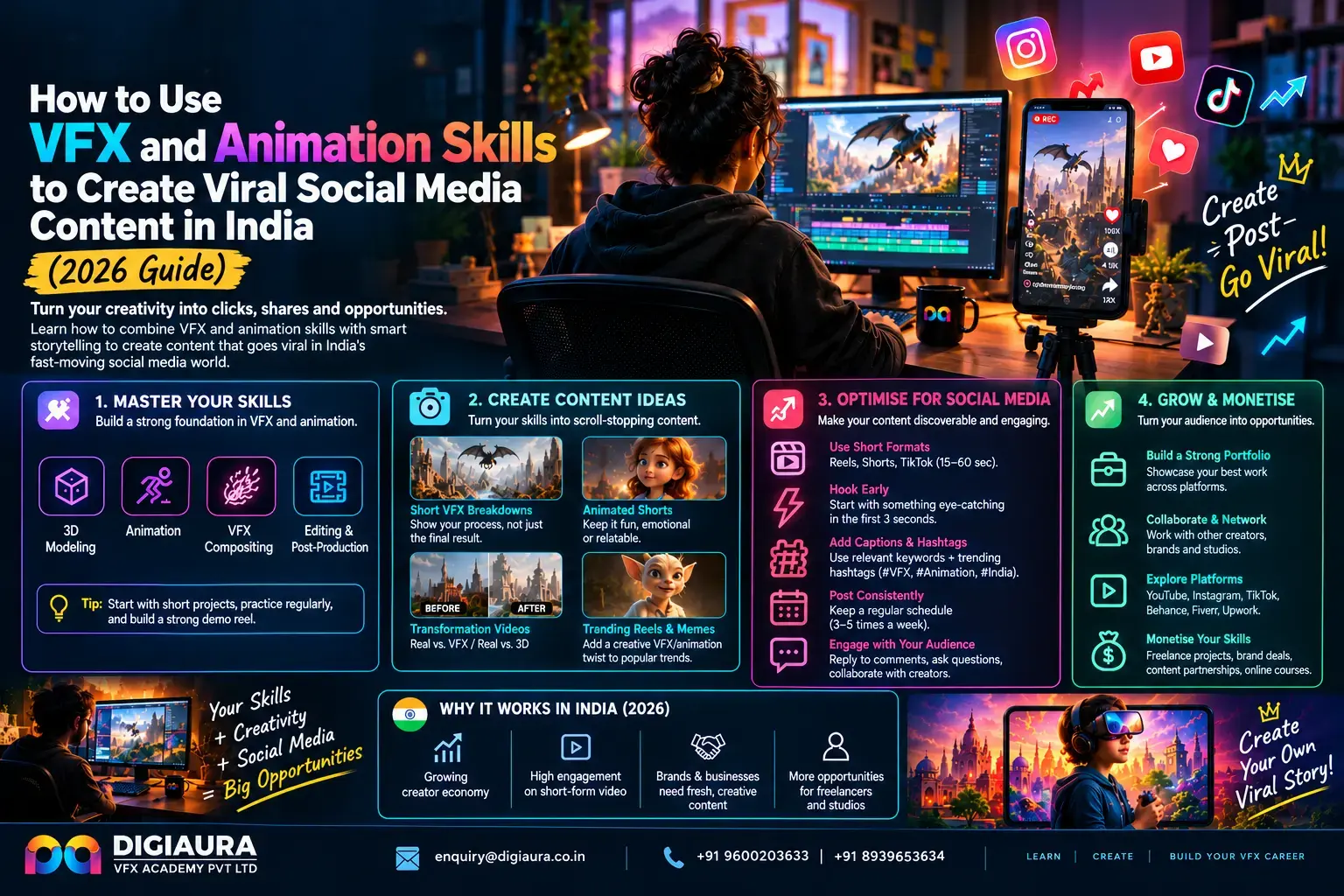
India is now the world's largest YouTube market, with 491 million monthly active users and a creative ecosystem that generated ₹18,000 crore in GDP and 9.6 lakh full-time jobs in 2025 alone (Oxford Economics / YouTube India, Sep 2026). Most VFX students see social media content creation as something separate from their film-industry training. That's a missed opportunity.
The skills you build in a VFX programme — After Effects, compositing, colour grading, motion graphics, 3D rendering — are exactly what brands and creators are paying premium rates for. India's influencer marketing industry is projected to reach ₹3,375 crore by 2026, growing at 18% CAGR (EY–Collective Artists Network, Apr 2024). The supply of professionals who can deliver cinematic-quality content at creator-economy speed is still well below demand.
This guide covers how to use your VFX training to enter the creator economy — whether as a freelancer, a brand content specialist, or a creator building your own channel.
- India is the #1 YouTube country globally — 491M MAU; YouTube's creative ecosystem supports 9.6 lakh jobs (Oxford Economics, Sep 2026)
- Motion graphics specialists earn a 35% salary premium over static designers — ₹4–8 LPA entry, ₹25 LPA+ senior (Fueler.io / CABA.in, 2026)
- Freelance VFX editors charge ₹5,000–₹25,000 per motion-graphics reel; brand retainers run ₹25,000–₹1.5 lakh/month (Fueler.io, 2026)
- Instagram leads brand influencer spend at 55% of platform budgets, followed by YouTube at 28% (Kofluence, 2026)
- CapCut is banned in India — legal AI alternatives include Runway ML, Pika Labs, Google Veo, and Adobe Firefly Video
Why India's Creator Economy Is the Biggest Opportunity for VFX Students Right Now
India's BCG "From Content to Commerce" report (May 2025) counts 2–2.5 million active monetised creators — people with 1,000+ followers who post consistently and earn income from content. These creators collectively influence over $350 billion in consumer spending annually, projected to surpass $1 trillion by 2030 (BCG, May 2025). The ecosystem's direct revenue stands at $20–25 billion today.
Only 8–10% of those 2.5 million creators monetise effectively. The gap between them and the rest isn't subscriber count — it's production quality. Creators who invest in professional VFX, motion graphics, and visual storytelling consistently outperform peers who don't, because platforms algorithmically reward content that holds attention longer. VFX-trained editors are the technical lever that creates that gap.
Digital advertising in India grew 26% in 2025 to ₹947 billion, representing 63% of total Indian ad revenues (FICCI-EY, Mar 2026). Online video accounts for approximately 29% of that spend. Brands need professionals who can deliver cinematic-quality content at creator-economy speed — that's where a VFX background becomes a direct commercial advantage.
India's short-form video market also reflects this scale: 588 million Indians — 61% of all internet users — consumed short-video content in 2025 (IAMAI–Kantar ICUBE 2025). The India digital video content market reached USD 21.1 billion in 2025 and is projected to reach USD 47.2 billion by 2034 at a 9.1% CAGR (IMARC Group). That's not a niche — it's infrastructure-scale demand for video production talent.
Which VFX Skills Transfer Directly to Social Media Content Creation?
Not all VFX skills are equally transferable to social media production, but several core competencies have direct, immediate commercial value. Understanding the mapping helps you position yourself accurately when pitching to brands or creators.
After Effects and Motion Graphics
This is the highest-demand skill set in social media production. Brands and creators pay significant premiums for animated lower thirds, kinetic typography, transition effects, and title sequences — outputs that standard video editors can't produce. After Effects proficiency turns a ₹2,000 editing job into a ₹10,000–25,000 motion graphics project. Motion graphics specialists earn approximately 35% more than static graphic designers at every experience level, with entry-level salaries starting at ₹4–8 LPA vs ₹3–5 LPA for static design (Fueler.io / CABA.in, 2026).
Compositing and Green Screen Removal
VFX-trained compositors can build photorealistic product placements and scene replacements that basic green screen plugins can't match. Brands selling lifestyle and consumer goods pay specifically for compositing that doesn't look like a budget Zoom background. This skill directly differentiates a VFX professional from a standard video editor on any brand brief.
Colour Grading
DaVinci Resolve and Lumetri colour grading — standard in VFX training — produce the cinematic, high-contrast look that drives Reels engagement. Indian creators with professionally graded content consistently outperform peers with flat colour profiles on platform engagement benchmarks. This is one of the fastest skills to translate from VFX training into paid social media work.
3D Product Visualisation
D2C brands — skincare, fashion, electronics — routinely commission short 3D product renders for Instagram Stories and Reels. Cinema 4D, Blender, and Maya skills from VFX training convert directly into product visualisation freelance work, with rates from ₹8,000 to ₹80,000 per animation depending on complexity and brand size.
What Platforms Should You Target as a VFX Creator in India?
India is simultaneously the world's #1 market for both YouTube and Instagram — a combination that makes it uniquely positioned for VFX-enhanced content creation. India has approximately 491–518 million monthly active YouTube users (Sprout Social, 2026) and 532 million Instagram users (NapoleonCat, Sep 2026). These aren't just large markets — they're the dominant global audiences for both long-form and short-form video.
Reels are Instagram's highest-engagement format — generating 140 billion daily views globally and driving 50% of all time spent on the platform (Meta). Average engagement rate for Indian creators on Reels is 3.61%, well above the global median of 2.55% (Katha Ads, 2026). Critically, 55% of Reel views come from non-followers — meaning Reels is the platform's primary content discovery engine. For a VFX freelancer, this means a single high-quality project can generate organic inbound leads rather than relying entirely on direct outreach.
From a brand budget perspective, Instagram captures 55% of India's influencer marketing spend, followed by YouTube at 28% (Kofluence, 2026). Instagram CPM averages ₹620 per reel; YouTube Shorts runs ₹540. For VFX freelancers targeting brand clients, Instagram Reels production is where the highest volume of paid briefs exists, while YouTube is where the highest-value individual projects tend to be commissioned.
For a VFX graduate entering the social media space, the practical priority order is: Instagram Reels first (highest volume, fastest feedback loop), YouTube second (higher per-project value, better long-term monetisation), then short-video apps as secondary distribution once production workflows are established.
See our guide on VFX vs Animation career paths in India if you're deciding which technical specialisation to develop for content creation work specifically.
How Much Can You Earn Creating Social Media Content with VFX Skills?
Motion graphics specialists earn a 35% salary premium over static graphic designers at every career stage, and this gap widens further in freelance work (Fueler.io, 2026). The income landscape for VFX-trained social media professionals in India breaks down across three models.
Freelance Per-Project Rates
Basic video editing — cuts, transitions, captions — runs ₹2,000–5,000 per Reel. Add motion graphics (animated titles, kinetic text, composited product overlays, particle effects) and the same brief becomes a ₹5,000–25,000 project. Full-production branded content with 3D elements, sound design, and multi-platform deliverables can command ₹40,000–₹1.5 lakh per deliverable for premium clients (Fueler.io, 2026).
Brand Retainer Income
Brands publishing consistently on social media — D2C fashion, skincare, food, and tech — pay monthly retainers for a dedicated VFX editor. Typical rates: ₹25,000–60,000/month for 8–12 pieces of content; ₹80,000–₹1.5 lakh/month for premium motion graphics packages or high-volume briefs. Experienced VFX freelancers simultaneously hold 2–4 retainer clients, making ₹1–4 lakh/month feasible within 2–3 years of experience.
Full-Time Creator Economy Employment
For those who'd rather be employed than freelance, YouTube's creative ecosystem already supports 9.6 lakh (960,000) full-time equivalent jobs in India — covering editors, motion graphics artists, production managers, and thumbnail designers who work directly with large creator channels (Oxford Economics, Sep 2026). Non-metro creative hubs are emerging in Jaipur, Lucknow, and Kochi — not just Bangalore and Mumbai. The 18,000+ Indian YouTube channels with 1 million+ subscribers all employ post-production staff, and that number grows every quarter.
India's influencer marketing market reached ₹3,000–3,500 crore in 2025, with 86% of influencers anticipating significant income growth over the next two years (Kofluence, 2026). Supply of professional-quality VFX editors who understand creator workflows remains well below demand — which is why rates stay elevated relative to standard video editing.
For broader salary benchmarks across VFX departments, see our VFX artist salary guide by department (India 2026).
Which AI Video Tools Are Legal and Useful for Indian Creators in 2026?
AI video generation tools are now standard in professional creator workflows — but not all tools are available in India. CapCut is permanently banned following government orders; do not plan your workflow around it. The following tools are legal, actively maintained, and in use by Indian creators and studios in 2026.
Runway ML
Runway closed a $315 million Series E round in February 2026 at a $5.3 billion valuation, backed by Nvidia and AMD Ventures (SiliconAngle, Feb 2026). Used by Ogilvy, VaynerMedia, and Publicis. Best for: text-to-video generation, background replacement, AI-assisted rotoscoping, and inpainting for clean-up work. Runway Gen-3 Alpha produces the most commercially viable outputs for branded social content currently on the market.
Pika Labs
Pika Labs has grown to 11 million total users with 500,000 active creators generating videos weekly. Particularly strong for short creative clips — ideal for social media teaser content, Reels openers, and product reveal animations. Free tier available; Pro plan suits freelancers handling multiple client projects monthly.
Google Veo
Google Veo (accessed via VideoFX and Vertex AI) handles coherent scene continuity better than most competitors — useful for brand storytelling content running 60–90 seconds. Available to Indian creators through Google One AI Premium. The model's strength in physical realism makes it the best choice for product-in-context visuals.
Adobe Firefly Video (Premiere Pro Integration)
For VFX-trained professionals already in the Adobe ecosystem, Firefly Video in Premiere Pro is the most workflow-integrated option. B-roll generation, clip extension, and object removal features work directly in the timeline without export. This is the most practical tool for daily professional workflow — no context switching, no separate subscription beyond Creative Cloud.
The competitive advantage for VFX-trained professionals using AI tools isn't speed — it's quality control. AI-generated content has recognisable artefacts (motion blur inconsistencies, edge ghosting, unnatural physics) that untrained creators miss and brand clients increasingly notice. A compositor with clean-up skills using Runway as a starting point produces far better outputs than a non-VFX creator using the same tool natively. That quality gap is your pricing justification.
How to Start Your Social Media VFX Career: A Step-by-Step Roadmap
The fastest path from VFX training to social media income isn't building a massive channel first — it's positioning yourself as a technical collaborator for existing creators and brands who need your skills. Here's the approach that converts VFX training into social media income most efficiently.
Step 1 — Build a Social Media-Specific Portfolio
Create 8–10 before/after transformation clips showing raw footage vs. your VFX work applied. Reels format (vertical, 15–30 seconds) works best. Focus on motion graphics overlays, cinematic colour grades, and composited elements — the specific outputs brands pay for. Post these natively on Instagram and YouTube Shorts for organic discoverability. Your portfolio is also your proof-of-concept — it needs to demonstrate you understand platform-native formats, not just technically polished but platform-unfriendly film output.
Step 2 — Target Micro-Creators First
Creators with 50,000–500,000 followers have brand deals but inconsistent production quality and can't yet afford full-time editors. They're the most efficient first clients — willing to pay ₹5,000–15,000 per video, reachable via Instagram DMs, and likely to offer long-term retainer work if quality is consistent. Nano-creators (2K–20K followers) typically have no production budget; macro-creators (1M+) usually have in-house teams already.
Step 3 — Pitch D2C Brands Directly
D2C brands in skincare, fashion, food, and electronics allocate significant social media production budgets and often lack in-house VFX capability. A specific pitch — "here's what your current Reels would look like with motion graphics" including a sample rework — converts at a much higher rate than generic capability pitches. Use LinkedIn for brand marketing manager outreach; many are reachable within 2–3 touch-points.
Step 4 — Build Your Own Channel as Proof-of-Work
A YouTube channel or Instagram profile demonstrating your VFX work isn't just about building subscribers — it's proof-of-work showing you can operate in the creator economy environment, not just a film studio. Brands and creators want evidence that you understand what makes content perform on the platform, not just what makes it technically impressive in isolation.
Step 5 — Layer AI Tools to Scale Output
Once you have a stable client base, integrate Runway ML and Adobe Firefly Video to increase throughput without sacrificing quality. Use AI for routine tasks — B-roll generation, background cleanup, extend clips — and reserve your manual VFX expertise for high-value differentiated elements. This creates a pricing model where your work justifies the rate because AI alone can't replicate the quality of the output.
For a comprehensive guide on building a portfolio that attracts both film and social media clients, see our guide to building a VFX showreel in 2026.
Frequently Asked Questions
Can a VFX student in India earn from social media without a large following?
Yes — and this is the most important distinction to understand. You don't need followers to earn from social media VFX; you need clients. Freelance VFX editors and motion graphics specialists work behind the scenes for creators and brands, earning ₹5,000–25,000 per project without needing a single follower. The creator economy creates as many behind-camera technical jobs as on-camera creator roles — Oxford Economics tracked 9.6 lakh such positions in India in 2025.
Which software should I learn first for social media content creation?
After Effects is the highest-value starting point, followed by Premiere Pro for editing. These two tools cover the majority of brand briefs — motion graphics, animated lower thirds, Reels effects, and cinematic colour work. For 3D product visualisation, Cinema 4D Lite (free with Adobe CC) or Blender are the next skills to layer in once After Effects is proficient. DaVinci Resolve is worth adding for dedicated colour grading projects.
Is the Instagram creator economy in India growing or contracting?
Growing significantly. India has 532 million Instagram users as of September 2026 (NapoleonCat), Instagram leads India's influencer marketing spend at 55% (Kofluence, 2026), and Reels generate 140 billion daily views globally with India as the dominant market. The 18% CAGR in influencer marketing spend (EY, 2024) confirms the trajectory firmly upward through at least 2027.
Are AI video tools replacing VFX artists in social media production?
Not replacing — restructuring. Runway ML, Pika Labs, and Adobe Firefly Video automate routine tasks like B-roll generation and background removal, but they produce artefacts (motion blur inconsistencies, edge ghosting, unnatural physics) that trained VFX artists catch and correct. Professionals using AI tools to increase output volume while applying VFX expertise to quality control are seeing the most income growth — not those competing with AI on speed alone.
What is the difference between VFX work for film vs. social media production?
Film VFX prioritises technical precision, large-scale effects, and longer production timelines — with shots reviewed across multiple departments over weeks or months. Social media VFX prioritises speed, platform-native formats (vertical, looping, under 60 seconds), and brand style consistency. Both use identical tools (After Effects, Premiere Pro, DaVinci Resolve, Nuke) but with different delivery standards. Most VFX professionals in India's creator economy do both, using social media work to maintain consistent income between larger film projects.
The Creator Economy Needs What VFX Training Produces
India's creator economy is in the middle of a rapid professionalisation phase. The 2–2.5 million monetised creators need technically skilled collaborators — editors who can deliver motion graphics, compositing, and cinematic colour at creator-economy speed. That's the specific gap a VFX-trained professional fills, and the data confirms the market is large enough to sustain high rates for years.
The numbers support the opportunity: ₹18,000 crore in YouTube GDP contribution, 9.6 lakh creator-economy jobs, ₹947 billion in digital advertising spend, and an influencer market projected at ₹3,375 crore by year-end 2026. Whether you pursue freelance Reels production, brand retainer work, or build your own creator channel, the skills from your VFX programme are the technical foundation the creator economy is actively recruiting for.
If you're deciding which VFX specialisation to develop first, read our comparison of VFX vs Animation career paths in India, or start with the complete guide to starting a VFX career after 12th.