
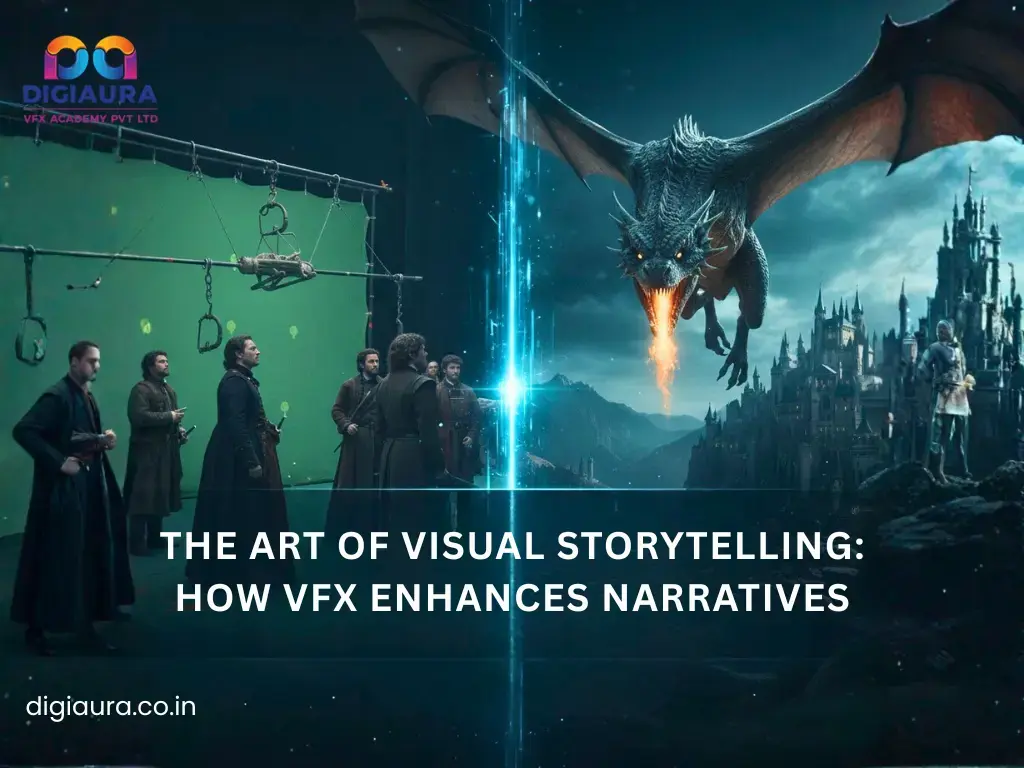
Indian cinema isn't just adopting VFX — it's redefining what the technology can do for a story. Brahmastra: Part One reportedly contained over 4,500 VFX shots, more than Avengers: Endgame. Kalki 2898 AD mobilised 1,200+ artists from DNEG and ReDefine. And India's VFX segment reached ₹54 billion (~$647 million) in 2023, growing 10% year-on-year before a temporary international market dip (FICCI-EY, 2024). Behind every spectacular image on screen is a craft decision — and understanding that decision is what separates a VFX artist from a visual storyteller.
Key Takeaways
- • India's VFX segment hit ₹54 billion in 2023; FICCI-EY projects recovery to ₹83 billion by 2026 after a 2024 dip
- • Brahmastra (2022) reportedly had 4,500+ VFX shots — more than Avengers: Endgame's ~2,400 (FICCI-EY / Prime Focus, 2022)
- • India's AVGC sector faces a 2.3 million skilled-worker gap, making trained VFX artists among the most in-demand professionals in the country
- • 521 million OTT users in India (2025) are driving structural demand for narrative-led VFX content beyond theatrical releases
What Does VFX Actually Do to a Story? The Four Core Functions
VFX does more than make things look spectacular. According to a peer-reviewed study published in Art and Design Review (SCIRP, 2024), high-quality VFX is a primary driver of commercial success in modern cinema — but only when it serves the narrative. The same research found that over-reliance on CGI without clear storytelling intent consistently diminishes emotional depth and audience engagement. The craft lies in knowing which function each effect serves.
World-building is the most visible function. VFX creates environments that couldn't be photographed: the apocalyptic Kashi of Kalki 2898 AD, the mythological battlefields of Brahmastra's Astraverse, or the hyper-stylised action spaces in Leo. These aren't just backdrops — they establish a film's tonal contract with the audience in the first frame.
Character enhancement operates more subtly. Digital doubles allow actors to perform in physically impossible scenarios. De-aging technology — used in Jawan to create a younger Shah Rukh Khan across parallel timelines — creates narrative continuity that practical makeup alone can't achieve. Full digital characters like RRR's pre-CGI water buffalo stampede rely entirely on VFX to convey authentic animal physicality.
Emotional amplification is the least discussed but most pervasive function. Subtle atmosphere enhancements — a haze that softens grief, a colour grade that heightens dread, a light leak that signals memory — are VFX decisions that shape how audiences feel without noticing the technology. Compositing artists and colour scientists at studios like Red Chillies VFX and NY VFXWaala make these choices on every shot.
Continuity and invisibility is VFX at its most demanding. Wire removal, rig painting, crowd replication, and set extension keep audiences inside the story. A failed invisible effect breaks narrative immersion harder than any obvious CGI creature — which is why paint and prep artists in India's VFX pipeline are among the most precision-skilled workers in any creative industry. Understanding paint and prep work shows just how much invisible craft holds a frame together.
How Indian Cinema Is Rewriting the VFX Rulebook
Five years ago, Bollywood VFX was often compared unfavourably to Hollywood equivalents. That conversation has shifted. Indian studios are now handling VFX at a shot count, complexity, and ambition level that matches — and in some cases exceeds — major Hollywood productions. Three films make the case most clearly.
Brahmastra: Part One — Shiva (2022) reportedly used over 4,500 VFX shots delivered by more than 3,000 artists from Prime Focus Group, including DNEG and ReDefine — making it one of the most VFX-intensive films ever produced (Filmibeat, 2022). The Astraverse mythology required creating entirely new visual languages: how celestial weapons move, how power manifests physically, how destruction feels viscerally real in a world with no photographic reference to draw from. That's a storytelling problem as much as a technical one.
Kalki 2898 AD (2024) took a different approach. With 900+ VFX shots delivered by over 1,200 artists from DNEG and ReDefine alone (Animation Xpress, 2024), each shot required integrating mythological imagery into a post-apocalyptic future — a visual concept that demanded original design from scratch. The estimated VFX budget of ₹150–230 crore out of a total ₹600 crore production cost (Koimoi, 2024) reflects how central VFX was to the film's storytelling identity, not just its spectacle.
RRR (2022) engaged more than 20 VFX studios globally — including Makuta VFX, NY VFXWaala, ReDefine, Digital Domain, MPC, and Framestore — to deliver the action sequences that became the film's signature. The bull stampede, the animal liberation sequence, and the finale's action choreography all required VFX that looked photorealistic while operating at a narrative intensity far beyond standard action cinema. RRR grossed $160 million globally on a $69 million budget — a ratio that validated the VFX investment (Wikipedia, 2022).
The Industry Behind the Magic — India's VFX Ecosystem in 2026
India's VFX segment reached ₹54 billion (~$647 million) in 2023, a 10% increase from ₹50 billion in 2022 and the highest point on record at the time. International co-production work generates approximately 70% of Indian VFX studio revenues, with studios in Mumbai, Bangalore, Hyderabad, and Chennai handling outsourced work from Hollywood and European productions alongside domestic film output (FICCI-EY, 2024 / IBEF, April 2025).
India now has over 4,000 VFX studios, with operations concentrated in Mumbai, Bangalore, Hyderabad, Chennai, and Pune (IBEF, April 2025). The studios leading India's global reputation span a range of ownership models and specialisations. DNEG — India-linked through its Prime Focus origins — employs over 11,500 people globally with 2,800+ in India across 9 cities, and has won 8 Academy Awards for Best Visual Effects, most recently for Dune: Part Two at the 97th Oscars in March 2025 (IFC, 2023). NY VFXWaala has earned 32 awards in 7 years, generates ₹380+ crore in annual revenue, and became the only Indian studio to win the Asian Film Award for Best VFX (Arthnova, 2025). Red Chillies VFX, Shah Rukh Khan's studio, won the Filmfare Award for Best Visual Effects for Jawan's de-aging work in 2024 (Vitrina AI, 2024).
OTT Platforms and the New Demand for Narrative VFX
What changes when 521 million people watch content on streaming platforms rather than in cinemas? The storytelling expectations for VFX shift. Theatrical VFX is calibrated for the impact of a large screen in a dark room. OTT VFX must hold attention on a 6-inch phone screen at 2 AM — which demands precision over spectacle, character-led effects over environment-led ones, and emotional authenticity over technical showmanship.
India's OTT user base reached 521 million in 2025 and is projected to hit 549 million in 2026, with a market value of $7 billion by 2027 (aggregated OTT market data, 2025–2026). Netflix committed $420 million to locally produced Indian content in a single investment cycle (Gulf News, 2023), and while OTT content spending growth slowed to 2% in 2024 due to profitability pressure, the structural demand for Indian-produced VFX content remained intact (FICCI-EY 2025, via Animation Xpress).
The practical implication for VFX artists: OTT work prioritises disciplines that serve intimate storytelling. Compositing, paint and prep, and look development are in higher demand relative to large-scale environment building. A single de-aging effect on a streaming drama requires the same technical rigour as a blockbuster — but must land emotionally on a small screen with a viewer who isn't primed by a cinematic event.
The 2024 Revenue Dip — and What the Recovery Looks Like
India's VFX segment declined 14% in 2024, falling from the ₹54 billion peak to an estimated ₹46 billion — a direct consequence of the 2023 Hollywood writers' and actors' strikes reducing the volume of outsourced work flowing to Indian studios (FICCI-EY 2025, via Animation Xpress). This is worth understanding clearly: the decline was an international supply shock, not a structural problem with India's VFX capabilities or domestic demand.
The recovery signals are already visible. Domestic productions continued throughout 2024. The AVGC Promotion Task Force's government-backed push targets 2 million direct and indirect jobs in the sector over the next decade (Ministry of Information and Broadcasting, 2024–2025). FICCI-EY's 2024 projections put the segment's recovery target at ₹83 billion by 2026 — a 80% increase from the 2024 trough — driven by resumed international outsourcing and an expanding slate of Indian theatrical and OTT productions. Understanding both the peak and the dip is essential context for anyone planning a career in the industry. India's evolving VFX landscape in 2026 covers how these macro trends translate into studio hiring patterns and skill demand.
Careers in VFX Storytelling: Who Creates These Effects?
India's AVGC sector faces a 2.3 million skilled-worker shortage against a current workforce of approximately 260,000 professionals (Storyboard18 / "FX & Beyond" report, August 2024). The gap is largest in the mid-level and senior specialisation bands — artists who understand both the technical craft and the narrative intent of each effect. That's the combination that matters in a studio that's serving a director's vision.
Professional VFX artists break down the craft and storytelling decisions behind Indian cinema's biggest VFX sequences (Corridor Crew, 2023)
The VFX pipeline roles that directly shape storytelling include compositing artists (who integrate every element into the final frame), lighting TDs (who determine a shot's emotional atmosphere), rotoscopy and paint artists (who maintain continuity and remove visible production infrastructure), and VFX supervisors (who make narrative decisions about which effects serve the story and which distract from it). The complete VFX pipeline explained shows how each discipline connects in a production workflow.
The path into any of these roles runs through structured training that covers both software fundamentals and storytelling context. VFX as a career after 12th covers how to plan a training sequence that leads to industry placement — and why the demand side of India's VFX market makes this one of the more career-secure creative fields available to students entering in 2026.
Want to work on the next Kalki or the next big OTT series?
DigiAura's VFX programmes in Chennai cover the full production pipeline — from roto and paint through compositing and lighting — with placement support at studios serving Indian and international productions.
Talk to our admissions team →Frequently Asked Questions
Why did India's VFX revenue fall in 2024 if the industry is growing?
The 14% decline in 2024 was caused by the 2023 Hollywood writers' and actors' strikes, which reduced the volume of outsourced work flowing to Indian studios. Domestic production and OTT demand continued growing throughout 2024. FICCI-EY's 2024 report projects the segment will recover to ₹83 billion by 2026, as international outsourcing resumes and domestic film and streaming production expands (FICCI-EY, March 2025).
How does Indian VFX compare to Hollywood in quality?
The gap has narrowed dramatically. DNEG — which grew from India's Prime Focus Group — has won 8 Academy Awards for Best Visual Effects, including Dune: Part Two in 2025. NY VFXWaala is the only Indian studio to win the Asian Film Award for Best VFX. Brahmastra's 4,500+ VFX shots and Kalki 2898 AD's 1,200+ artists from DNEG and ReDefine represent production scales and complexities comparable to the largest Hollywood franchise films.
What skills matter most for someone wanting to work on Indian film VFX?
Compositing, rotoscopy, and paint skills remain the highest-volume entry points at Indian studios handling both domestic and outsourced production. For specialisation tracks, lighting and look development are the highest-paid disciplines with the clearest senior career paths. Understanding narrative intent — why each effect serves the story — is what studio recruiters describe as the differentiator between technically capable artists and artists ready for senior roles.
VFX and Indian Cinema: A Creative Industry at Its Inflection Point
Indian cinema's relationship with VFX has moved from aspiration to international leadership in less than a decade. The studios, the talent, the ambition, and the infrastructure are all present. What the sector needs most — as the 2.3 million talent gap makes clear — is trained artists who understand both the tools and the storytelling purpose those tools serve.
The films being made right now — and the OTT content being commissioned at scale — are creating a sustained demand for VFX work that didn't exist five years ago. Artists entering the pipeline today will build careers during the most active period in Indian VFX history. The question isn't whether the opportunity exists. It's whether you're ready to step into it. The complete guide to breaking into every VFX department covers where to start and what each role requires.
DigiAura's VFX programmes in Chennai train artists for exactly this market — from foundational pipeline skills through specialisation tracks in compositing, lighting, and effects. Talk to our team about starting your VFX career →