
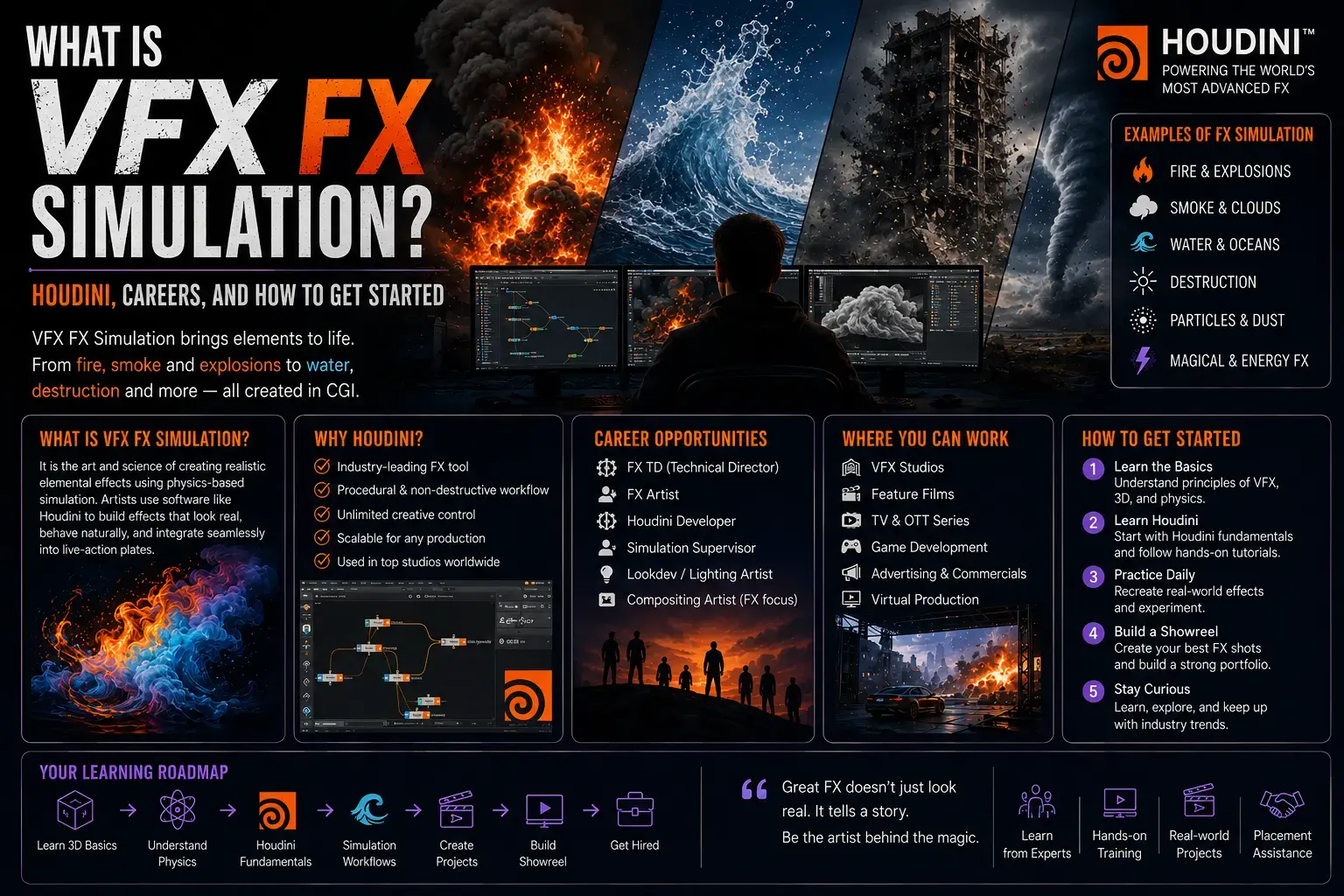
Naukri.com listed 626 Houdini job vacancies in India in August 2026 — more than LinkedIn, Indeed, and Glassdoor combined. Yet most VFX students in India have never touched Houdini, and fewer still understand what FX simulation actually means inside a real studio pipeline.
The FX department sits at the intersection of art and engineering. FX artists don’t model characters or composite shots — they simulate the physical world: fire that behaves like fire, water that moves like water, and buildings that collapse with the weight and debris of the real thing. Without them, even the most polished VFX shot looks empty.
This guide explains what FX simulation is, why Houdini dominates every major studio, what the career path looks like from junior artist to CG supervisor, and — most importantly — what you need to do to land your first FX role in India.
Key Takeaways
- India’s combined animation and VFX segment is expected to grow from Rs 105 billion in 2025 to Rs 138 billion by 2028, with FX simulation driving demand for Houdini-skilled artists (FICCI-EY 2026).
- 626 Houdini vacancies were active on Naukri.com alone in August 2026 — confirming real industry demand across Indian cities.
- India FX artists earn ₹2.5–5 LPA at entry level, rising to ₹18–40+ LPA at CG supervisor level (PayScale 2024; GUVI 2026).
- DNEG India, NY VFXwaala, and Prime Focus World all require Houdini skills for their FX pipeline roles.
- Your first FX reel must show live-action plate integration — not black-background renders. Breakdowns are mandatory.
What Does the FX Department Do in a VFX Studio?
India’s combined animation and VFX segment is on track to grow from Rs 105 billion in 2025 to Rs 138 billion by 2028 (FICCI-EY 2026). Much of that growth is driven by demand for complex simulated effects — the kind that can’t be done practically on set and can’t be faked with compositing alone.
In a VFX studio, the FX department is responsible for any element that needs to simulate real-world physical behaviour. That includes explosions, fire, smoke, ocean water, flooding, avalanches, building destruction, falling debris, cloth and hair movement, and crowd behaviour at scale. These are not assets you model — they’re phenomena you simulate.
A typical FX artist in production works closely with the compositing team and the CG supervisor. They receive a brief — “the building facade shatters when the vehicle hits it” — and must produce a simulation that matches the lighting, scale, and timing of the plate. The result is cached as a sequence of geometry or VDB volumes, then handed to lighters and compositors to complete the shot.
Above the FX artist is the FX Technical Director (FX TD), who builds the pipeline tools and custom solvers that make complex simulations possible at scale. Senior FX TDs and lead FX artists typically manage shot assignments, review simulations for quality, and handle escalations. At the top of the hierarchy sits the CG Supervisor, who oversees all CG output across a production.
To understand where FX fits into the broader production workflow, see the complete guide to the VFX production pipeline.
Why Do Studios Use Houdini Instead of Maya FX?
An industry estimate from Artivoxa’s 2025 survey suggests over 65% of large VFX studios have integrated Houdini into their core simulation pipeline, compared to around 48% of mid-sized studios (Artivoxa 2025). While that figure relies on industry self-reporting rather than a verified studio census, the directional evidence is confirmed by studio job postings: virtually every FX role at a major production facility requires Houdini.
Maya does have its own particle and fluid systems. So why did the industry standardise on Houdini? Three reasons stand out.
Procedural node-based workflow. Houdini uses a node network rather than a destructive modifier stack. Every parameter in a simulation — the turbulence on a fire, the viscosity of a fluid, the fracture pattern on a collapsing wall — is a node you can revisit, change, and re-simulate without rebuilding the effect from scratch. When a director asks for the explosion to be 20% larger with a slower initial shockwave, a Houdini artist adjusts two nodes and re-caches. The same change in a traditional DCC tool would require rebuilding the effect from the beginning.
Cacheable output for pipeline integration. Houdini exports to Alembic geometry caches and OpenVDB volumes — two formats that every major lighting and rendering application reads directly. This means an FX artist’s output slots cleanly into a Katana or Solaris lighting pipeline without manual conversion or baking. Studios running large-scale productions can’t afford FX that breaks at handoff.
Depth of production-grade solvers. SideFX has built solvers specifically engineered for production: Pyro for combustion, FLIP for fluids, Bullet RBD for destruction, Vellum for cloth and hair, and MPM for snow and mud. Each solver is production-proven on major feature films. No other DCC tool offers this range at the same depth inside a single application (SideFX 2026).
DNEG India’s Greenlight Program — a six-month structured entry pathway for FX and CFX artists launched in April 2026 — lists Houdini as its foundational requirement. New cohorts start at DNEG’s Mumbai and Bangalore studios. This is the clearest evidence yet that India’s largest VFX facilities are actively building Houdini talent pipelines rather than importing senior artists from abroad.
What Can You Simulate in Houdini? The 6 Core FX Types
SideFX ships Houdini with six production-grade simulation solvers, each designed for a specific class of physical phenomenon (SideFX 2026). Knowing what each solver does — and which types of shots require it — is the starting point for deciding which FX skills to develop first.
| Simulation Type | Houdini Solver | Typical Studio Use |
|---|---|---|
| Pyro FX (fire, smoke, explosions) | Pyro Solver | Hero explosions, wildfire, industrial smoke, practical combustion |
| FLIP Fluids (water, ocean, liquids) | FLIP Solver | Ocean simulations, splashes, pouring liquids, flooding, lava flow |
| RBD Destruction (rigid body) | Bullet Solver | Building collapses, vehicle impacts, debris fields, structural fracture |
| Vellum (cloth, hair, soft body) | Constraint-based | Costume simulation, hero hair, sand, balloon deformation, organic shapes |
| MPM (snow, mud, deformables) | MPM Solver | Snow accumulation, mud splatter, soft tissue, jelly-like materials |
| Crowd Simulation | FSM Solver | Battle sequences, stadium fills, disaster evacuation, urban crowd flows |
Entry-level FX artists typically start with Pyro FX — it’s the most visually learnable solver and appears in the highest volume of junior job descriptions. Fluid simulation (FLIP) and RBD destruction are the next most requested. Vellum and crowd simulation are usually mid-to-senior level specialisations.
One thing hiring TDs watch for in junior applications is whether the applicant understands the difference between a simulation and a render. Many students submit reels showing polished final frames with no indication of how the simulation was set up. An FX artist’s value is in the simulation itself — lighting and rendering are done downstream by other departments. Show the work, not just the result.
For a broader view of how FX sits within the full production hierarchy, read the department-by-department guide to breaking into VFX.
What Is the FX Artist Career Path in India?
PayScale data from October 2024 puts the median salary for an FX Artist with SideFX Houdini skills in India at Rs 322,774 per year, with a 90th-percentile ceiling of approximately Rs 12 LPA (PayScale India 2024). That range reflects the wide spread between junior artists at entry-level studios and experienced FX TDs at major production facilities.
The FX artist career path is one of the more structured progressions in VFX. Each level has distinct responsibilities, and movement between levels is driven by the quality of your simulations and your pipeline contributions.
Junior FX Artist (0–2 years): Takes assigned shots and produces simulations under TD supervision. Responsible for matching the brief, maintaining cache quality, and hitting shot deadlines. Expected to know Houdini’s Pyro and basic RBD workflows. India salary: ₹2.5–5 LPA.
Mid-Level FX Artist (3–7 years): Works independently across multiple effect types. May supervise junior artists on smaller sequences. Expected to resolve pipeline issues without escalating. India salary: ₹5–10 LPA.
Senior FX Artist / FX TD (5–10 years): Designs simulation setups for hero shots. Builds Houdini Digital Assets (HDAs) and pipeline tools. Works directly with CG supervisors on effect design briefs. India salary: ₹8–20 LPA.
Lead FX / CG Supervisor (10+ years): Manages FX output across a full production or multiple sequences. Reviews all submitted simulations. Presents FX solutions in client reviews. India salary: ₹18–40+ LPA.
For a full breakdown of VFX salaries across every department — roto, compositing, lighting, matchmove — see the VFX artist salary guide for India 2026.
What Should Your First FX Showreel Contain?
The single most common mistake in junior FX reels is submitting simulations on a black background. FX never exists in isolation in a real production — it always composites into a live-action plate. A reel showing particle effects or fire against pure black tells a recruiter that the artist doesn’t understand how FX work is actually used. Every shot in your reel should show the simulation composited into a plate, even if that plate is royalty-free footage downloaded from a stock platform.
1–2 pyro shots with breakdowns. Fire and smoke are the first skills most Houdini learners develop, and they’re the most requested skill in entry-level FX job descriptions. Show the rendered final, then show the simulation cache and the node network that produced it. Label exactly what you did: “Pyro simulation — Houdini 20.5, Karma render.”
1 destruction or RBD shot. A wall fracture, a vehicle impact, or a building facade collapse shows you understand Bullet RBD and debris dynamics. Compositing the debris onto a real background plate is critical. Without plate integration, even technically strong destruction work reads as a tutorial exercise rather than a production contribution.
Breakdowns are non-negotiable. Show the raw simulation cache, the VDB volume, or the geometry without shading. Label your contribution clearly on screen for every shot. Recruiters are specifically looking for evidence that the quality in the final shot is your simulation — not a purchased asset or a tutorial reproduction.
Total length: 60–90 seconds. Junior FX reels should be short and focused. Four to six strong shots with proper breakdowns beat twelve mediocre ones without context. Hiring supervisors typically make a shortlist decision within the first 15 seconds.
For full showreel production guidance — cover music, file formats, hosting, and platform strategy — see the step-by-step VFX showreel guide for 2026.
How Do You Start Learning Houdini? A Practical Roadmap
Houdini’s learning curve is steeper than Maya or Blender. The node-based interface is unfamiliar to artists who’ve trained on modifier stacks, and the procedural thinking required takes time to internalise. That said, structured progression makes Houdini learnable. The artists who struggle are usually those who try to learn all six solvers simultaneously rather than one at a time.
Step 1 — Install Houdini Apprentice (free). SideFX offers Houdini Apprentice at no cost for learning and non-commercial work. It has a watermark on renders but is otherwise full-featured. Spend your first two weeks understanding the interface: the network editor, the parameter panel, and the viewport. Don’t start a simulation until you can navigate confidently.
Step 2 — Start with Pyro, not everything. Pick Pyro FX first. Complete two to three beginner pyro tutorials on YouTube — Rebelway and Applied Houdini have free content. Then build three pyro shots yourself from scratch without following a tutorial. That’s when the learning actually happens.
Step 3 — Learn RBD destruction next. After Pyro, move to Bullet RBD. The voronoi fracture workflow and constraint networks are what studios use for building and vehicle destruction. RBD and Pyro together cover the majority of junior FX briefs you’ll encounter in a first role.
Step 4 — Composite into plates from the start. Download free plate footage and composite every simulation into a real background from your first week. This trains your eye for scale, lighting match, and integration from the beginning — not as an afterthought before you apply.
Step 5 — Apply to structured programmes. Once you’ve completed six to eight reel-ready shots, apply to entry programmes like DNEG India’s Greenlight Program, or enroll in a structured FX simulation course that includes industry mentor feedback. Self-study without feedback usually takes 12–18 months to reach interview-ready quality; structured training compresses that timeline significantly.
Before applying anywhere, work through the VFX career checklist to confirm your reel, resume, and application strategy are production-ready.
Learn FX Simulation at DigiAura
DigiAura’s 3D FX Simulation programme covers Houdini Pyro, FLIP Fluids, and RBD Destruction with production briefs, mentor feedback, and placement support — designed for students who want to build a reel that gets shortlisted at Indian studios.
View FX Simulation Course →Frequently Asked Questions
Is Houdini hard to learn for a complete beginner?
Houdini has a steeper initial learning curve than Maya or Blender because it uses a procedural node-based workflow instead of a standard modifier stack. Most students with zero prior VFX experience take three to six months to complete their first reel-quality pyro simulation. Starting with one solver — Pyro FX — before moving to fluids or destruction makes the process significantly more manageable.
Do I need a degree to become an FX simulation artist in India?
No. Studios hire FX artists based on the quality of their showreel and their Houdini proficiency, not on degree status. DNEG India’s Greenlight Program accepts fresh graduates and non-graduates alike, provided they can demonstrate foundational Houdini skills. A structured training programme is valuable for learning access and mentor feedback, but the reel is what gets you hired.
What is the starting salary for a Houdini FX artist in India?
Entry-level FX artists in India typically earn between ₹2.5 LPA and ₹5 LPA, depending on city and studio tier. Mumbai-based roles at larger facilities tend to start higher than roles at boutique studios in smaller cities. PayScale data from 2024 puts the median FX Artist salary with Houdini skills at Rs 322,774 per year, with significant variation by experience and employer.
Which Indian studios use Houdini FX in their pipeline?
DNEG India, NY VFXwaala, and Prime Focus World all use Houdini in their FX pipelines. DNEG India’s 2026 Greenlight Programme explicitly lists Houdini as a requirement for their FX and CFX tracks. Naukri.com listed 626 active Houdini vacancies across Indian studios in August 2026, confirming widespread adoption at both large facilities and boutique studios.
What is the difference between an FX artist and a compositor?
An FX artist creates the simulated elements — fire, water, destruction, cloth — using Houdini. A compositor integrates those elements into live-action footage using Nuke or After Effects. The FX artist’s output is a cache file (geometry or VDB volume) that the compositor then lights, renders, and composites into the final shot. Both departments are essential and work in sequence, not in parallel. For a full breakdown of compositor responsibilities, see the guide to compositing in VFX.
Conclusion
FX simulation is one of the few VFX specialisations where the learning path is genuinely clear: start with Houdini Pyro, build reel-quality shots composited into live-action plates, then add RBD and fluids before applying. The career ceiling is high — CG supervisors in India earn ₹18–40+ LPA — and demand is demonstrably real, with 626 Houdini vacancies on Naukri.com alone in August 2026.
What separates successful early-career FX artists from those who spend years self-studying without progress is usually not Houdini skill — it’s structured feedback on production-standard briefs. Without someone reviewing your simulations against real requirements, it’s easy to optimise for visual attractiveness rather than production utility.
If you’re mapping out your full career strategy, the VFX career checklist is a useful starting point for auditing your current readiness before you apply anywhere. And for context on how FX artists work alongside riggers and 3D generalists, see the 3D modelling and rigging career guide.